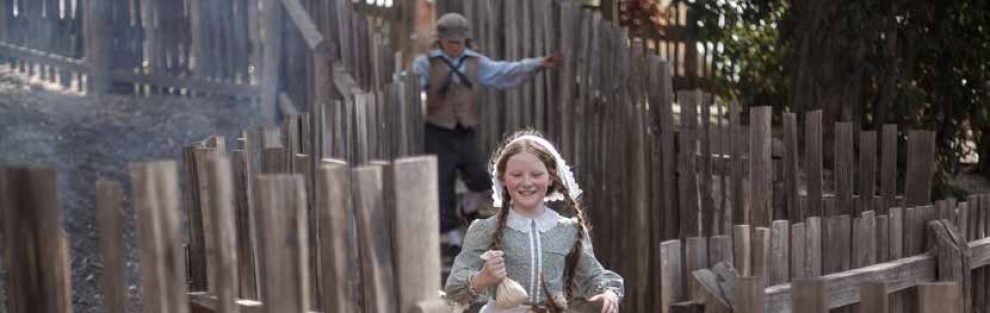
Happy International Donkey Day to our two favourite donkeys, Augie and Archie.

If you’ve visited Sovereign Hill, you may have spotted this famous pair nibbling on hay or perhaps refusing to budge their as-, ah, bottoms – donkeys are notoriously stubborn after all.
But why do donkeys deserve their own day? Aside from their cuteness, donkeys have been working alongside humans for over 5,000 years.

Pictured: Postcard: Donkey in the wheel – Carisbrooke Castle. Sovereign Hill Museums Association collection.
Over this time, donkeys have inspired some curious expressions. For example, ‘donkey’s years’ is Cockney rhyming slang for a long time — alluding to the length of donkey’s ears. Then there’s ‘talk the hind legs off a donkey,’ meaning you could bore this beast of burden into sitting down.
The English writer Anthony Trollope, during his 1879 visit to Australia, noted that Aussies had their own spin on this saying. Instead of a donkey, they’d say you could ‘talk the hind legs off a dog.’
You might have heard a donkey-inspired, distinctly Australian turn of phrase this past weekend during the Australian Federal election. To ‘donkey vote’ is to vote by numbering candidates in a preferential voting system in the order in which they appear on the ballot paper. A donkey vote may reflect a voter’s actual preferences, but it is more likely to indicate that the voter doesn’t understand how to vote correctly, or that they don’t care how their vote is cast.
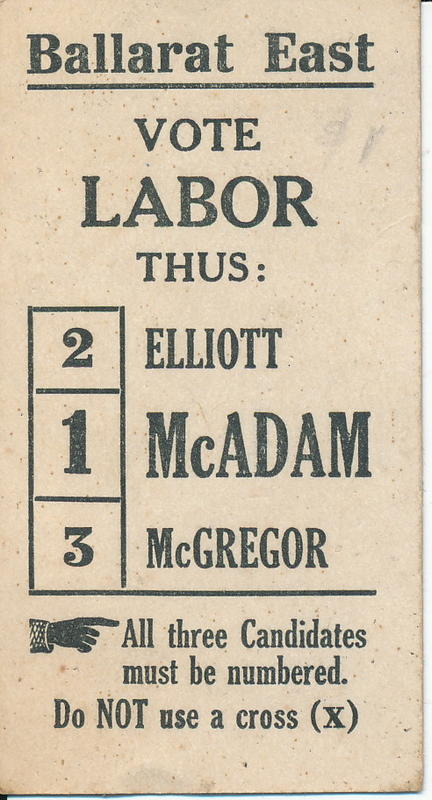
Pictured: How To Vote Card, 1924. Sovereign Hill Museums Association Collection.
Some think a donkey vote will invalidate their vote – but if all boxes are numbered, the vote is counted as a ‘formal vote’ and contributes to election outcomes. The act of throwing away your hard-fought for right to vote in Australia is considered ‘stupid’, as are donkeys, hence the turn of phrase.
But – are donkeys stupid? A study published in the Journal of Veterinary Behaviour used non-verbal problem solving tests on 300 donkeys to measure their cognitive ability, finding that donkeys are “intelligent animals when comparatively scoring them based on an analogous human scale”. Donkeys also exhibit a high level of emotional intelligence and empathy, and have been successfully used in assisted therapy in the treatment of people with affective and emotional disorders.
Donkey intelligence aside, it isn’t quite clear when the phrase donkey voting appeared in the Australian vernacular. The donkey vote is considered a consequence of compulsory voting, which came into effect on a federal level in 1924, however, it was not until 1984 that Aboriginal people were included in compulsory voting. Rhetorical connections to voting and donkeys can be found well before this though in the newspapers of the Ballarat goldfields.
In 1855, in the wake of the Eureka Rebellion, two miners’ advocates were elected to new seats on the Legislative Council, Irishman Peter Lalor, leader of the violent rebellion, and Welshman John Basson Humffray, a pacifist and chartist. The following year, the two men were again elected as members of the Legislative Assembly in the new bicameral parliament.

Pictured: Postcard: Parliament House, Melbourne. Victoria. Australia. Sovereign Hill Museums Association collection.
In 1856, Humffray continued to advocate for the principles of the People’s Charter, including the abolition of property qualifications for voters or members of parliament. Humffray recounted an anecdote “of a man who had a right to vote on account of possessing a donkey. Between the time of registration and voting the donkey died and, consequently, the vote was lost. It was not, however, the man that would have voted, but, in fact, the donkey.”

Pictured: The Hon. John Basson Humffray, first Commissioner of Mines. State Library of Victoria collection.
In 1857, Lalor, son of a British MP and landowner, enraged his constituency by voting in the interests of the land-holding class. In a heated discussion in 1857 – Lalor at one point has to declare “I am cool now” – constituents argue that merely owning property does not make an intelligent voter. One constituent uses the analogy of a man with a right to vote by virtue of owning a donkey, “if the animal were shot, or broke his leg, the man lost his vote, so it was not the man that voted, but his donkey.”
This International Donkey Day, let’s retire the idea that donkeys are dim. These long-eared legends are clever, compassionate, and have carried our burdens for over 5,000 years. Give donkeys the respect they deserve, and your democracy the same!
The Eureka Rebellion and its legacy are explored in two of our education programs, Put Yourself in the Eureka Story and Collection Close-Up: Eureka.
Written by Sovereign Hill Education Officer Ellen Becker
Discover more from Sovereign Hill Education Blog
Subscribe to get the latest posts sent to your email.


 Sovereign Hill Education Blog