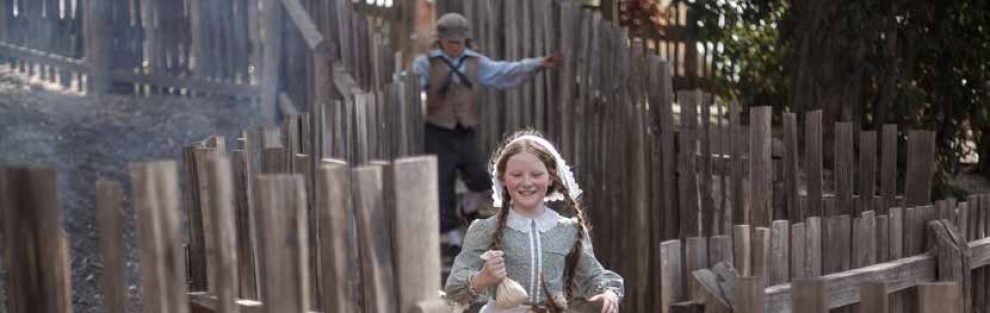
When you first step into Sovereign Hill, you arrive on Main Street—an immersive gateway into Ballarat’s goldrush past. This bustling thoroughfare recreates not just the sights, sounds, and even smells of the 1850s in Ballarat, but a very specific moment in time.
Main Street is modelled on Main Road as it appeared 1855-59 – the first planned street in Ballarat. It marked the shift from the chaotic sprawl of the diggings to the beginnings of an organised township, laying the foundations for the city Ballarat would become.
The businesses and buildings you can explore as you walk up Main Street are recreations of originals that were here in Ballarat during this period. What you see has been faithfully recreated through primary sources such as photographs, drawings and paintings.
Several of these buildings are based on drawings by François Cogné (1829 – 1883), a French artist and lithographer who lived in Ballarat for three years during the 1850s. In 1859 he made a series of lithographs depicting Main Road with acute attention to detail. If you look upon Cogné’s prints from a distance, they are so finely drawn that they could easily be mistaken for photographs.
Clarke Brothers’ Grocer
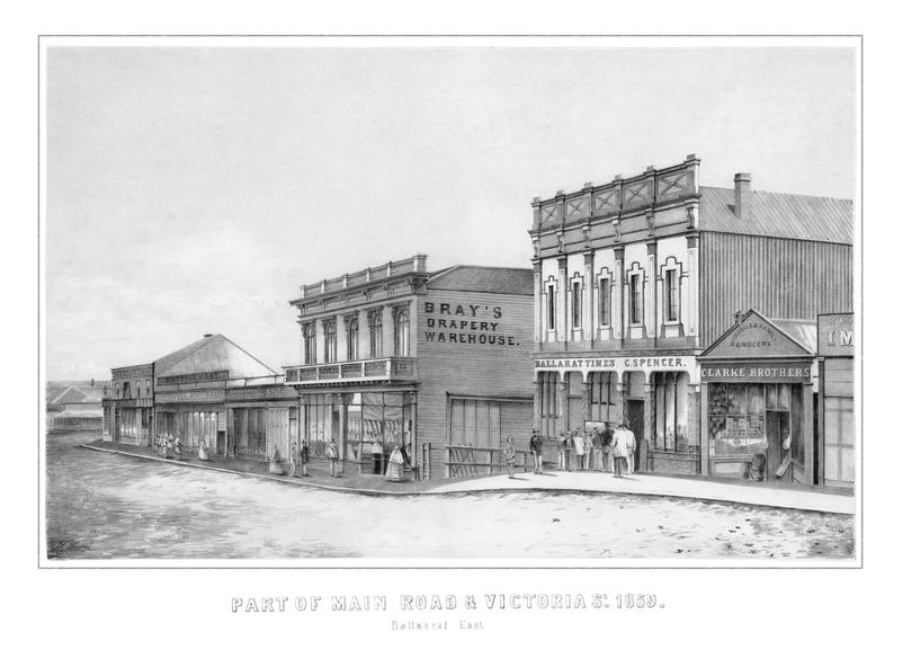

Pictured upper: Part of Main Road and Victoria Street, 1859. Lithographic print by François Cogné. Sovereign Hill Museums Association collection. Pictured lower: The recreated Ballarat Times and Clarke Brothers Grocers at Sovereign Hill.
Thomas and Richard Clarke arrived in Melbourne from England in 1850, chasing opportunity in a new land. When the goldrush reached Ballarat, they followed the excitement—but rather than digging for gold, they found their fortune another way: by opening a grocery store. The shop seen in Cogné’s image, on Victoria Street, is believed to be their very first, opening its doors in early 1857.

Pictured: An advertisement in the Ballarat Star newspaper on the opening of Clarke Brothers grocer, 1st June 1857.
Clarke Brothers sold pickled foods and cheeses, coffee and tea, as well as in demand goods like blankets, buckets and pickaxes. Grocery stores at the time were very much ‘general stores’, stocking items familiar to British migrants like oats “sweet as nut” from Ayrshire, Scotland, but also exotic imports such as bananas from Tahiti, lemons from Portugal, and loquats from Japan. Business boomed, and within just two years, the Clarkes had set up two more stores.

Pictured: An advertisement in the Ballarat Star for the newly opened Clarke Brothers Coffee Works on Mair Street, 11th August 1859.
In 1864, the partnership between the brothers ended when Richard moved to Geelong to launch his own grocery store. Thomas stayed behind, continuing to serve Ballarat locals well into the 1890s—most likely from the original Victoria Street site. The distinctive coffee pot sign above the door, recreated here at Sovereign Hill, was once a familiar sight in town, remembered fondly even into the 20th century.
Criterion Store
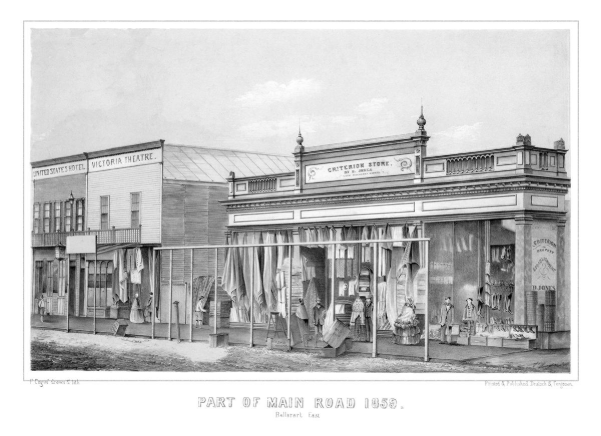

Pictured upper: Part of Main Road, 1859. Lithographic print by François Cogné. Sovereign Hill Museums Association collection. Pictured lower: The recreated Criterion Store at Sovereign Hill today.
The Criterion Store was established by Welsh-born draper David Jones, who arrived on the goldfields in 1853. By the early 1860s, Jones had established three stores in Ballarat.
A proto-department store, the Criterion represents a lesser-told story of the goldrush; the growing presence of women and the increasing emphasis on fashion and refinement on the goldfields.
Like the grocery stores of the day, the Criterion Store was filled with goods from across Europe and America, but not your everyday necessities – here you could find silk taffeta, muslin gowns, imported gloves and bonnets—luxuries that appealed to the aspirational nouveau riche of Ballarat.
Jones suffered the slings and arrows of starting a business on the goldfields. Ballarat suffered several disastrous fires in the 1850s which caused extensive loss of life and property. The excerpt below mentions a few of the businesses which have been recreated at Sovereign Hill, reduced to “a heap of ashes” in a conflagration in 1855, including Jones’ Criterion Store.

Pictured: An excerpt from The People’s Advocate and New South Wales Vindicator, 8th December 1855, p4.
Calamities abounded at this time, and Jones’ stores also experienced destruction caused by floods and sludge (the waste material produced during the extraction and processing of minerals from ore) causing extensive loss and damage to stock.
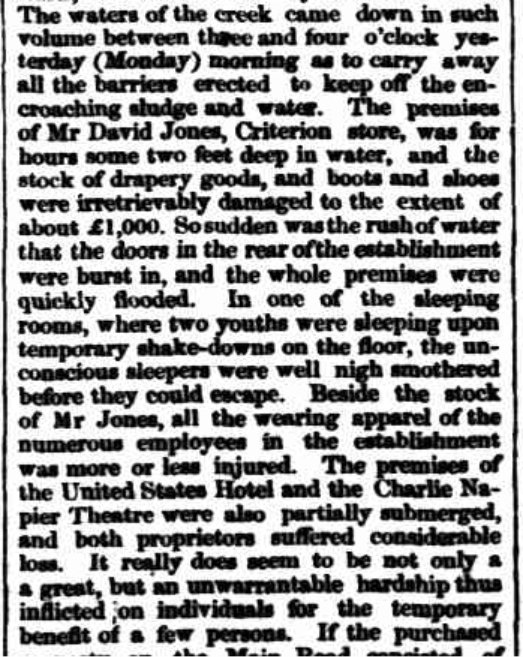
Pictured: An excerpt from the Ballarat Star, 28th December 1858, p3.
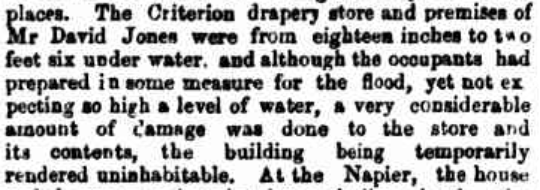
Pictured: An excerpt from ‘Floods: Great Destruction of Property’ in the Ballarat Star, 30th May 1859, p3.
Jones’ third Criterion Drapery in Ballarat was a grand brick and stucco Italianate two-storey building. The Illustrated Times of London commissioned an engraving of the building, below, which they painted as evidence of civility among the once “wild waste of pits and gullies, where men… live amidst the ceaseless sound of the pick and the cradle, with strength and endurance for capital, and revolvers for law and order.” The publication also reported that having been burned in his previous ventures, the building was fitted with a water supply and hose, “kept in constant readiness.”
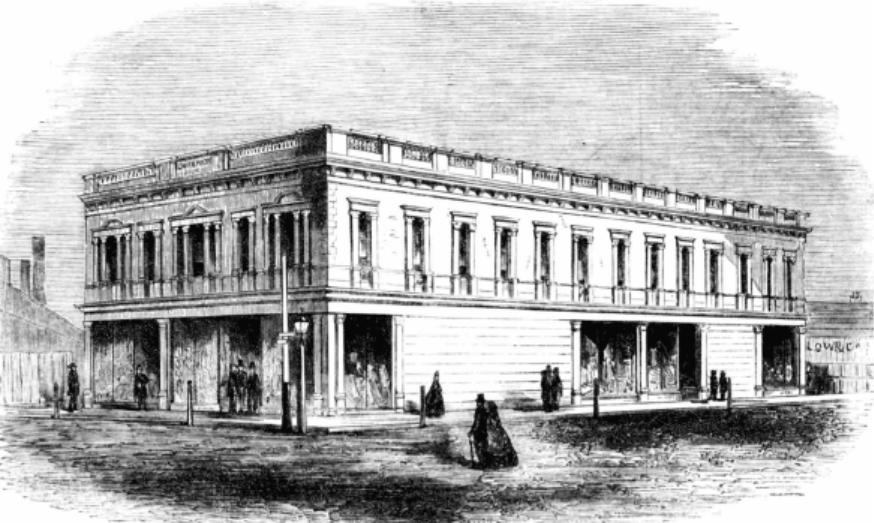
Pictured: Engraving of the third Criterion Drapery Store, on the corner of Armstrong and Sturt Streets, Illustrated Times [London], 11th May 1861, p307.
Rees and Benjamin Jewellers

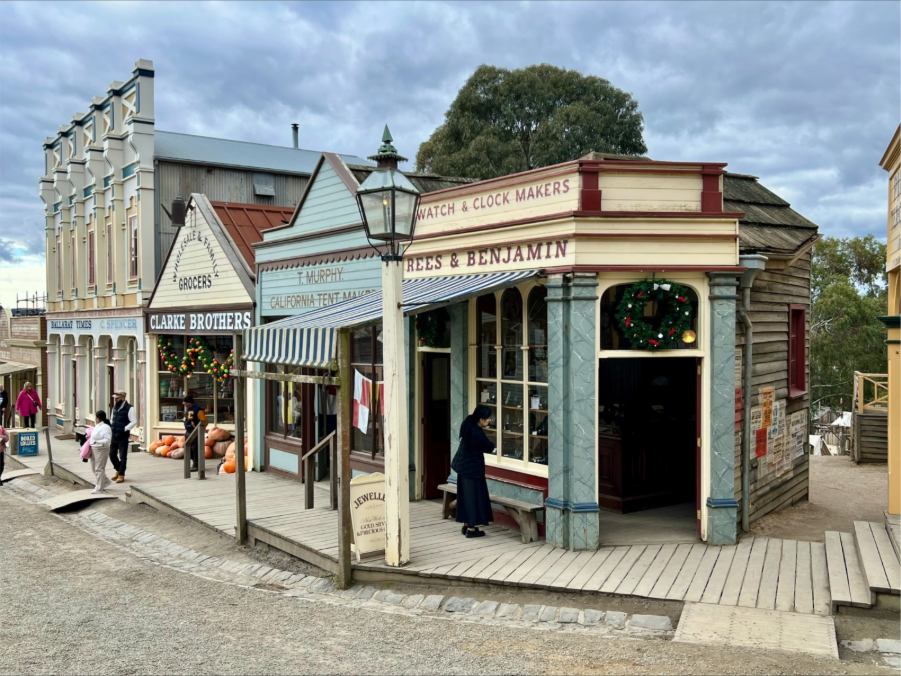
Pictured upper: Part of Main Road, Ballarat East, 1859. Lithographic print by François Cogné. State Library of Victoria collection. Pictured lower: the recreated Rees and Benjamin Clockmakers at Sovereign Hill today.
The peculiar shopfront of Rees and Benjamin certainly paled in the relative grandeur of stores such as the Criterion, but this small corner store had a striking interior. The Ballarat Star reported on the 4th December 1857 that the interior was “fitted up in a very appropriate manner, and contains, as a remarkable feature, no less than four hundred clocks, all tick-ticking.”
The store kept the city of Ballarat on time, reported as donating clocks to public institutions such as the Council Chambers and the Benevolent Asylum, and as being contracted to keep the ‘town clock’ in working order.
Rees and Benjamin later built a two-storey suite of brick shops in 1861 at the corner of Lydiard and Sturt Streets, which would become known as ‘Cobb’s Corner’ – as the top offices housed the Cobb & Co booking offices. The building was replaced in 1904, but a jewellery shop still occupies the ground floor today – over 160 years later.
* * *
Cogné moved back to Melbourne in 1862 where he started working with Charles Trödel producing lithographs. He subsequently returned to Paris in 1864, and died there in 1883.
Written by Sovereign Hill Education Officer Ellen Becker
Discover more from Sovereign Hill Education Blog
Subscribe to get the latest posts sent to your email.


 Sovereign Hill Education Blog