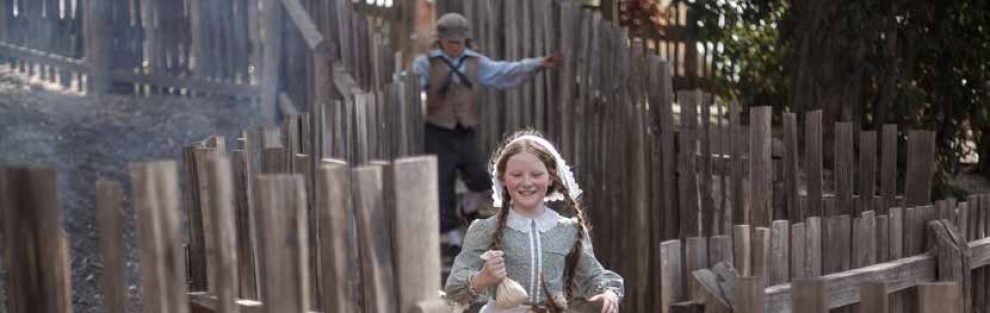

574.79 Black Hill site, abandoned mining land, being considered for rubbish tip, 1962.
What’s in your modern rubbish bin? Almost half of the waste in an average household wheelie bin is food waste. Over the year that adds up to over 300kg per person. The other big component is plastic waste, containers and packaging for example.
What’s in my rubbish bin in the past? I don’t have one!
In our nineteenth century streets we did not have rubbish bins (or recycling or green waste bins either) so where did all the rubbish go? Did no-one throw anything away? Not exactly. Letters to the newspaper describe some very dirty streets and backyards and complain about the fact that we do not have an organised system to pay for or remove waste.
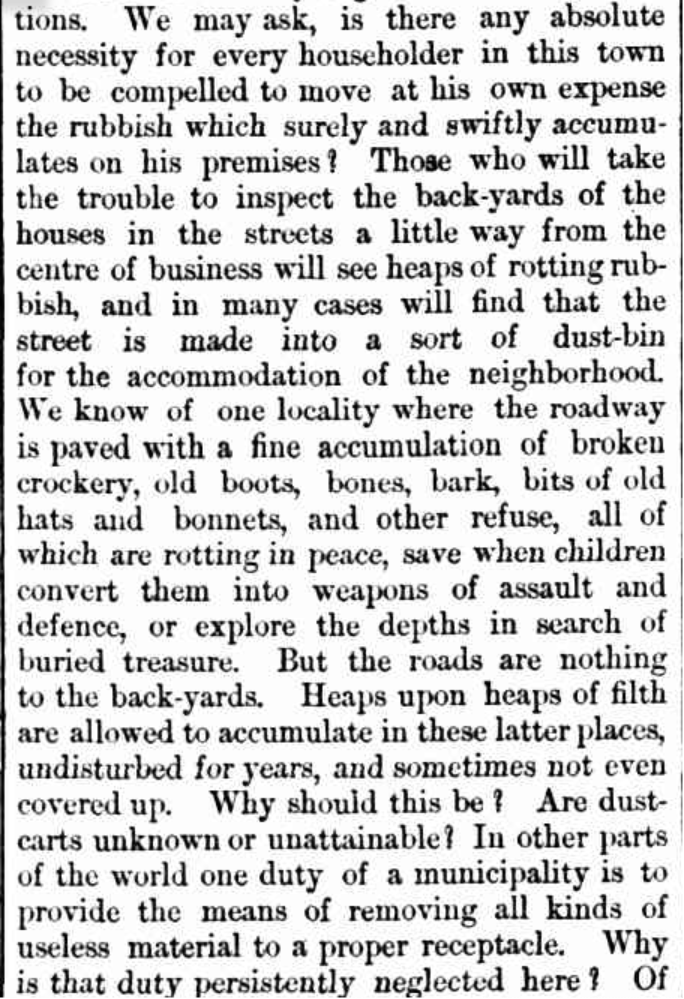
1868 ‘The Ballarat Star.’, The Ballarat Star (Vic. : 1865 – 1924), 28 February, p. 2., viewed 27 May 2025, http://nla.gov.au/nla.news-article113601453
The author describes items like broken crockery and old clothing and food waste like bones; they do not describe the main ingredients of our rubbish today, plastic and food. However, in some respects a lifestyle without sinks, taps or pipes, and without electricity – where your own muscle power drives a lot of your daily activities – means being very careful around how you use and reuse those resources and being very careful around what becomes waste.
Some of these waste products support small itinerant industries, the ‘rag-and-bone’ trade of collecting and selling scraps. Rags for example, are sold to make paper, which is in short supply at the time.
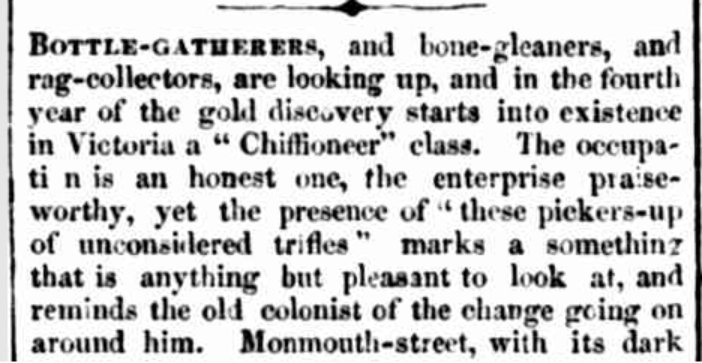
1855 ‘No Title’, Geelong Advertiser and Intelligencer (Vic. : 1851 – 1856), 25 September, p. 2. (DAILY), viewed 26 Jun 2025, http://nla.gov.au/nla.news-article91871240 Chiffioneer refers to a French term for “rag-picker,” and in English came to refer to a popular piece of ‘useful’ furniture.
Here are a few examples of sustainable choices within our nineteenth century household.
- Water use.
There are also no taps or sinks to leave the water running. You fetch water by the bucket load to fill your bathtub, laundry tub and other containers for water use through the day; you will be very aware of how much water you use. When a bathtub was filled with water it was often shared between family members – the water was not changed between people. This hip tub is much smaller than a modern bathtub and it does not fit your whole body, but instead allows you to sit and soak while washing. Washing was done less frequently at the time and sponge baths with wash basins were common for daily freshening.

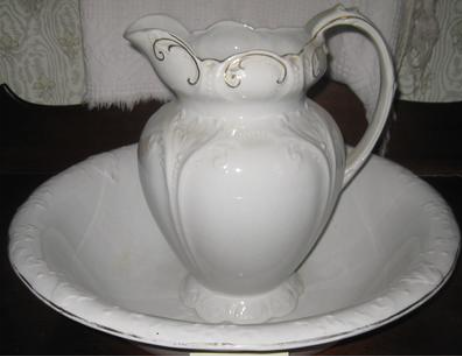
09.0726 (19th century hip tub) 70.2949 (19th century wash basin)
- Homemade
Without refrigeration, many things, like butter and soap are made as needed. Shopping is done frequently so food is purchased as needed and vegetables are grown in the household garden. Preserving is common, including pickling and jam making, to ensure access to some foods out of season and to make the most of foods when they are plentiful.

- Using up scraps.
Clothing is handmade and will be mended, altered and passed down, sometimes several times, before it is replaced. Fabric scraps could also be used in toy making, like peg dolls, and even used as toilet paper. This is a rag rug made from offcuts of clothes being made or rags from old clothes being torn up. It provides some insulation on the floor, a way to practice a skill and a second life for what would otherwise be waste pieces of fabric.

Think about the choices we make in our homes today. How often do we repair when something is broken? Can we preserve over-ripe food before disposing of it? What scraps do you have around the house that could have a second-life?
Information on modern waste statistics:
https://www.dcceew.gov.au/environment/protection/waste/food-waste
Written by Education Officer Sara Pearce


 Sovereign Hill Education Blog