Imagine turning the page of your morning newspaper in 1865 to find a thrilling announcement: a brand-new kind of vehicle has just rolled out of a local Ballarat workshop:
We have seen an elegant vehicular novelty just manufactured by Mr Proctor, the coachbuilder in Sturt Street. He calls it the ‘Ascot Car’… Look at an Albert car and imagine an extra seat where the dashboard is, and a pair of small wheels underneath, and the mind will have a picture of Mr Proctor’s new Ascot Car.
1865, The Ballarat Star (Vic. : 1865 – 1924), 1 December, p. 2. , viewed 26 Mar 2025, http://nla.gov.au/nla.news-page12090639
Unfortunately, we do not have a picture of Mr Proctor’s newly built car, but below is an Albert Car to get you started. Can you picture it?
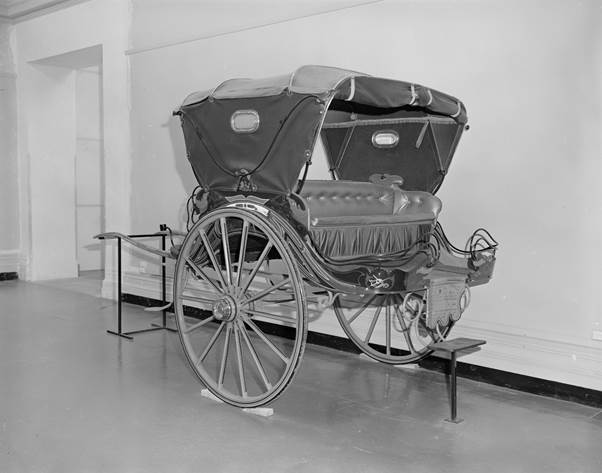
Pictured: Albert Car ‘Jingle’ on Display, Swanston Street Museum, 1960s. Photograph by Clyde Tilson, Museums Victoria Collection. Copyright Museums Victoria.
Our nineteenth-century streets were busy, bustling places – filled with foot and vehicle traffic of all kinds, though no motorised cars as we know them today. Horsepower dominated our roads and the skilled artisans behind these vehicles were in high demand.
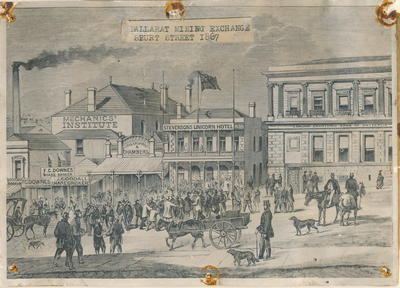
Pictured: ‘Ballarat Mining Exchange Sturt Street 1867’, print originally published in a supplement of the Illustrated Australian News. Sovereign Hill Museums Association collection.
The world of the nineteenth century is a world of mass migration to the far corners of the globe. As the number of people moving grows, the technology for movement grows apace. Steam power moves from factory to travel as trains puff their way across Britain, Europe and across colonial empires. Steam power enters the sea in large iron-hulled passenger ships.

Pictured: Painting of the S. S. Great Britain, artist unknown. Sovereign Hill Museums Association collection.
Your sea journey to the goldfields will shrink from an average of 100 days to 60 days over the course of the goldrush. Having travelled from home to a seaport, and from international seaport to Australian seaport, your journey to the goldfields is not over yet. What sort of travel technology might you encounter on the road to the diggings? Everything from hobnail boots, to wheelbarrows, to carts and carriages.
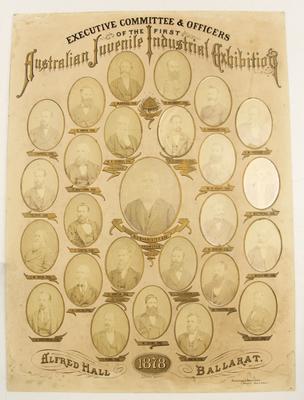
Pictured: Photographic Montage, Executive Committee & Officers of the First Australian Juvenile Industrial Exhibition, Alfred Hall, Ballarat, 1878. A ‘W. Proctor’ is near the bottom right, unconfirmed if the correct Proctor). Sovereign Hill Museums Association collection.
One of these new arrivals was an Englishman, William Proctor and his family. Mr Proctor had his start with coachbuilder JD Morgan; famous for the construction of the monstrous Leviathan carriage, which carried 89 passengers, depending on reports.

Pictured: Leviathan coach panel, Morgan & Co, 1859. Sovereign Hill Museums Association collection.
In 1860 Mr Proctor left to start up his own coachbuilding business. The Proctor workshop produced vehicles of all sizes, including dog carts, bread carts, and buses for large groups.
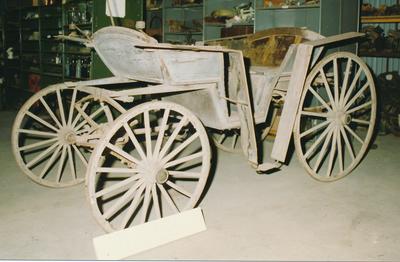
Pictured: Pony Phaeton by W. Proctor. Sovereign Hill Museums Association collection.
In 1861, Proctor celebrated the first anniversary of his coachbuilding business with a long advertisement in the local paper detailing the quality of their work – including employing a local artist to produce beautifully painted side panels – and the quantity of his work. He announced they were in the process of importing a wide range of steam powered machinery to further increase production.
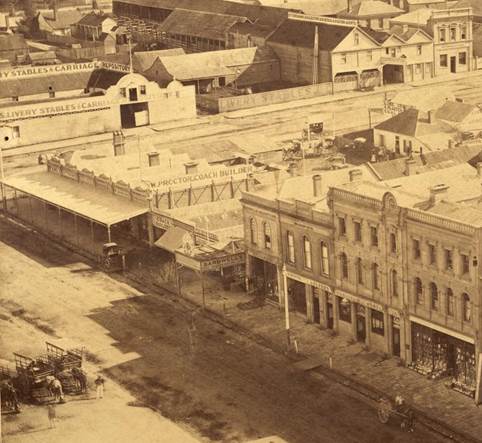
Pictured: Panoramic Photograph, from the Town Hall Tower Looking North West, 1870-1872. Bardwell’s Photographic Studio. Sovereign Hill Museums Association collection.
Mr Proctor’s business was one of many coach manufactories in the region servicing a variety of farm and town vehicles. Their business included both a wheelwrights and blacksmiths so that all parts of the coach or carriage, from frame to springs to wheels, could be produced or repaired onsite.
They carried a variety of carriage plans to help you choose the appropriate vehicle for your family or business and it would be built to order in their workshop. Newspaper reports suggest that by the mid-1860s his ‘hands’ (workers) were paid between £4 10s and £5 per week. “The fame of Mr Proctor’s superior work in all the departments of the coachbuilding trade” meant those who worked in his workshops were sought after (1881 ‘NEWS AND NOTES.’, The Ballarat Star (Vic. : 1865 – 1924), 5 December, p. 2. , viewed 10 Apr 2025).
W. Proctor’s steam-powered workshop, from the late nineteenth century, has been recreated here at Sovereign Hill, where you can get an up-close look at the rare trade of the wheelwright as one step in an early industrial process. Here we see the impact of the Industrial Revolution and a move towards a more ‘mass production’ approach to pieced construction in the late nineteenth century Wheelwright. The carriage makes its way through a series of specialised trades towards the back of the building in a form of piecework.
Mr Proctor’s business continued to grow throughout the nineteenth century. Around 1883 he withdrew from the business, all the fittings of his business being up for sale in 1885. He passed away in Melbourne in January 1886, survived by his wife and children.
Want to know more about nineteenth century wheelwrights?
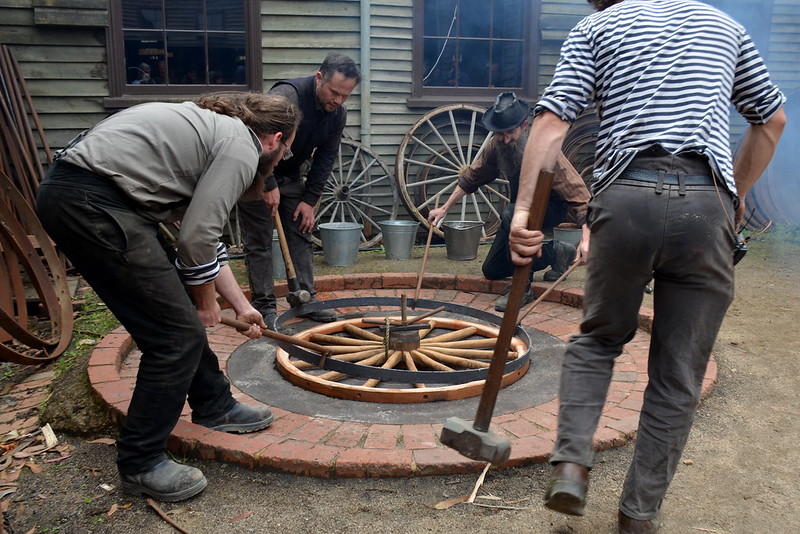
Pictured: The Sovereign Hill wheelrights team during the hot tyring process. Photograph by Chris Fitall.
Making and using transport on the goldfields
Worshipful Company of Wheelwrights
Wheelwright George Sturt’s Memoir
Written by Sovereign Hill Education Officer Sara Pearce
Discover more from Sovereign Hill Education Blog
Subscribe to get the latest posts sent to your email.


 Sovereign Hill Education Blog
Love reading about the craftsmanship behind trades like coachbuilding. Amazing to think how much skill and effort went into something we now take for granted.