Tag Archives: STEM in history

WOMEN in STEM: Goldfields Pioneers

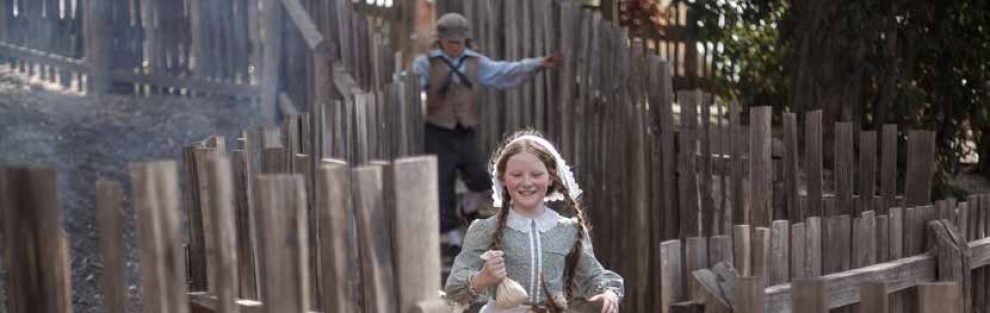
Pioneer Women. ACGRC: 78.707, Courtesy of Sovereign Hill Museums Association & Ballarat Historical Society Collection

At Sovereign Hill we are often asked about the experiences of women in the past; in particular, limitations on their dress, behaviour, education, and job opportunities as compared to men. Values, beliefs, and even some science of the time promoted the idea that men and women were inherently different and that this then justified their different treatment and access to opportunities. STEM (Science, Technology, Engineering, Mathematics) fields in the nineteenth century provide us with stories of amazing women, who were engaging, inventive, inquisitive, and pioneering in their respective fields.


MADAME ELIZABETH CHARPIOT: Daguerreotype 

Elizabeth Henwood, with her younger brother and sister, arrived in Port Phillip Bay aboard the Barque Velore in 1853. They made their way to the Victorian goldfields where in 1855 Elizabeth married George Charpiot, a watchmaker and dentist. It is unclear where her training or equipment came from but by 1856 Elizabeth had set herself up as a photographer, perhaps one of the earliest female photographers in Australia. Within her husband’s jewellery and dentistry business, she had a set of photographic rooms. The Ballarat Star, whose offices were opposite the business commented on her skill: 

“THE FINE ARTS.” The Star (Ballarat, Vic. : 1855 – 1864) 15 November 1856: 2. Web. 18 Jul 2024 <http://nla.gov.au/nla.news-article250439079&gt;. 

 A daguerreotype is the first form of commercial photography. A silver-plated copper plate was treated with a light-sensitive material that reacted when exposed to light. The plate was developed and fixed in a chemical bath, so it was a unique, single image. Our collection includes several examples of daguerreotypes like the style that Elizabeth was producing. The daguerreotype below is carefully mounted and beautifully framed. The lady is wearing several pieces of jewellery and carefully holding a book open – why do you think she chose to include a book in her picture?  

If you had your picture taken, would you wear anything special?
What one special object would you want to be included? 

“Unknown lady with book”  daguerreotype, 19th century. ACGRC: 2014.1392 

When the Charpiot’s moved to Dunolly, both continued their businesses; Madame Charpiot’s portrait services were regularly advertised alongside her husband’s dental business.  
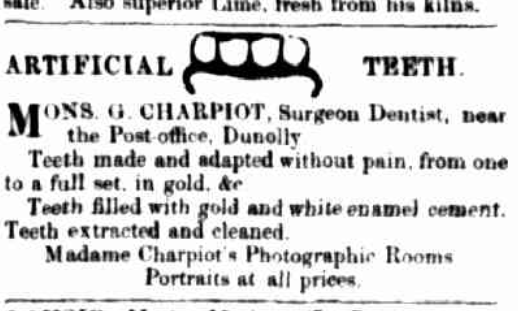
1858 ‘Advertising’, Maryborough and Dunolly Advertiser (Vic. : 1857 – 1867 ; 1914 – 1918), 23 April, p. 3.   http://nla.gov.au/nla.news-article253586868

A few years later they moved again to the goldfields town of Tarnagulla. On New Year’s Day 1868, their business caught fire and was destroyed. Most of Elizabeth’s photographic equipment was likely lost and it would seem she never returned to professional photography after the fire. 


EADY HART: Inventor 

  
Eady Hart, ACGRC: 06.0577 

Eady Hart arrived on the goldfields in 1854 as a six-year-old, with her family seeking gold. She became a dressmaker and married engineer William Hart. It seems to have been a difficult marriage and William deserted Eady and their eight children. Eady was remarkably resilient, she supported the family, including six foster children, with her sewing and millinery skills, then taxidermy, then an innovative fire-lighting product. Eady was curious and innovative and turned her attention to dyes. In her small kitchen, she experimented with native plants, like grass trees, to produce a beautiful range of natural dyes – useful for fabric and foodstuffs. Here she met with great technical success. Thirty years of experimenting led to the formation of Hart’s Royal Dyes in 1921. In our collection, we care for a number of her recipe and sample books, along with patent applications and business correspondence.  

What is a patent? Why would Eady need a patent for her idea? 

Eady had to solve various problems with her experiments. She needed to figure out what colours different plants produced, what was required to make the colour stable and stick to fabric, and whether the ingredients were safe to work with when mixed together. She also had to ensure there were enough ingredients to make lots of dye, and that the recipes were repeatable for others to follow.

Sample page in Eady Hart’s scrapbook. Accession Number 06.0576

People loved the colours Eady created; she won awards for her colours and her dye-making process. Newspapers were filled with reports of her wonderful discovery and for seeing the Australian bush as a sustainable resource: “Mrs. Hart says she has barely tapped on the possibilities of our vegetation. The glory of the Australian bush is not yet known … Mrs. Hart regards as criminal the ruthless cutting for firewood and building purposes valuable timber that should be producing priceless dyes”1 


EUPHEMIA BAKER: Artist & Photographer 

For Euphemia Baker, the move to Ballarat as a young girl to live with her grandparents opened to her the world of the Ballarat Observatory and the technology of the camera. In our collection we have a photo of young Euphemia “Effie” Baker with her grandfather, Captain Henry Baker, who ran the Ballarat Observatory, standing beside a large telescope. A retired sea caption, Baker was a master instrument maker, and his daughters grew up around the telescope and observatory. Access to this world inspired in them a love of looking at life through a lens for art and science. 
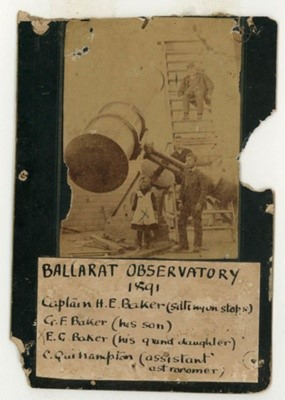
Ballarat Observatory 1891, ACGRC: 163.80 

His daughter Elizabeth Baker became a photographer and astronomical assistant at the observatory, down the road from where Sovereign Hill is situated in Golden Point. In 1896, the Ballarat Star noted that Miss Baker had taken charge of the observatory, the meteorological equipment and was contributing to international research projects and winning awards for her astronomical photography2. When her young niece, Effie, came to live with the family she gifted her a camera and mentored her in photography. Both Elizabeth and Euphemia were noted for their photography, including photos of the moon and stars taken through the telescope. 

Where do you find inspiration? 

The Goldrush Centre holds several early cameras, including this quarter-plate camera, perhaps similar to the one gifted to Effie, and the camera belonging to astronomer Mr John Brittain, who lectured in astronomy at the Ballarat School of Mines. 
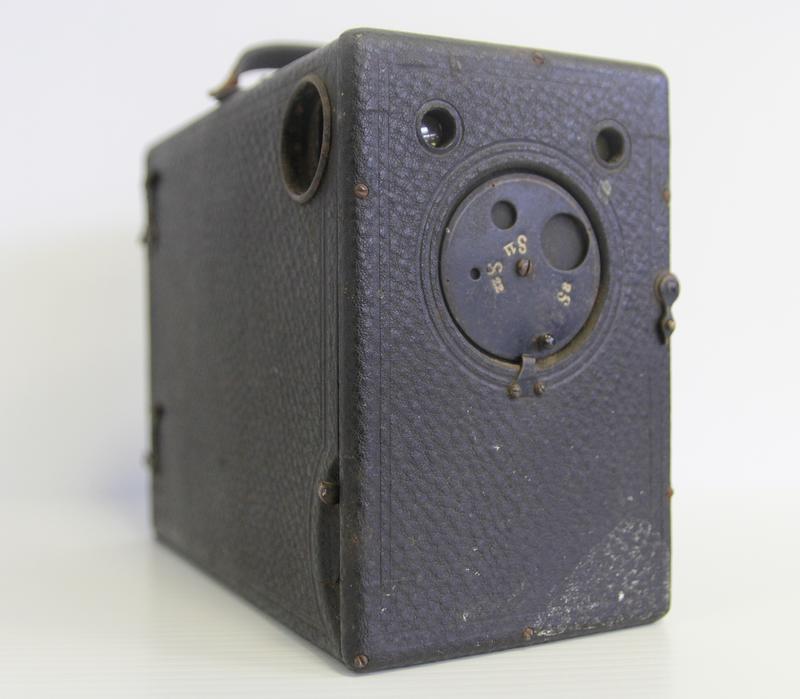
Quarter-plate camera, unknown maker and age, ACGRC: 2014.0204 
Camera belonging to Mr James Brittain c. 1890s, ACGRC: 78.0442 

DR. GRACE VALE: Doctor 

Were women treated equally in science and medicine? 

As a founding member of the Victorian Medical Women Society, one of the first female graduates from medical school in Melbourne, and then the first woman public vaccinator (in 1910), Dr. Vale became both a doctor and an active public figure in Ballarat, including being highly active in the suffrage movement to give women the vote. She was present for the first X-rays experiments at the Ballarat School of Mines. 

“Dr. GRACE VALE.” Table Talk (Melbourne, Vic. : 1885 – 1939) 28 December 1899: 6. Web. 18 Jul 2024 <http://nla.gov.au/nla.news-article145933182&gt;.  

The article below gives a hint of the medical environment in which Dr Vale worked. The “medical profession for women” suggests that only part of the profession is open to them and they are always described as “woman” or “lady” doctors specifically. She has been working in the practice of another woman doctor, Margaret Whyte with whom she had graduated.  Her appearance, rather than her abilities, becoming the focus of newspaper articles. In closing remarks, she is described as “the tallest of all the lady doctors, and commanding in appearance.” 
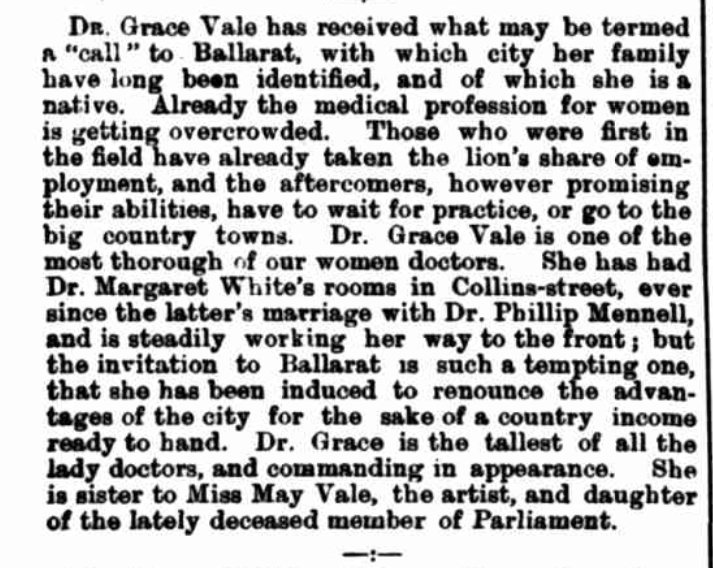
“Personal.” Table Talk (Melbourne, Vic. : 1885 – 1939) 24 April 1896: 2. Web. 17 Jul 2024 <http://nla.gov.au/nla.news-article145921688&gt;. 

Dr Vale used her position to lobby throughout her career for the rights of women. She was active in advocating for free or low-cost healthcare for female factory workers in Melbourne, she was elected to the Ballarat City Board of Advice and spent much of her career as a Medical Officer for schools in Victoria and NSW. 

These four stories are amongst many examples of resilient, adaptable, and curious women on the goldfields. But this is just the beginningwhat stories can you find? Do challenges still exist today for some groups wanting to enter STEM fields and how can we learn from these pioneers in the past?

The Science of Gold

What is gold and why do we like it so much? In response to the many questions we receive like this from visiting students during our education sessions, let’s explore the origins of gold and our fascination with it.

Where does gold come from?

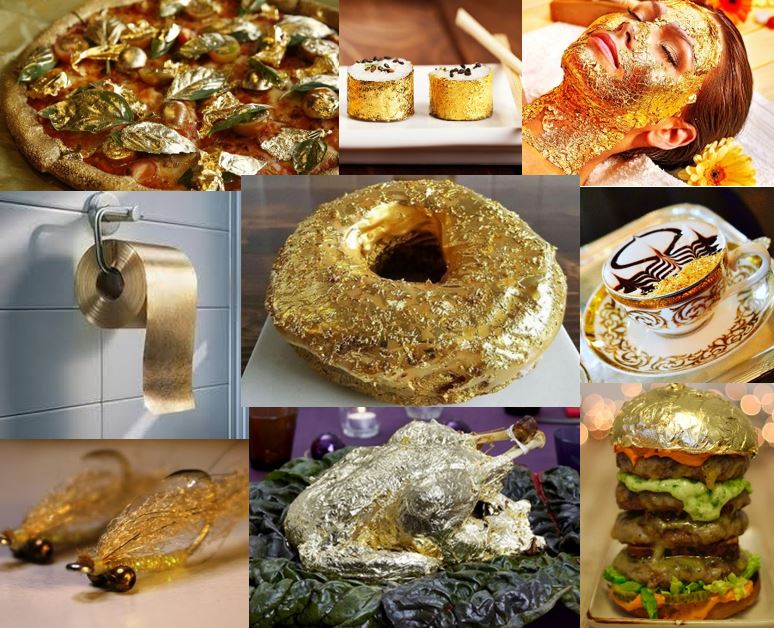
Humans can’t make gold, although many in the past have tried. And the Earth can’t make more of it even if we wait a couple of billion years. Only recently did scientists confirm the long-held theory that gold is created by the universe during supernovae (when neutron [dying] stars explode/collide). These violent astronomical events produce lots of the heavy metals we now use for things like ‘bling-y’ jewellery, as well as microcircuits for electronic devices like smartphones and tablets. Gold can even be used in food like this burger, which costs $AU81! This great video explains the creation of gold really well.

All

People today use gold for all kinds of weird and wonderful things. We hope the 24 karat gold toilet paper isn’t a real thing. Pictured are gold pizza, gold sushi, a gold facial, gold toilet paper, a gold doughnut, a gold cappuccino, gold flies for fly-fishing, a gold turkey, and the $AU81 gold burger!

Neutron stars are the densest objects in the known universe, and when their super-hot collapsing cores explode or smash into one another, they create elements like gold and silver. It is believed that such an event or series of events in the distant past created meteors containing gold and silver which then fell to Earth, delivering the precious heavy metals that adventurous miners sought to dig out of the ground in places like Ballarat and Bendigo during the 19th century. According to some research published in 2011, a meteor shower about 4 billion years ago dumped 20 billion billion (Wow!! That’s a big number!) tons of gold and other precious metals on our planet!

The chemical symbol which you find on the periodic table for gold is Au (from the Latin word aurum meaning ‘shining dawn’). As gold is an element, it can’t be broken down into other substances, which is the reason humans can’t make gold themselves (although with the development of nuclear chemistry, one day we might figure it out).

Why do we like gold so much?

Many cultures around the world for at least the last 8,000 years have used gold for things like decoration/art, religious ceremonies, false teeth, currency, sporting medals, medicine, and more recently in human history, electronics and satellites. It is useful to us because it never goes rusty, it’s soft and easy to shape, it conducts heat really well, and it’s a beautiful colour. In scientific language, we describe gold as being dense (that’s why it’s heavy), malleable (soft and easy to bend) and lustrous (shiny).

While some cultures have used it for thousands of years, others have not. For example, the Aboriginal people of Ballarat – the Wadawurrung people – knew of the gold that could easily be picked up from the ground across Western Victoria, but instead they valued much more practical and sustainable natural resources like brushtail possums, and certain kinds of stones useful for tool making. You can learn about how gold has been used by many cultures here.

One of the main reasons we like gold today is because it’s rare. If all of the gold found on Earth were collected together, it would only fill three Olympic-sized swimming pools! If it were more common and easy to find, it wouldn’t be worth anywhere near as much money as it is today. The price of gold changes day to day, depending on how much is being dug out of the ground, and the number of people keen to buy the gold (the demand for it). The price of gold today (9/2/18) is $54.52 per gram, or to state the value in the unit of measurement more commonly used to weigh gold, it’s currently worth $1,695.97 per ounce (1 ounce = 31.1 grams). You can find the current price of gold here: https://goldprice.org/

Ballarat is an alluvial goldfield, basically meaning that our gold has been brought here and is moved around by water (including underground rivers) and is often on the surface or not far beneath it. For miners in Ballarat at the beginning of the gold rush (from 1851 until about 1853), this meant they didn’t have to dig very deep underground to find big gold nuggets. By the 1860s most of that easy-to-find gold near the surface was gone, meaning miners had to dig much deeper underground to continue finding payable (enough to make a profit) amounts of the precious yellow metal. This is when deep lead and quartz mining really took off in Ballarat.

The gold miners who came to Ballarat largely used gold to buy better lives (better clothes, housing, food, investments etc.) and the majority of the billions of dollars of gold found here was turned into gold sovereigns (English money made of gold, after which our museum – Sovereign Hill – got its name) or gold ingots (gold bars). Some however, was turned into spectacular, flashy pieces of jewellery, and even the beautiful mayoral chains owned by the City of Ballarat!

If you visit a jewellery store, you will notice items made of gold are usually described as ’18 karat gold’ or ’10 karat gold’. A karat is a unit of measurement which explains how much gold was mixed into the alloy (a mixture of metals) that have gone into the making of that piece of jewellery. A carat is used to value gemstones and pearls. 18 karat gold jewellery has a higher amount of gold in it than 10 karat gold jewellery, which is why it is always more expensive. If, say, a ring is made from 24 karat gold, it is pure gold – but of course this would make it an easily bent piece of jewellery!

The Castlemaine Goldfields is the only mining company in Ballarat still successfully finding payable gold underneath the city. There is still a lot of gold in the ground in this part of Victoria, but it’s very difficult and expensive to get out of the ground.

Links and References

TED Ed on the chemistry and origins of gold: https://www.youtube.com/watch?v=jf_4z4AKwJg

Sovereign Hill research notes for students about the different kinds of mining common in Ballarat in the 19th century: http://education.sovereignhill.com.au/media/uploads/sovehill-pdf-file/SovHill-mining-notes-ss1.pdf

Some great facts about gold: https://www.livescience.com/39187-facts-about-gold.html

A report on the recent confirmation that gold is produced by supernovae: https://www.eurekalert.org/pub_releases/2017-10/uoc–asc101517.php

A fantastic explainer video on the creation of gold: https://www.youtube.com/watch?v=-iaviqwMfJ0

How the gold karat system works: https://en.wikipedia.org/wiki/Fineness

Gold in antiquity: https://www.ancient.eu/gold/

A video explaining why we use gold for currency: https://www.youtube.com/watch?v=18yIHCSemhs

How NASA uses gold for space exploration: https://curiosity.com/topics/nasa-uses-gold-on-its-spacecraft-curiosity/

Should we eat gold?: http://www.foodandwine.com/news/is-gold-safe-to-eat

Gold according to Wikipedia: https://en.wikipedia.org/wiki/Gold

What is more valuable than gold?: https://www.smithsonianmag.com/science-nature/what-is-rarer-than-gold-45073180/