In Victorian times, collecting was all the rage. People collected many different things such as butterflies, stamps, shells, stones, weapons, and even human bones. Some were motivated to collect in the name of science, while others filled their parlours with “curiosities” just for the fun of it. While some of these 19th century collectors and their collections have helped us better understand nature and the many different cultures around the world, collecting may have sometimes caused more harm than good.
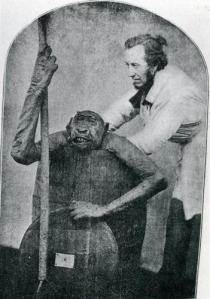
Zoologist and taxidermist Araham Dee Bartlett with his first gorilla (pickled…!), collected by Dr. Du Chaillu for Professor Owen, British Museum, 1861.
One fascinating Victorian collector was the explorer Paul Du Chaillu. He was the first European to see (and later kill) a live gorilla while he was travelling around Africa from 1856 to 1859. Until the 1860s, Europeans thought gorillas were mythical creatures. Their bones had been collected and studied in the late 1840s, but pickled (eew!) and stuffed examples of them weren’t brought back to Europe until the 1860s! Only then did people believe that these large, hairy Great Apes really existed.
Collectors have taught us much about the world. Probably the most famous collector of all was Charles Darwin, who developed the theory of evolution by natural selection (he published his famous book on this topic, On the Origin of Species, in 1859). In the 1830s Darwin sailed around the world for five years collecting many different kinds of plants and animals. This helped him develop his world-changing idea that successful animals adapt to suit their environment. While he brought many dead and preserved specimens back to England, he also collected live animals including giant Galapagos tortoises. Many people believe that Harriet, a tortoise at Australia Zoo which died in 2006 at the age of 176, was originally collected by Darwin.
Darwin was one of many famous collectors who popularised collecting as a hobby, and by the 1850s it was a very fashionable pastime for a gentleman. Here on the Ballarat goldfields there were many men who collected minerals (stones), bird eggs, postcards, weapons made by the local Aboriginal people (the Wathaurong), and animals which would commonly be preserved using the technique of taxidermy (stuffing them). Sadly, there is even evidence that at least one collector in Western Victoria dug up bodies of Aboriginal people to take their skulls (Griffiths, Hunters and Collectors: The Antiquarian Imagination in Australia, p.28-9).
The bones of such “exotic” people would be sent to places like the British Museum to be studied and displayed. At the time this was seen as scientific inquiry but today the practise is illegal and recognised as being totally inappropriate and insensitive to the families and descendants of those deceased people. Fortunately, human remains from many countries which were sent to European museums and universities in the 19th century have now been respectfully returned to their communities of origin. The remains of Truganini, mistakenly believed to be the last Tasmanian Aboriginal person, were finally returned from the Royal College of Surgeons of England in 2002, 130 years after they were sent away from her homeland.

Feejee Mermaid Year: 1842. Con artist: P.T. Barnum.
Sometimes people would try to use their collections to make money, and this often caused more creative collectors to invent curious creatures and artefacts. A good example of this is the Feejee Mermaid, which was exhibited from 1842 until the 1860s in P. T. Barnam’s world-famous circus. Another example was a petrified wooden carving of a head that claimed to have been discovered in a gold mine at Creswick, 12kms north of Ballarat in 1855. This was revealed to be a hoax after some initial excitement about what it meant for understanding Australia’s history of human habitation (Griffiths, Hunters and Collectors: The Antiquarian Imagination in Australia, p.35).

An advertisement for a human zoo in Stuttgart, Germany, 1928.
Perhaps the most dark and worrying aspect of collecting were zoos which displayed humans. Cities such as London, New York, Paris, Milan and Barcelona all had zoos containing “exotic” peoples by the 1870s.
While the word ‘scientist’ only came into use in 1834, the 19th century was an exciting time for science and discovery; fossils of dinosaurs and mammoths were being unearthed as were the tombs of ancient Egyptian pharaohs, and millions of people were moving from one country to another – by choice – for the first time in history. While many people still collect all kinds of weird and wonderful things today like Barbie dolls, rare books and beautiful antiques, we are much more careful about the kinds of things we collect and the way we collect them. Check out some of the fascinating collections preserved by The Gold Museum here.
Links and References:
On gorillas – http://en.wikipedia.org/wiki/Paul_Du_Chaillu
About Charles Darwin and his work – http://darwin200.christs.cam.ac.uk/pages/index.php?page_id=jb
Harriet the Giant Galapagos Tortoise – http://en.wikipedia.org/wiki/Harriet_(tortoise)
Museum of things Queen Victoria and Prince Albert collected – http://www.vam.ac.uk/
The return of Truganini’s remains – http://www.theage.com.au/articles/2002/05/28/1022569769905.html
The Feejee Mermaid – http://en.wikipedia.org/wiki/P._T._Barnum
Another fake mermaid – http://www.goldmuseum.com.au/fake-mermaid-photograph/
Human zoos – http://en.wikipedia.org/wiki/Human_zoo
History of the word “scientist” – http://www.npr.org/templates/story/story.php?storyId=127037417
Gold Museum collections – http://www.goldmuseum.com.au/about-our-collections/
On creepy Victorian mummy unwrapping parties (‘Egyptomania’) – http://neovictorianparlour.blogspot.com.au/2013/04/victorian-mummy-unwrapping-parties.html
Griffiths, Tom. Hunters and Collectors: The Antiquarian Imagination in Australia, Cambridge University Press, 1996.


 Sovereign Hill Education Blog