Category Archives: Immigration

“Why do I have to learn about the Gold Rush?”

Naturally, at Sovereign Hill we think everyone should learn about the Ballarat Gold Rush. Why is it such an important period in Australian history you ask? Well, in essence it changed our country in profound ways which continue to impact on the way we live today. If gold hadn’t been found in this region, Australia may have developed a very different system of government, economy and population. And without gold, Ballarat itself probably wouldn’t even be on the map! Let’s examine some of the most important legacies of the Gold Rush, including some aspects that perhaps we are not so proud of…

The impact of the Gold Rush on our government

bh

In the lead up to the Eureka Rebellion, those involved held public meetings to discuss their ideas for making Victoria’s democracy better. Reproduced with permission from the Gold Museum.

Due in large part to the tragic loss of life at Ballarat’s Eureka Rebellion, Victoria had the most advanced democracy in the world by 1855 (Littlejohn, Marion. Eureka Stockade, Black Dog Books, Victoria 2013, p. 29). This historic event, which occurred on Sunday 3rd December, 1854, saw at least 30 people killed. It continues to be an event that historians argue about; some say it had to happen to force the government to change the taxation and democratic systems, while others say it was an utter waste of life. Historians sometimes argue that it’s a story of pesky troublemakers, or a kind of Irish uprising against the English for the long history of conflict between those two nations. Some people claim it was the start of the union movement, and the birthplace of Australian left-wing politics, while others think it was an act of terror committed by a group of extremists.

All of this debate about its significance makes it all the more interesting and important to study – and regardless of your opinion, at the time it did push the Victorian government to improve the taxation and democratic voting systems. As a result of the Eureka Rebellion, Victoria introduced the secret ballot (secret voting), salaries for members of parliament, and for the first time, most men of European descent over the age of 21 could vote. Learn more about the Eureka Rebellion here.

The impact of the Goldrush on the economy

Approximately $100 billion of gold (in today’s dollar value) was discovered in Victoria during the Gold Rush (Bradby, Doug. Don’t go to the Goldfields, 2015, Waller & Chester, Victoria, p.126) making Melbourne one of the richest cities in the world! This wealth enabled Victorians to make huge investments in industrial technologies such as foundries, factories and ports, and bought us important public infrastructure such as schools, hospitals, roads, and bridges. The foundation stones for both The University of Melbourne and the State Library were laid on the same day in 1854; such huge building projects were only made possible as a result of the Gold Rush.
wn

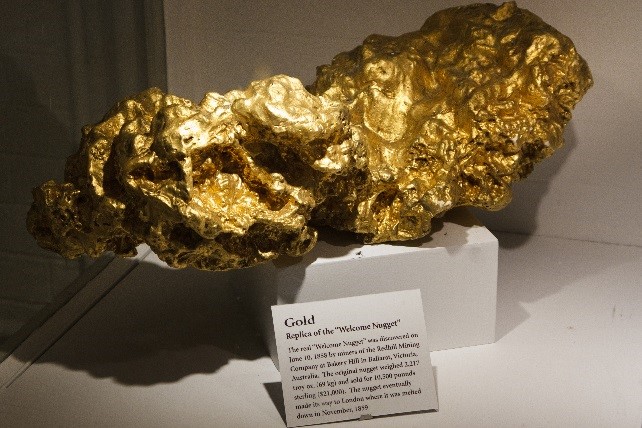
Most of the world’s largest gold nuggets were found in the Ballarat region, like this 68kg monster – the famous ‘Welcome Nugget”. Reproduced with permission from the Gold Museum.

Gold also transformed the structure of Victoria’s economy. Before gold, our economy was based on producing wool (sheep farming) to be exported to the factories of industrial England thus making all involved very rich. If we go back even further, the (pre-European) Aboriginal economy in this region was based on the trade of things like precious greenstone axes and possum-skin cloaks.

Many historians argue that the Ballarat Gold Rush finished when World War 1 began, as by that time Ballarat’s economy had turned to manufacturing – the city’s foundries and factories were used to make trains, shoes, woollen blankets etc. This is one of the reasons Ballarat continued to grow and thrive after the Gold Rush finished. And what is our local economy based on now? It’s based on a combination of things like healthcare, tourism and manufacturing to name just a few. Learn more about Ballarat’s 21st century economy here.

The impact of the Goldrush on Victoria’s population

Without the Gold Rush, many Victorians wouldn’t be here today. The reason many of you were born here is because your great-great-great-great grandparents immigrated to Australia in search of gold during the 19th century.

The goldfields were a true melting pot of cultures, languages and ideas. Things were harmonious at times while at others, sadly, there was racially-fueled violence in the streets. Regardless of such details, Victoria’s population exploded from about 80,000 people before gold in 1851, to more than 550,000 only ten years later (Serle, Geoffrey. The Golden Age: A history of the colony of Victoria 1851-1861, 1977, Melbourne University Press, p.382). Ask your parents and grandparents some questions about your family history – was your family in Australia at the time of the Gold Rush or did they come later as a result of it?

Some negative impacts of the Goldrush

History must not be “sugar-coated”. There are important aspects of the Gold Rush that should also be studied which don’t fill us with pride about the development of modern Australia. The first of the negative consequences of the Gold Rush involves the disruption it caused to Ballarat’s ecosystems. 160 years later there is still lots of evidence of this region being turned upside-down in pursuit of gold. Forests, animal populations and waterways are still recovering today.
hh

Learn more about the Aboriginal side of Sovereign Hill’s Gold Rush story by exploring our new digital tour – Hidden Histories: The Wadawurrung People.

This relates to the second negative consequence of the Gold Rush – this region has been the country of the Wadawurrung People for 2,000 generations. Although there were already Europeans in Victoria (mostly farming sheep) before the Gold Rush, the huge population increase the Gold Rush brought had a devastating impact on the traditional lifestyles of the Wadawurrung People. All of the new arrivals needed food, water, and wood for houses and mineshafts, which meant that natural resources in this region were in unparalleled demand. This meant that traditional hunting grounds were turned into private farms with fences, and forests that Wadawurrung People had looked after for thousands of years to ensure they produced all of the food, shelter and fibre their population needed to live comfortably, were chopped down to be built with, or burnt in the boiler houses of the goldfields (learn more about this here). In one generation, the lives of Victorian Aboriginal People were radically transformed. As a result, the Wadawurrung People will never be able to truly practice their traditional culture, as their ancestors have done for perhaps as long as 60,000 years. These aspects of the Gold Rush story are just as important to learn about as all of the wealth and prosperity it brought to this country. Sovereign Hill recently launched a new digital tour focusing on the Gold Rush experiences of the Wadawurrung People called Hidden Histories.

So, do you think the Gold Rush is an important part of the Australian story? Does studying it help us better understand who we are now? What other periods in Australian history do you think people should learn about?

Links and references

Here’s a great Lego movie about the Eureka Rebellion made by some Victorian Grade 5 students: https://www.youtube.com/watch?v=wSySV9xoHzg

A brief history of Ballarat: https://simple.wikipedia.org/wiki/Ballarat,_Victoria

Information about all of the Australian gold rushes: https://en.wikipedia.org/wiki/Australian_gold_rushes

A wonderful interactive map of Australia’s gold rushes: http://www.sbs.com.au/gold/GOLD_MAP.html

Some fascinating places to visit where you can learn more about the gold rushes: http://www.visitvictoria.com/Regions/Goldfields/Things-to-do/History-and-heritage/Gold-rush-history

A video on the history of democracy: https://www.youtube.com/watch?v=k7dTDjRnBqU&index=30&list=PL8dPuuaLjXtNjasccl-WajpONGX3zoY4M

Littlejohn, Marion. Eureka Stockade, 2013, Black Dog Books, Victoria.

Bradby, Doug. Don’t go to the Goldfields, 2015, Waller & Chester, Victoria.

Serle, Geoffrey. The Golden Age: A history of the colony of Victoria 1851-1861, 1977, Melbourne University Press.

1850s Transport

It is difficult to imagine life before cars, trucks, motorbikes and aeroplanes. Those who came to Australia during the gold rush however, travelled here, explored the place, and moved huge quantities of cargo long before the car, truck, motorbike and aeroplane were invented. How did they do it?

Let’s examine the journey of an imaginary gold miner who we will call Mr Yuilisses, or Mr Y for short, to better understand 19th century transport technologies.

The year is 1852. Like many well-educated young men, Mr Y has decided to try his luck on the Australian goldfields. He lives in the UK in the “cottonopolis” of Manchester, the first industrialised city in the world, where he has been studying canal engineering. The first part of his trip involves taking a train west to Liverpool (the Liverpool to Manchester Railway, opened in 1830, was the first intercity passenger rail line in the world). He says goodbye to his parents, who he is unlikely to ever see again, as for the majority of gold rush immigrants to Australia, this was a one way trip (Serle, The Golden Age, 1977, p. 382). He then boards a noisy, dirty, uncomfortable steam train. He decides not to get a first class ticket as he is saving his pennies for gold mining supplies. The train is still 5 times faster than getting to Liverpool by horse (Nicholson, Steam, Steel and Speed, 2008, p. 7). This relative ease of movement makes Mr Y very grateful for the Industrial Revolution!

1

Opening Liverpool and Manchester Railway, 15th September 1830. Most train carriages had roofs by 1852, but they weren’t much more comfortable than this.

After a freezing, windy journey in an open carriage he alights at Crown Street Station in Liverpool. Next, he has to organise a ticket for a ship to the Antipodes (Australia). He decides to travel on a “clipper” – a very fast, yacht-like sailing ship – and gets his equipment for the long journey in order. While basic rations (food/water) are part of the ticket price, Mr Y needs to take clothes and his own bedding. If he were a woman and mother he would probably think to take some seeds or fruit tree seedlings to make sure his family are fed once they settled on the goldfields. However, Mr Y is going by himself, so he is more focused on gold than food and knows there will be plenty of mutton to be eaten in the new state of Victoria (only made separate from NSW in 1851). After all, until gold was “discovered” (by non-Aboriginal people) in 1851, Victoria’s main export was wool from the 5 million sheep farmed across the state.

2

An 1855 poster advertising the Red Jacket clipper ship.

If Mr Y were extremely lucky, the clipper would take him from Liverpool to Melbourne in as little as 3 months. If he bought the cheapest ticket – in steerage, below the waterline at the very bottom of the ship – he not only risked his life through exposure to unhygienic conditions, but also a lack of air and potentially days of total darkness if the weather turned bad. Rarely were people in steerage class allowed to use candles or oil lamps in their highly flammable environment, even when the hatches were battened down (the openings in the deck for ventilation/sunlight were closed during storms). Buying a first class ticket didn’t make the journey much more comfortable. Read more about the horrendous conditions on 19th century sailing ships here and here.

When Mr Y arrives in Melbourne having survived his trying journey via the Great Circle Route (one of the most dangerous parts of which was Victoria’s Shipwreck Coast– where 638 ships are known to have sunk!), safe and scurvy-free thanks to all of the lime juice he drank and pickled cabbages he ate (an idea of British Navy surgeon James Lind), everything in 1852 Melbourne costs a fortune! A bed for the night, supplies to take to the goldfields, even the cost of clean water was a rip-off… Of course the reason these “goods” (products) were so costly, was because most had made the long, expensive journey from the UK to the Australia just as he had. Little did Mr Y know such things were even more expensive on the diggings! Once he had stocked up on tent canvas, a mattress, a shovel, gold pans and a wheelbarrow, he would investigate how to get to Ballarat, and if indeed that was a good goldfield to venture to. In 1852 there was much talk among the people at the port that Ballarat’s gold had run out, and that the Bendigo Creek was a better bet. But who could you trust for such advice? If he selected Ballarat the journey could be shortened by taking a “steamer” (boat) from Melbourne to Geelong, which only takes half a day and shaves 3 days off the walk, but again the tickets were quite expensive.

3

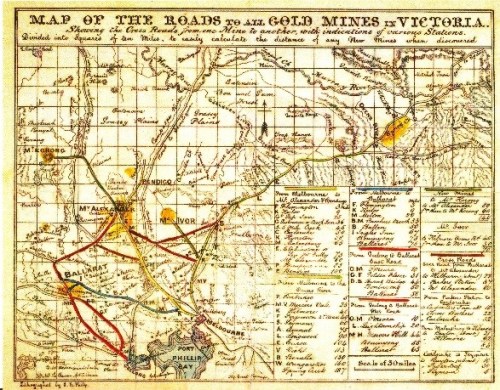
Map of the Roads to all gold Mines in Victoria, lithograph by J.B. Philp, 1853.

Our brand new, inexperienced gold miner Mr Y decides to head to Ballarat after all, and early the next morning he sets out with many others making the same journey. His expensive mattress becomes waterlogged after a big storm on the first day of the 113km walk, so he decides to abandon it along with the hundreds of other pieces of broken, spoiled, or foolishly heavy equipment others before him have dumped along the way. He wishes he had paid the ridiculous price to travel by wagon (or at least have his belongings sent by bullock dray) but the price was far too high. He had heard that the journey by wagon is so bumpy that most people end up walking anyway, as the jarring motion of the wagon makes many “seasick”.

While there is no actual road to the diggings of Ballarat, there is already a well-worn path that takes Mr Y past beautiful eucalypt forests, the likes of which he has never seen before. It takes him over hills and creeks (which he has heard are sometimes so deep and dangerous on the road from Geelong to Ballarat that you have to pay the local Aboriginal People to make bark canoes to get your mining gear across), and eventually he arrives within earshot in Ballarat on day 3 of his journey. He can barely sleep for all of the exciting noise he can already hear coming from the goldfield, now little more than a few miles (kilometres) away. If he had approached Ballarat from Geelong he would be staying in Mother Jamieson’s Inn just south of Mt Buninyong (in 1849 this was the “the busiest town in Victoria outside Melbourne and Geelong”), but instead he’s sleeping under the stars (close to the town we now know as Ballan), yet again.

4

William Strutt, En route to the diggings, pencil and watercolour, 1851. Reproduced with the permission of the Victorian Parliamentary Library.

Mr Y finally arrives at the Ballarat diggings, and looks in wonder at the tent city in front of him, bursting with adventurers from all over the world. He lives in a tent for the first few months, then a slab hut, and then, once he finds a large gold nugget, he builds a house and gets married. Up until this point, his only means of transport around Ballarat has been his own two feet, but now he can afford to buy a horse to help with his mining work and deliver his children to school.

Horses were incredibly useful on the goldfields for both transport and work. Apart from being used to move people and cargo, they could also be attached to whims, Chilean mills and puddling machines to extract gold from mud, clay and rock. However, horses are dangerous, and back then were responsible for many deaths and injuries, and are still the most likely animal to kill you in Australia! In the 1860s, camels were imported to Australia for Burke and Wills ill-fated expedition, but there weren’t any in Ballarat at this time. As far as we know Ballarat has never had a resident camel!

After an exciting life of adventure, pioneering, and hard work to secure his family’s comfort, let’s imagine Mr Y dies in 1885, one year before the first car was invented. His great-grandchildren living in Ballarat would become the first of his descendants to own cars, as cars didn’t become popular and affordable here in Australia until well into the 20th century.

Links and References:

Sovereign Hill Education: Transport in the 1850s, Research Notes for secondary school students: http://education.sovereignhill.com.au/media/uploads/sovehill-pdf-file/SovHill-transport-notes-ss1.pdf

Horrible Histories on the pioneers of transport: https://www.youtube.com/watch?v=NLL2Txs8kCg

SBS Gold on goldrush transport: http://www.sbs.com.au/gold/story.php?storyid=18

Clipper ship routes and records: http://en.wikipedia.org/wiki/Clipper_route

A fantastic blogpost about 1850-1870 ocean journeys to Australia: http://museumvictoria.com.au/discoverycentre/websites-mini/journeys-australia/1850s70s/

Another which is terrifying!!: http://museumvictoria.com.au/discoverycentre/websites-mini/journeys-australia/1850s70s/privies-and-hygiene/

“See the Land from an Aboriginal Canoe” – Aboriginal bark canoe technology was in high demand in the 1800s: http://www.cv.vic.gov.au/stories/aboriginal-culture/seeing-the-land-from-an-aboriginal-canoe/seeing-the-land-from-an-aboriginal-canoe/

Is your train commute quicker now than it was 100 years ago? http://www.theage.com.au/victoria/is-your-train-commute-quicker-than-90-years-ago-the-answer-might-surprise-you-20150219-13gx1c.html

The history of Australian immigration: http://museumvictoria.com.au/discoverycentre/websites-mini/immigration-timeline/

Website on the last surviving clipper ship, City of Adelaidehttp://cityofadelaide.org.au/

An interesting article on scurvy: http://www.bbc.co.uk/history/british/empire_seapower/captaincook_scurvy_01.shtml

The introduction of cars to Melbourne: http://museumvictoria.com.au/marvellous/powered/car.asp

Henderson, W. F. and Unstead, R. J. Transport in Australia, A & C Black LTD., London, 1970.

Nicholson, John. Steam, Steel and Speed: Transport, Trade and Travel in Australia 1850s-1920s, Allen & Unwin, NSW, 2008.

Serle, Geoffrey. The Golden Age: A history of the colony of Victoria 1851-1861, Melb. Uni. Press, Vic, 1977.

A Deaf Digger

Having recently learnt about a very interesting deaf man who spent some time on the Victorian goldfields during the 1850s, we thought we would share his story with you.

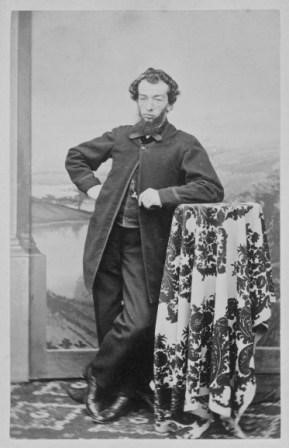
Frederick John Rose.

Frederick John Rose.

Frederick John Rose was a deaf man from England. He was born in 1831 and became profoundly deaf due to Scarlet Fever. He was educated at a Deaf School in Old Kent Road, London.

Rose came to Australia with his younger brother in 1852 when he was 21 years old. He began work as a cabinet maker in South Melbourne but was soon keen to try his luck prospecting for gold. He walked to the goldfields near Bendigo in 1853. Unfortunately he had no luck finding gold so he worked as a carpenter/builder.

While working in Bendigo, Rose saw a series of letters in the newspaper The Argus. One letter was from an unknown author who claimed there were as many as 50 deaf children living in Victoria who were without any form of schooling. Another letter was from a widow, Mrs Lewis, with a deaf daughter. Mrs Lewis wrote appealing for anyone who could educate her daughter Lucy. Rose had not realised there were so many deaf children in Victoria and so he decided to establish a school for the deaf in Melbourne. He wrote about this intention as a letter to The Argus and received answers from parents with deaf children who were interested in supporting the development of a school.

In 1860 the school, which has now become The Victorian College for the Deaf, was established and Lucy Lewis was the first pupil. By 1861 the school had eight students. Rose was now married and he and his wife had to keep renting new, bigger premises due to the increase in student numbers. Further enrolments led to Rose and his associates lobbying with the local church for a purpose-built school and in 1866 they moved into the new building and became a school and support service for Deaf children. The school and support service continued and still operate today as Deaf Children Australia, a not-for-profit agency supporting deaf and hard of hearing children and their families, and The Victorian College for the Deaf.  The school itself is no longer solely located in the original building (although some classes still occur within its facilities) however the original building still stands and is now listed with Heritage Victoria.

Frederick J. Rose continued as Superintendent and Headmaster of the school until 1891 when he was forced to leave when the school’s board of management decided to focus more on education taught through speaking and listening rather than signing. This was a result of the resolutions passed at the 2nd International Congress on Education of the Deaf. [See Milan Congress 1880 here and the rejections of the 1880 resolutions in 2010 here.]

Throughout his life, Rose raised lots of money for various organisations supporting deaf people and was a highly respected member of the community. He died in 1920 at the age of 89 and is buried in the St Kilda Cemetery in Melbourne. See a signed version of his story by Stan Batson, a highly respected deaf man, here.

Learning about the story of Frederick J. Rose has highlighted some of the historical discrimination deaf people have faced, and in some cases still face in Australia, in terms of access, education and also immigration. Jan Branson and Don Miller have written extensively on this topic. In 1998 they wrote about ship captains getting fined for bringing “infirm” people to Australia or New Zealand. Fortunately for F. J. Rose, and for all of Victoria’s deaf people past and present, he arrived in Australia before these immigration laws were created!

The sign language used by deaf people in Victorian times evolved as all languages do over time, and has today become what is called Australian Sign Language, or Auslan. This language is specific to Australian deaf people and is not ‘universal’; something many people mistakenly believe. Each country has its own sign language and culture that is particular to the deaf people living in those countries. This means that people in England use British Sign Language (BSL), people in America use American Sign Language (ASL) and people in France use French Sign Language (LSF). Auslan has links to both British and Irish sign languages because when deaf people migrated here or were transported here as convicts they brought their languages with them.

Auslan was recognised by the Australian government as a “community language other than English” and the preferred language of the Deaf community in policy statements in 1987 and 1991. However, this recognition is yet to filter through to many institutions, government departments and professionals who work with Deaf people. (http://en.wikipedia.org/wiki/Auslan)

Deaf, hard of hearing, and deafblind people may have differing needs or individual preferences to ensure access to clear communication. This may involve working with Auslan/English interpreters, Tactile Signing interpreters, seating arrangements, lighting, written information or gaining information through non-verbal signals such as facial expressions, lip patterns and body language.

In the days before technological advances such as mobile phones, the internet, television or even electric lighting, many deaf people met by gas light in the streets of Melbourne. These lights allowed deaf people to chat long after the sun had gone down.

This sign indicates that an event or video etc. has an Auslan interpreter.

This sign indicates that an event or video etc. has an Auslan interpreter.

Australian Deaf Culture is specific to the deaf community here in Australia. It contains a wealth of history, humour, customs, etiquette, and of course the language of Auslan is integral to all people who are members of the deaf community. Read more about Deaf culture here.

In many ways it can be useful to consider Auslan and the deaf community as a minority language community rather than a disability group. The deaf community in Australia have a different language, culture, history and customs to the mainstream community in Australia. In this way they are similar to people who have migrated to Australia from other countries, except that deaf people have not migrated. For this reason, many people feel there are strong similarities between deaf communities and Aboriginal or Torres Strait Islander communities who also have different languages and cultural practices compared with broader society. If we think about the deaf community like that it becomes easier to understand the challenges they face as a minority language seeking recognition, access and fair treatment in our society.

Did you know that there are also Aboriginal and Torres Strait Islander communities who use a sign language for cultural reasons and at certain times? Some of these communities have deaf people as well and use different signs to Auslan to communicate. Read more about Aboriginal and Torres Strait Islander communities and signing here.

Links and References:

Timeline of F. J. Rose’s life: http://www.deafchildrenaustralia.org.au/FJ_Rose_Chronology

Short biography of F. J. Rose: http://en.wikipedia.org/wiki/Frederick_J_Rose

Interesting article on the history of Australian government discrimination against deaf immigrants: http://deafhistoryaustralia.com/tag/frederick-j-rose/

The Victorian College for the Deaf: http://www.vcd.vic.edu.au/6354650/victorian-college-history.htm  

The history of Auslan: http://www.auslan.org.au/about/history/

An explanation of deaf culture, do’s and don’t’s for interacting with deaf people, and a history of Auslan: http://www.aussiedeafkids.org.au/deaf-culture.html

On deaf culture: http://en.wikipedia.org/wiki/Deaf_culture

Utmost for the Highest: The History of the Victorian School for Deaf Children, by J. H. Burchett, Melbourne, 1964.

No Longer By Gaslight, by John W Flynn. Adult Deaf Society, East Melbourne. 1984.

How not to say “I beg your pardon?”: http://bit.ly/17g0PfE 

Deaf History – Milan 1880: http://deafness.about.com/cs/featurearticles/a/milan1880.htm

A New Era: Deaf Participation and Collaboration, Vancover 2010: http://nad.org/sites/default/files/2010/July/ICEDNewEraVancouver2010.pdf

Frederic John Rose. Founder of the Victorian Deaf and Dumb Institutionhttp://bit.ly/1CGKgST 

Deaf History: Frederick John Rose: http://www.auslanstorybooks.com/fj-rose.html      

Goldfields Immigration 3

The Irish influence on Ballarat

Gentlemen and savages – Men of Ballarat and fellows of Bungaree” These were just some of the inflaming words spoken by the controversial Victorian politician C. E. Jones, at a political meeting in Ballarat, 1864. Jones was attempting to trade on the popular Old World idea of the Irish as lower-caste, illiterate and priest-ridden trouble makers who were intent on lowering the standards of this new society in Ballarat. In fact these ideas about the Irish presence in Ballarat were completely inaccurate.

The Irish were the second largest national group (the largest being the English), to influence the history of Australia during the gold rush and colonial periods. From 1851 to 1901 the percentage of the population considering themselves Irish remained at around 20%. Most of these immigrants came from the southwest counties of Clare, Tipperary, and Galway.

Continue reading

Goldfields Immigration: Part 2

The Jewish contribution to Ballarat’s History

Ballarat Synagogue, cnr Princes & Barkly Streets, Ballarat. Gold Museum Collection.

Ballarat Synagogue, cnr Princes & Barkly Streets, Ballarat. Gold Museum Collection.

“Hidden away in plain view”, that is how many people describe the location of the Ballarat Synagogue. On the main tourist route from Melbourne to Sovereign Hill, a large stone structure on a bend of road near the East Ballarat Fire Station, hints at a connection to a Jewish community in Ballarat. In fact there have been people of the Jewish faith involved actively in Ballarat’s history from the beginning of European settlement here.

Continue reading

The Walk from Robe: Retracing the Chinese Journey to the Goldfields

From Left; Oscar Zhang, Charles Zhang and Bill Moy From the CACSB

From Left; Oscar Zhang, Charles Zhang and Bill Moy From the CACSB standing in front of the Chinese Temple at Sovereign Hill

On the 15th of December 2013, Charles Zhang and his son Oscar will begin to retrace the footsteps of the Chinese prospectors, who travelled from Robe in South Australia to the Victorian Goldfields. The re-enactment is planned to take 15 days, with Charles and Oscar travelling approximately 35 kilometres per day. Before they leave Ballarat on their way to Robe, Charles, Oscar and Bill Moy visited the Chinese Temple at Sovereign Hill to ask for permission and good fortune from their ancestors during their adventure. Their walk from Robe to Ballarat will also end at Sovereign Hill on Saturday the 28th of December. Charles Oscar and Bill are all members of the Chinese Australian Cultural Society of Ballarat (CACSB). Interestingly they represent different generations of Chinese immigrating to Ballarat. Bill’s Ancestors came to Ballarat during the Gold Rush. Charles and Oscar represent more recent arrivals to our city.

The Aim of the walk is to follow the route taken by the Chinese miners. Oscar and Charles will commemorate the contribution made by the Chinese gold diggers on the Central Victoria Goldfields, while promoting rural Australian towns and cities.

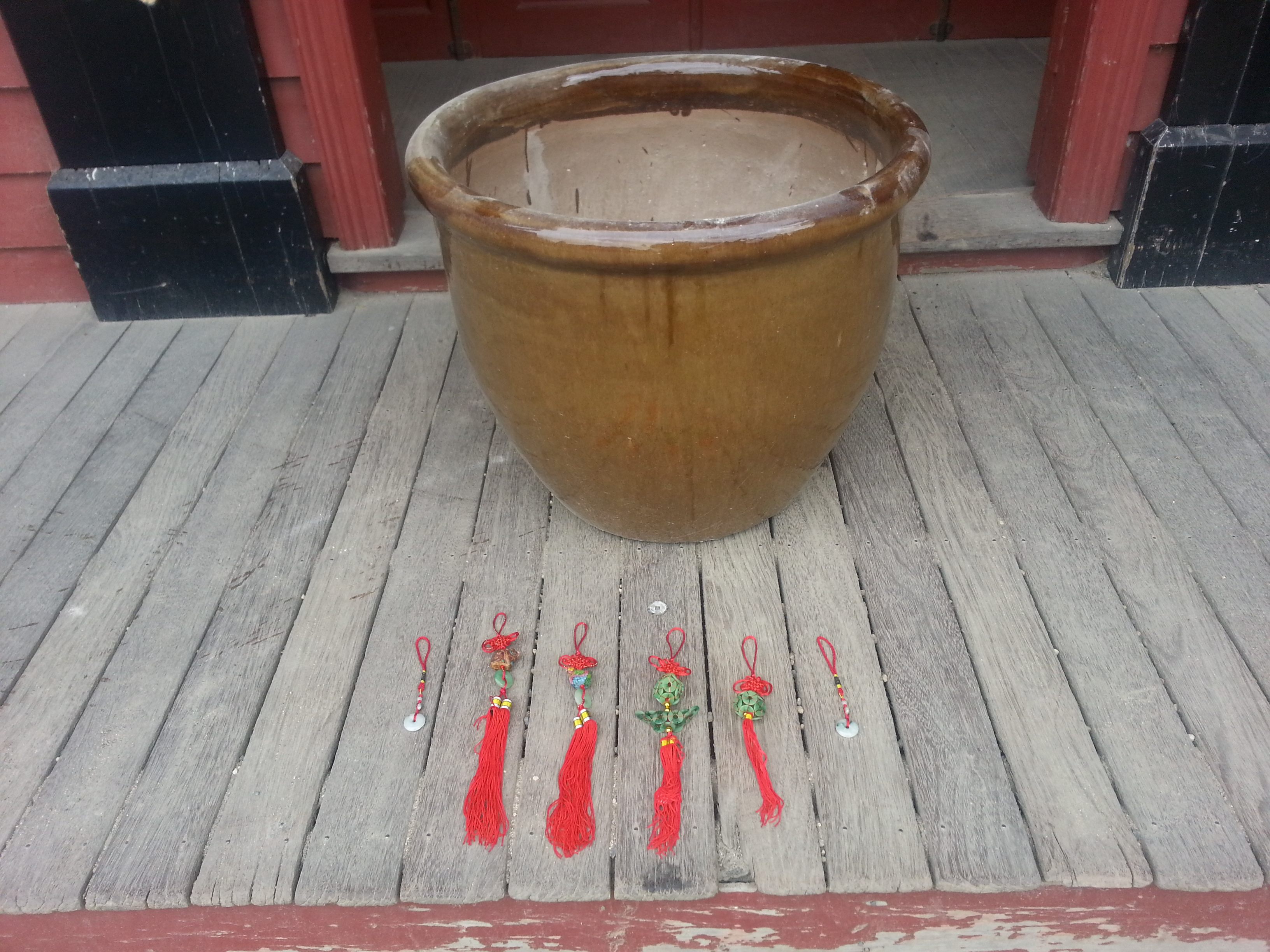
Pot for Incense burning with Jade talismans and a coin given to Charles with links to the Avoca Goldfileds. These will be carried on the journey.

Pot for Incense burning with Jade talismans and a coin given to Charles with links to the Avoca Goldfileds. These will be carried on the journey.

Regular details, stories & photos will be posted on the Chinese Australian Cultural Society Ballarat website: www.chineseballarat.org.au and Ballarat Community Radio Station 99.9 Voice FM: www.voicefm.com.au. We will also attempt to keep this post updated with information about the progress of the walk.

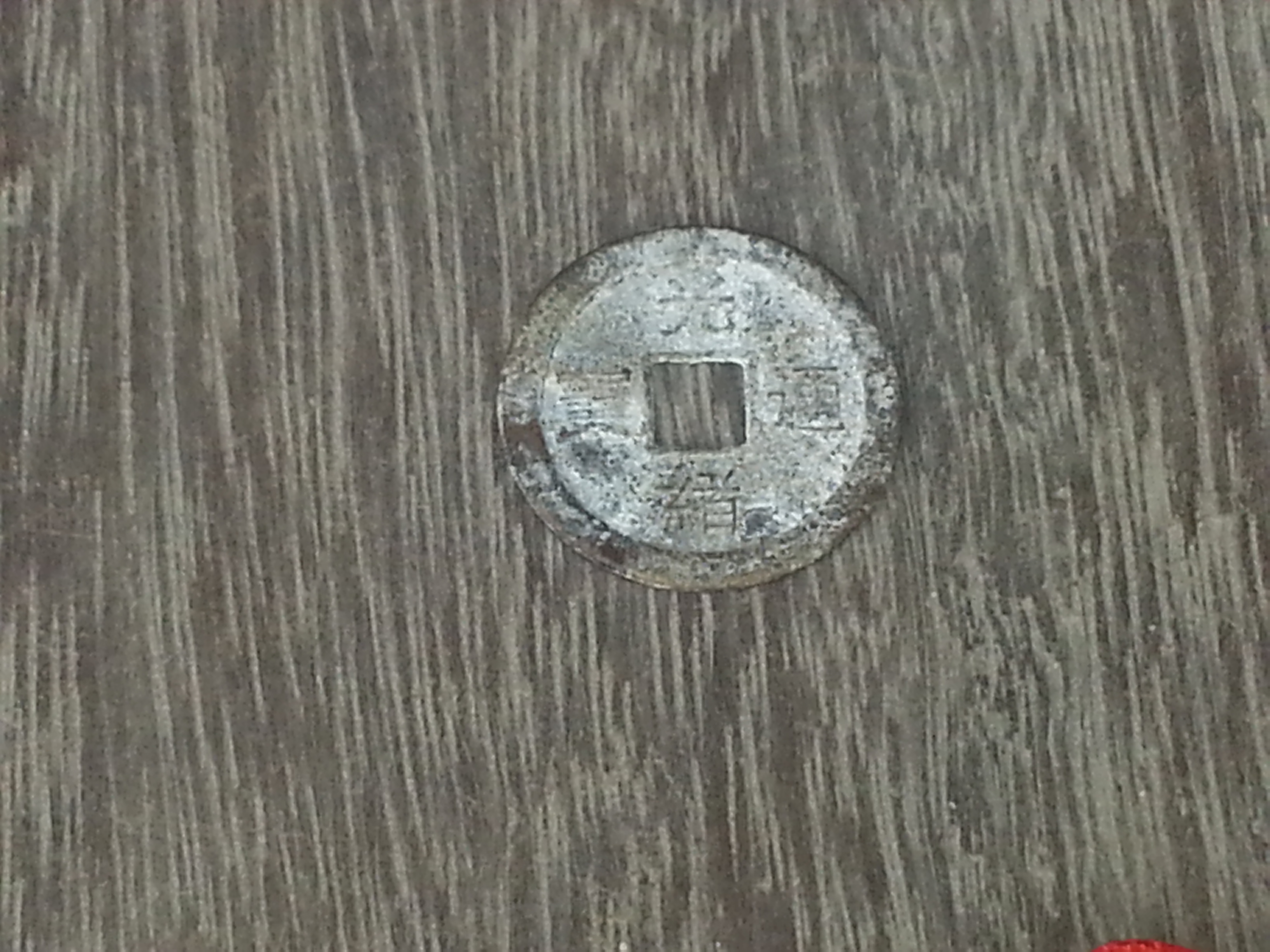
Chinese coin from Avoca

Chinese coin from Avoca

So keep coming back to follow our intrepid adventurers on their special voyage.

**Historical Note**

The Chinese were forced to travel overland from South Australia, due to an immigration tax imposed on them by the Victorian Colonial Government. The Government were concerned by the numbers of Chinese travelling to the goldfields, and tried using taxes to stop immigration from China. You can read more about this at Heritage Australia and our previous blog: Racism and Taxes: Life for the Chinese on the Goldfields

Continue reading

Goldfields Immigration

Ballarat’s Scottish Heritage

This blog post has been summarised from notes by Sovereign Hill’s senior historian, Dr Jan Croggon on the Scottish in Ballarat. We would like to thank Jan for her contribution and hope she has more to share with us in the future.

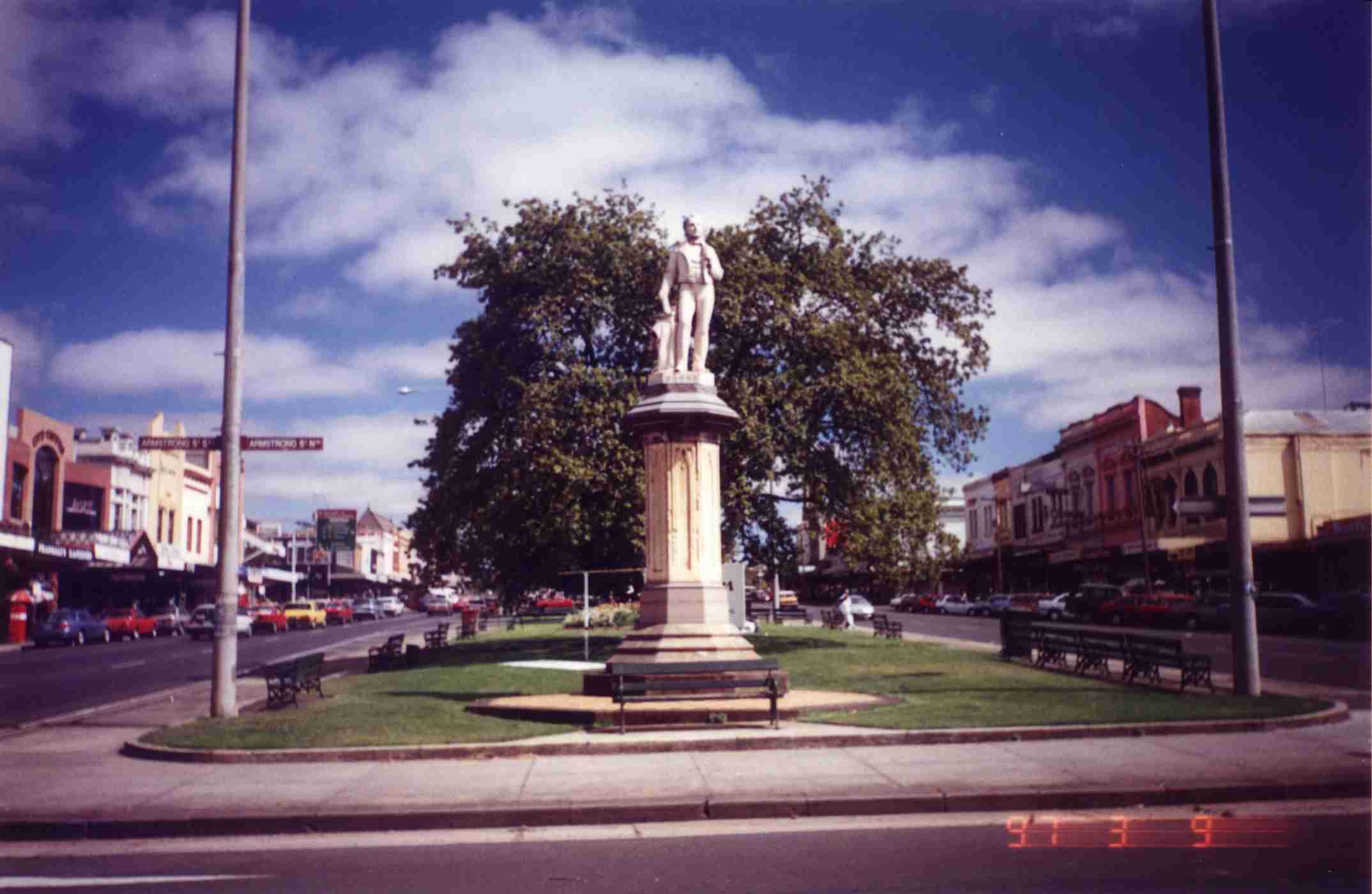
Statue of Robert Burns, Scottish poet. Sturt St Ballarat

Statue of Robert Burns, Scottish poet. Sturt St Ballarat. Gold Museum Collection

Nineteenth century Scotland was at the heart of the massive Industrial Revolution which transformed Britain, and which largely created the population pool which travelled to the Antipodes in search of gold and a new life.

EMIGRATION TO AUSTRALIA

The characteristics of the Scots who emigrated to Ballarat can be understood more clearly if regarded in the light of the world from which they came. Poverty, famine and epidemics in Scotland in the 1820s and 1830s caused the first significant Scottish emigration to Australia. Victoria was the most popular colony in which they settled. Scottish squatters and rural workers established farms, and urban settlers worked as skilled artisans and professionals.

In the Victorian census of 1854, Scots were the third largest group after the English and Irish, with 36,044 people. Within three years a further 17,000 had arrived, many hoping to make their fortunes on the goldfields. Immigration assistance schemes also swelled the number of Scottish arrivals. By 1861 the Scotland-born population of Victoria reached 60,701 – the highest level it would ever reach.

Continue reading