Author Archives: sovereignhilleducation

The Environmental Impacts of the Gold Rush

If we compare our environmental footprint to that of those who lived here during the gold rush, it’s easy to think they were gentler on the environment than us. During the 1850s the vast majority of people travelled about on foot, while modern Ballarat is a city of cars. Much of the food they ate was produced locally (mutton) and organically (using human or animal excrement as fertiliser on vegetable gardens) while we eat food with huge food miles, the production of which relies on intensive farming practices. Today, most Australians shower every day, which would have been unheard of in the 1850s; bathing only occurred once a week – if that! – in Victorian times, as clean water was often scarce. Life was simple and more environmentally harmonious before the Industrial Revolution got into full swing here in Australia, right?

Let’s look at the evidence.

Environmental change began in Ballarat when squatters established sheep runs across Victoria after 1835. The millions of sheep which fed on Victoria’s lush natural grasslands during this time not only destroyed much of those grasslands, they also caused the near-extinction of the Myrniong Daisy – the staple plant food of the local Aboriginal people. The Myrniong, which has an edible, nutritious tuber all but vanished within three years following the introduction of sheep.

The second wave of environmental change in Ballarat occurred as a result of the discovery of gold in 1851. According to research undertaken by Dr Fred Cahir, the early miners knew their work to be “the great despoiler of nature” (Black Gold: Aboriginal People on the Goldfields of Victoria, 1850-1870, 2012, p.118). During the time when surface (alluvial) gold was easy to find, Ballarat was quite literally turned upside down by the diggers. In addition to this, waterways quickly became polluted by the mining itself and by the miners living nearby. Trees were cut down to house and warm the miners, but also to use as timber in the mines.

William Howitt wrote that “The diggers seem to have two especial [sic] propensities, those of firing guns and felling trees. It is amazing what a number of trees they fell.” (Land, Labour and Gold, 1855, p.176-7).

In 1852 the artist Eugène von Guérard, wrote:

Just a year since my arrival at Ballarat, and how changed it all is in that short time. Stretches of fine forest transformed into desolate-looking bare spaces, worked over and abandoned. In many parts, where a year ago all was life and activity, there now is a scene of desolation. At the same time the population has enormously increased, and there is less and less chance of having a lucky find… (Smith, Documents on Art and Taste in Australia: The Colonial Period 1770-1914, 1975, p. 119).

Ballarat Flat from the Black Hill - 1857

S.T. Gill, Ballarat Flat from the Black Hill, 1857, Gold Museum Collection.

Ballarat’s forests, soil composition, waterways, and air quality were all profoundly impacted by the post-1851 population boom and the mining practices of these immigrants. Further evidence of this can be seen in the two drawings by Samuel Thomas Gill. “Ballarat Flat from the Black Hill” shows a vast, largely treeless plain with only small tufts of grass between the mounds of unearthed clay. The purpose-built cart in the background of “The Splitters” suggests the considerable size of the timber industry by 1864.

Splitters

S.T. Gill, Splitters, 1864, Gold Museum Collection.

The photo “Black Hill and Railway” by William Bardwell shows Ballarat’s light-coloured clay which is here excavated and piled up in enormous mounds which loom over the centre of the city.
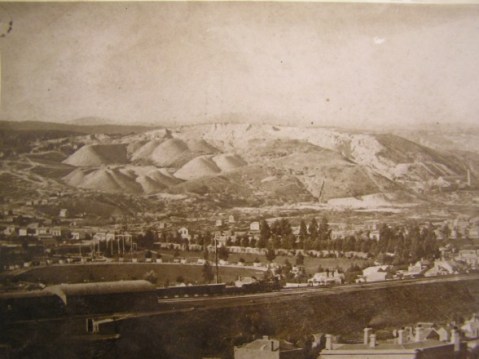
Black hill and Railway - 1874

W. Bardwell, Black Hill and Railway, 1874, Gold Museum Collection.

The Black Hill area was the only site in Ballarat where open-cut mining was practiced. Although not visible in this image, the principle waterway in Ballarat, the Yarrowee River, runs along the bottom of this clay moonscape and was used for steam production and washing (to separate gold from soil) by the Black Hill Quartz Mining Company pictured on the far right. Fortunately, Black Hill has now been completely reforested by trees which hide much of its ugly upturned history. Similarly, the photo “Llanberis Mine” shows a damaged landscape, silted water (on the left) and air pollution resulting from the introduction of largely wood-fuelled steam boilers which powered the mines from the 1860s onwards. In the steam powered stamper batteries, quartz rock was crushed into powder to extract the gold. This process not only consumed a lot of trees and water, it also utilised dangerous chemicals like mercury and cyanide which no doubt lingered in the landscape for a long time.

Llanberis Mine, Ballarat - 1906

Llanberis Mine, Ballarat, 1906, Gold Museum Collection.

The city of Ballarat was built as a direct result of this environmental damage, but to a degree the wounds on the landscape have healed. Trees in backyards and public parks have brought wildlife back to the city, and the Yarrowee River now has a great walking track along it which takes people past lovely bush areas and relics from our mining history. The people of the Ballarat gold rush left a much more visible mark on the environment than us, but are we really doing a better job at caring for nature? What will be written about our treatment of the environment in 150 years?

Links and References:
Cahir, Fred. Black Gold: Aboriginal People on the Goldfields of Victoria, 1850-1870, ANU Press, 2012: https://press.anu.edu.au/publications/aboriginal-history-monographs/black-gold

Goodman, David. Gold Seeking: Victoria and California in the 1850s, Allen and Unwin, 1994, http://trove.nla.gov.au/work/9718935

Howitt, William. Land, Labour and Gold, Cambridge University Press, 1855, http://goo.gl/UmMvAU

Smith, Bernard. Documents on Art and Taste in Australia: The Colonial Period 1770-1914, Oxford University Press, 1975.

On the Myrniong Daisy – http://en.wikipedia.org/wiki/Microseris_lanceolata

On the Myrniong Daisy – http://www.bundianway.com.au/yamfields.htm

Eugène von Guérard, Warrenheip Hills near Ballarat 1854, oil on canvas on plywood, 46.0 x 75.5 cm, National Gallery of Victoria, Melbourne – http://www.abc.net.au/news/2011-05-03/eugene-von-guerard-warrenheip-hills-near-ballarat/2702474

A similar blog on the environmental impact of gold – http://www.sbs.com.au/gold/story.php?storyid=124

Goldfields Immigration 3

The Irish influence on Ballarat

Gentlemen and savages – Men of Ballarat and fellows of Bungaree” These were just some of the inflaming words spoken by the controversial Victorian politician C. E. Jones, at a political meeting in Ballarat, 1864. Jones was attempting to trade on the popular Old World idea of the Irish as lower-caste, illiterate and priest-ridden trouble makers who were intent on lowering the standards of this new society in Ballarat. In fact these ideas about the Irish presence in Ballarat were completely inaccurate.

The Irish were the second largest national group (the largest being the English), to influence the history of Australia during the gold rush and colonial periods. From 1851 to 1901 the percentage of the population considering themselves Irish remained at around 20%. Most of these immigrants came from the southwest counties of Clare, Tipperary, and Galway.

Continue reading

Goldfields Immigration: Part 2

The Jewish contribution to Ballarat’s History

Ballarat Synagogue, cnr Princes & Barkly Streets, Ballarat. Gold Museum Collection.

Ballarat Synagogue, cnr Princes & Barkly Streets, Ballarat. Gold Museum Collection.

“Hidden away in plain view”, that is how many people describe the location of the Ballarat Synagogue. On the main tourist route from Melbourne to Sovereign Hill, a large stone structure on a bend of road near the East Ballarat Fire Station, hints at a connection to a Jewish community in Ballarat. In fact there have been people of the Jewish faith involved actively in Ballarat’s history from the beginning of European settlement here.

Continue reading

The Goldfields Police

This post was inspired by an inquiry from a Year 9 student. Thank you Arron.

The origins of public policing

Propelled by the discovery of gold, the nature of policing in Victoria changed dramatically during the 1850s. These changes aimed to develop a united professional police force, based on a model of civil policing introduced in London by Sir Robert Peel in 1829.

The introduction of Peel’s model of civil policing is now seen as a great leap forward in law and order. At the time, Peel’s model was controversial because it took the responsibility of policing away from local control and placed it in the hands of the government. The British public feared a police force used by the government to keep itself in power.

London Police Uniform 1829

London Police Uniform 1829

To help people accept this new form of policing, Peel’s model had several developments. These included police having no weapons except a concealed club and a rattle to attract attention; trying not to accept men of military rank or influence within the Government; and applying methods of crime prevention, rather than punishment. Police were assigned to a particular district, which was then divided into beats. A policeman would get to know his beat, and this would help him detect crime. Regulations and manuals regarding civil policing duties were also published.  The distinctive police uniform functioned to make people aware of the police presence and minimise accusations of police acting as spies.    Police were also ordered to be civil towards all members of the public. This civility extended to the point of accepting ridicule without any argument. You can read more about the development of Peel’s police here.

Continue reading

Alcohol on the Goldfields

Where and what did diggers drink?

This blog was inspired by a speech given by our CEO, Dr Jeremy Johnson in April 2010 at  the University of Ballarat Beer Awards. The speech was based on research done by Sovereign Hill’s Senior Historian, Dr Jan Croggon. The speech was recorded and an audio file is available at the end of this blog.

The problem of alcohol and young men

Diggers of low degree, S. T. Gill. Gold Museum Collection

“Diggers of low degree”, S. T. Gill. Gold Museum Collection

The colonial government of Victoria was incredibly worried about alcohol on the goldfields. The population of Victoria before 1860 was mainly young men, and the authorities were concerned that over indulgence in alcohol could lead to a breakdown in law and order in the colony. For that reason an act was passed to prohibit alcohol from being sold on the goldfields. This act allowed for harsh penalties if you were caught manufacturing or selling liquor.  A first offence carried a £50 fine, whereas threatening with a pistol might only incur a fine of £5. The Act was policed by plain clothes men, who were given half of the £50 fine for a first offence, and then, because a second offence brought months of hard labour, and no profit for the police, they resorted to blackmail, taking £5 whenever they felt like it.

Continue reading

Books for Teaching History – The Phoenix Foundry: Locomotive Builders of Ballarat. The History of a Ballarat Engineering Company.

The Phoenix Foundry: Locomotive Builders of Ballarat. The History of a Ballarat Engineering Company. By  Bob BUTRIMS & Dave MACARTNEY.

Here at Sovereign Hill we are in an enviable position as we are able  to portray the beginnings of the Industrial Revolution in Australia. Our museum contains the best collection of working steam engines in Victoria on permanent public display. Because of this we have developed several online education resources and face to face programs designed to support  teachers and students studying this period of Australian history. We are continually searching for more material to help our understandings of this subject.  Recently we discovered a new book focusing on Phoenix foundry bookone of the key foundries which grew from the gold rush period of Ballarat’s history. Marion Littlejohn, one of our Education Officers, has reviewed this book, which we feel would be a useful addition to any year 9 reference library for Depth Study 1 – the Industrial Revolution.

Continue reading

Weird and wonderful goldfields history. Part 2

 Weird People

Diver_smallIn this blog we continue our research behind the weird and wonderful activities created for our school holiday program. The last blog focussed on our animal stories, this post is about the people of the goldfields and the weird but true stories of their lives on the Ballarat goldfields.

Continue reading

Weird and wonderful goldfields history. Part one.

Animals

TigerDuring the Christmas school holiday period this year Sovereign Hill has focussed on some of the strange but true stories of the Ballarat gold rush period. These have included stories about a deep sea diver, zebra, tiger and diggers dressed as women.  As entertaining as these weird and wonderful stories have been, we must remember that as a museum it is our responsibility to be as accurate in our portrayal of goldfields’ history as possible.

ZebraFor that reason all of these activities had to have some basis in fact, and this makes the stories even better. In this Blog we will explore two of these activities and the amazing true stories that they are based on.

Continue reading