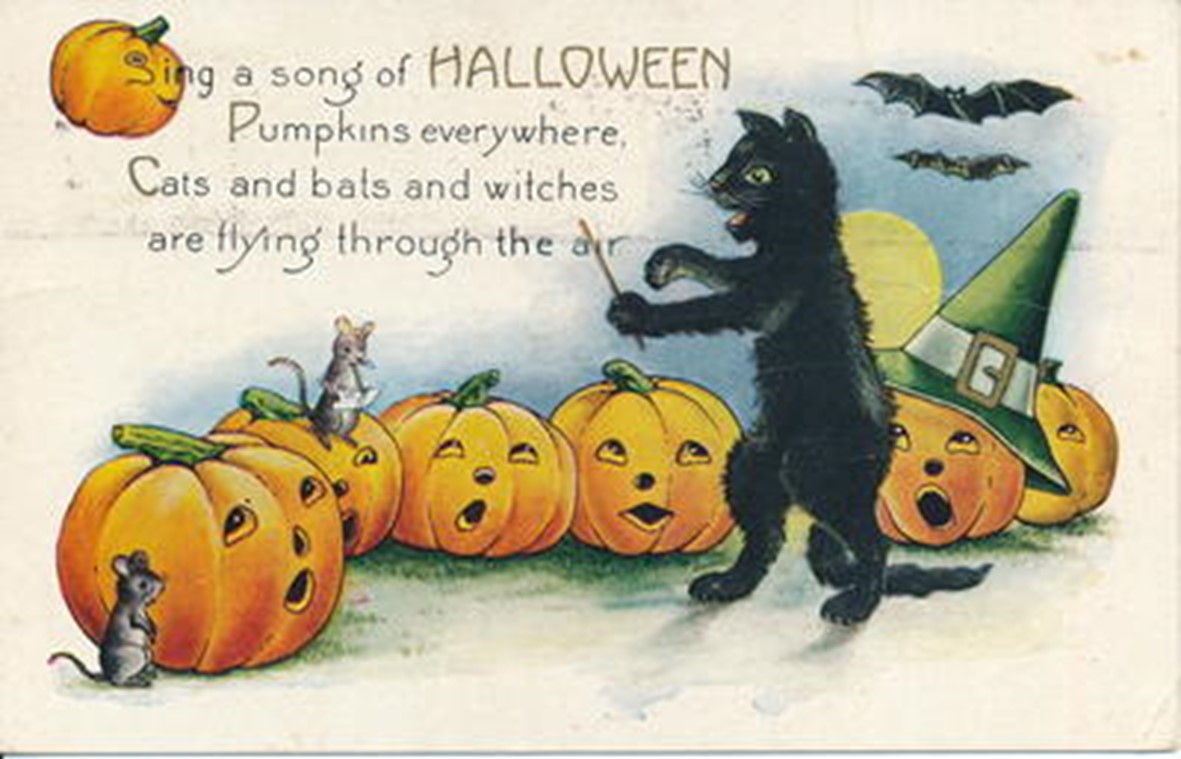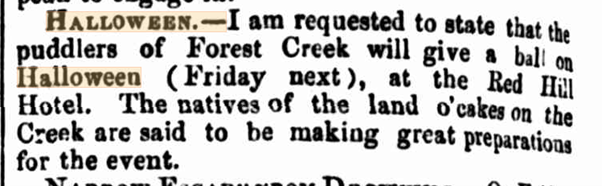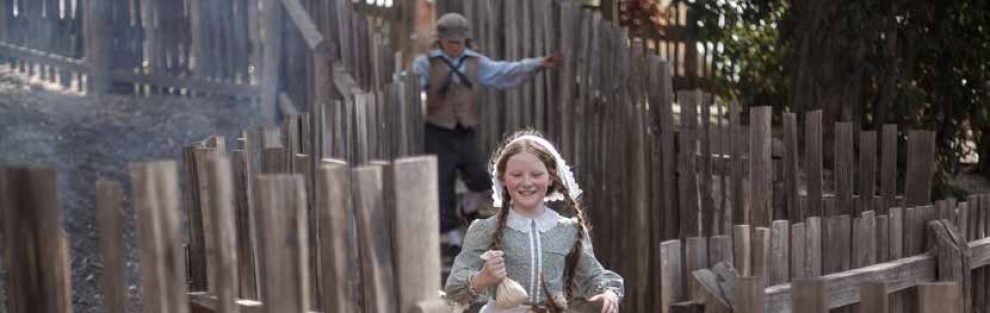
Hallowe’en is often considered a recent addition to Australian celebrations, imported from the United States. However, Halloween’s roots go back thousands of years to Celtic traditions in Ireland and Scotland, and here in Australia to the nineteenth century.
All Hallow’s Eve adopted the Celtic festival of Samhain, which celebrated the end of summer and a thinning of the line between life and death. As the season turned and the days started to get shorter and darker, it was incorporated into the Christian calendar with All Saints (All Hallows) Day. By the early nineteenth century, many of the traditions we associate with Halloween were firmly entrenched. Carved vegetables, like turnips, were used as rough lanterns for celebrations in the dark and sometimes carved with faces to scare off evil spirits. People would dress up to confuse wandering spirits; children in costume would wander from house to house in costume receiving offerings of fruit or nuts and sometimes singing or reciting poetry in return. This was known as guising, today it is known as trick-or-treating. Bonfires and fortune-telling were common practice, and Queen Victoria herself was known to love the Halloween festivities at her Balmoral property in Scotland.
83.3948
In the mid-nineteenth century, we saw the mass migration of large numbers of Irish and Scottish people around the world, estimated at 90,000 people, including to Australia. Driven by the potato famine, disease wiped out potato crops in Ireland and Scotland leading to widespread starvation in rural communities, and land clearances, the forcible eviction of cottage farmers to enable large commercial farms, along with the lure of gold large numbers headed to the colony of Victoria. In the 1854 Victorian Census, the largest migrant group, after English and Irish, was the Scottish.
In moving to a new country our Scottish migrants brought with them many traditions from home, food, music, and festivals. These traditions became really important in maintaining a connection to family and culture from the other side of the world. Scottish, or Caledonian Societies sprang up across Victoria as a way of connecting with people. They were an important part of community-building. From our Caledonian Societies, we get one of our earliest references to Halloween being celebrated in Australia.
If you attended a Halloween ball in 19th-century Victoria, you would likely enjoy music, dancing, and traditional Scottish country dances. One popular dance was the Flying Scotsman, inspired by the famous steam train.
Watch the video to learn the steps to the Flying Scotsman, or view the written instructions HERE
Poetry reading.
The work of Scottish poet Robert Burns was very popular. His poem, Halloween, which covers many of the folk fortune-telling, match-making games was adapted into a ballet that toured the gold field towns to great enjoyment. His poems include a mix of Scots and English dialect. Can you read a stanza?
Among the bonny winding banks, Where Doon rins, wimplin' clear, Where Bruce ance ruled the martial ranks, And shook his Carrick spear, Some merry, friendly, country-folks, Together did convene, To burn their nits, and pou their stocks, And haud their Halloween Fu' blithe that night.
Try writing a poem inspired by Robert Burns?
Inspiration: How to do poetry like Robert Burns
Trick or Treat.
Practice guising (trick or treating) by taking turns presenting poems to classmates.
Here is some inspiration for your poem from our own Scottish community on the diggings of Ballarat sourced from the Centre for Gold Rush Collections. Break the classroom into 4 groups and allocate an item to each group to work on a poem either as a group or individually. Use the following prompts to help identify the artefacts.
Create a list of describing words (colour, shape, size)
Create a list of sensory words (sound, taste, smell, feel)
What makes your thing unique? (scratches, repairs, stains)
Word association (what else does it make you think of?)
Piece of embroidered linen with the alphabet, and flowers in cross-stitch. Name embroidered: Jane Patterson. Jane Patterson migrated to Ballarat from Scotland in the late 1850s. She married Phillip Waterson in 1860. A 12-year-old Jane made the needlework sample in 1854 when she was in school in Scotland.
A long chain of three intertwined strands composed of human hair held at intervals by Gold clips. Link join has a small wooden pipe attached which contains 4 views of Scotland. Hair comes from Donor’s Aunts in Scotland.
Wooden rolling pin ridged for making Scottish Oatcakes. This belonged to Mathilda Lang who came to Australia in 1855 in the Sailing Ship The Star Of The East to join her husband in Ballarat, bringing with her their five children. Her husband Thomas Lang built a house at Warrenheip and had extensive nursery gardens there till they moved to Melbourne in about 1869. He came to Australia in The SS Great Britain in 1854 from Kilmarnock, Scotland. [Thomas’ story ]
Small leather purse with a short leather strap. There is a brass clasp and the front is decorated with stars of mother of pearl and a brass stud in the centre. Purple paper lining, with a leather light tan colour body for a purse. It is Worn by Jane Patterson who migrated to Ballarat from Scotland in the late 1850s. She married Phillip Waterson in 1860. An 18-year-old Jane drove in a bullock dray from Ballarat to Buckley & Nunn’s in Melbourne where the dress was made. Purse worn on the belt of the wedding dress (83.4664) expandable with concertina sides.
If you were to travel to a new home far away, what traditions would you take with you?
Pioneer Women. ACGRC: 78.707, Courtesy of Sovereign Hill Museums Association & Ballarat Historical Society Collection
At Sovereign Hill we are often asked about the experiences of women in the past; in particular, limitations on their dress, behaviour, education, and job opportunities as compared to men. Values, beliefs, and even some science of the time promoted the idea that men and women were inherently different and that this then justified their different treatment and access to opportunities. STEM (Science, Technology, Engineering, Mathematics) fields in the nineteenth century provide us with stories of amazing women, who were engaging, inventive, inquisitive, and pioneering in their respective fields.
MADAME ELIZABETH CHARPIOT: Daguerreotype
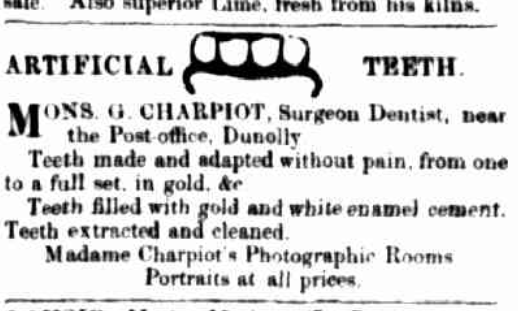
Elizabeth Henwood, with her younger brother and sister, arrived in Port Phillip Bay aboard the Barque Velore in 1853. They made their way to the Victorian goldfields where in 1855 Elizabeth married George Charpiot, a watchmaker and dentist. It is unclear where her training or equipment came from but by 1856 Elizabeth had set herself up as a photographer, perhaps one of the earliest female photographers in Australia. Within her husband’s jewellery and dentistry business, she had a set of photographic rooms. The Ballarat Star, whose offices were opposite the business commented on her skill:
A daguerreotype is the first form of commercial photography. A silver-plated copper plate was treated with a light-sensitive material that reacted when exposed to light. The plate was developed and fixed in a chemical bath, so it was a unique, single image. Our collection includes several examples of daguerreotypes like the style that Elizabeth was producing. The daguerreotype below is carefully mounted and beautifully framed. The lady is wearing several pieces of jewellery and carefully holding a book open – why do you think she chose to include a book in her picture?
If you had your picture taken, would you wear anything special? What one special object would you want to be included?
“Unknown lady with book” daguerreotype, 19th century. ACGRC: 2014.1392
When the Charpiot’s moved to Dunolly, both continued their businesses; Madame Charpiot’s portrait services were regularly advertised alongside her husband’s dental business.
A few years later they moved again to the goldfields town of Tarnagulla. On New Year’s Day 1868, their business caught fire and was destroyed. Most of Elizabeth’s photographic equipment was likely lost and it would seem she never returned to professional photography after the fire.
EADY HART: Inventor
Eady Hart, ACGRC: 06.0577
Eady Hart arrived on the goldfields in 1854 as a six-year-old, with her family seeking gold. She became a dressmaker and married engineer William Hart. It seems to have been a difficult marriage and William deserted Eady and their eight children. Eady was remarkably resilient, she supported the family, including six foster children, with her sewing and millinery skills, then taxidermy, then an innovative fire-lighting product. Eady was curious and innovative and turned her attention to dyes. In her small kitchen, she experimented with native plants, like grass trees, to produce a beautiful range of natural dyes – useful for fabric and foodstuffs. Here she met with great technical success. Thirty years of experimenting led to the formation of Hart’s Royal Dyes in 1921. In our collection, we care for a number of her recipe and sample books, along with patent applications and business correspondence.
What is a patent? Why would Eady need a patent for her idea?
Eady had to solve various problems with her experiments. She needed to figure out what colours different plants produced, what was required to make the colour stable and stick to fabric, and whether the ingredients were safe to work with when mixed together. She also had to ensure there were enough ingredients to make lots of dye, and that the recipes were repeatable for others to follow.
Sample page in Eady Hart’s scrapbook. Accession Number 06.0576
People loved the colours Eady created; she won awards for her colours and her dye-making process. Newspapers were filled with reports of her wonderful discovery and for seeing the Australian bush as a sustainable resource: “Mrs. Hart says she has barely tapped on the possibilities of our vegetation. The glory of the Australian bush is not yet known … Mrs. Hart regards as criminal the ruthless cutting for firewood and building purposes valuable timber that should be producing priceless dyes”1
EUPHEMIA BAKER: Artist & Photographer
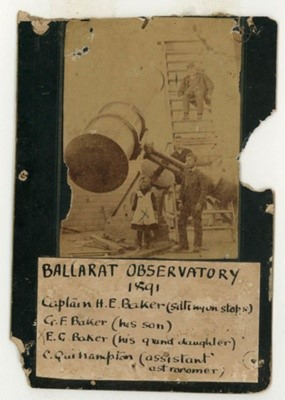
For Euphemia Baker, the move to Ballarat as a young girl to live with her grandparents opened to her the world of the Ballarat Observatory and the technology of the camera. In our collection we have a photo of young Euphemia “Effie” Baker with her grandfather, Captain Henry Baker, who ran the Ballarat Observatory, standing beside a large telescope. A retired sea caption, Baker was a master instrument maker, and his daughters grew up around the telescope and observatory. Access to this world inspired in them a love of looking at life through a lens for art and science.
Ballarat Observatory 1891, ACGRC: 163.80
His daughter Elizabeth Baker became a photographer and astronomical assistant at the observatory, down the road from where Sovereign Hill is situated in Golden Point. In 1896, the Ballarat Star noted that Miss Baker had taken charge of the observatory, the meteorological equipment and was contributing to international research projects and winning awards for her astronomical photography2. When her young niece, Effie, came to live with the family she gifted her a camera and mentored her in photography. Both Elizabeth and Euphemia were noted for their photography, including photos of the moon and stars taken through the telescope.
Where do you find inspiration?
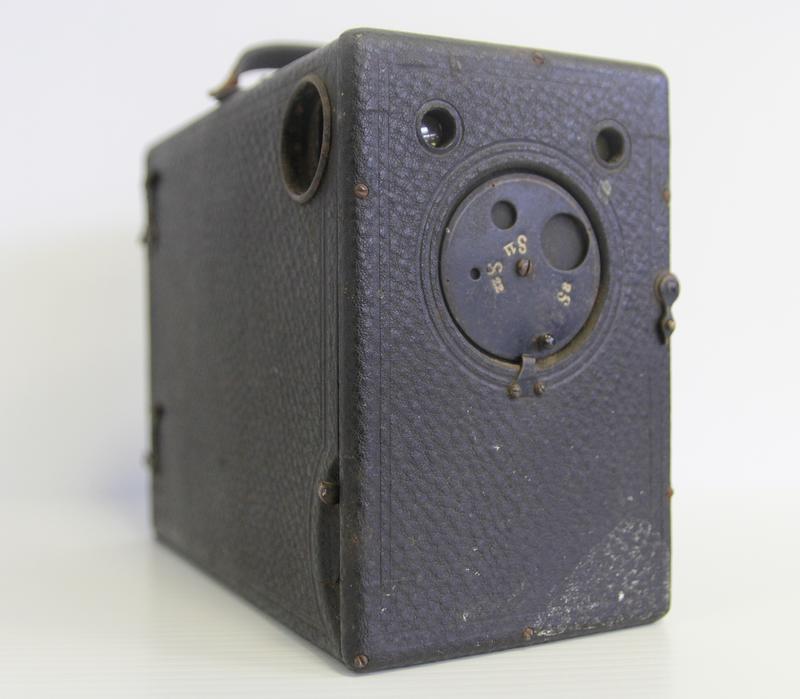
The Goldrush Centre holds several early cameras, including this quarter-plate camera, perhaps similar to the one gifted to Effie, and the camera belonging to astronomer Mr John Brittain, who lectured in astronomy at the Ballarat School of Mines.
Quarter-plate camera, unknown maker and age, ACGRC: 2014.0204 Camera belonging to Mr James Brittain c. 1890s, ACGRC: 78.0442
DR. GRACE VALE: Doctor
Were women treated equally in science and medicine?
As a founding member of the Victorian Medical Women Society, one of the first female graduates from medical school in Melbourne, and then the first woman public vaccinator (in 1910), Dr. Vale became both a doctor and an active public figure in Ballarat, including being highly active in the suffrage movement to give women the vote. She was present for the first X-rays experiments at the Ballarat School of Mines.
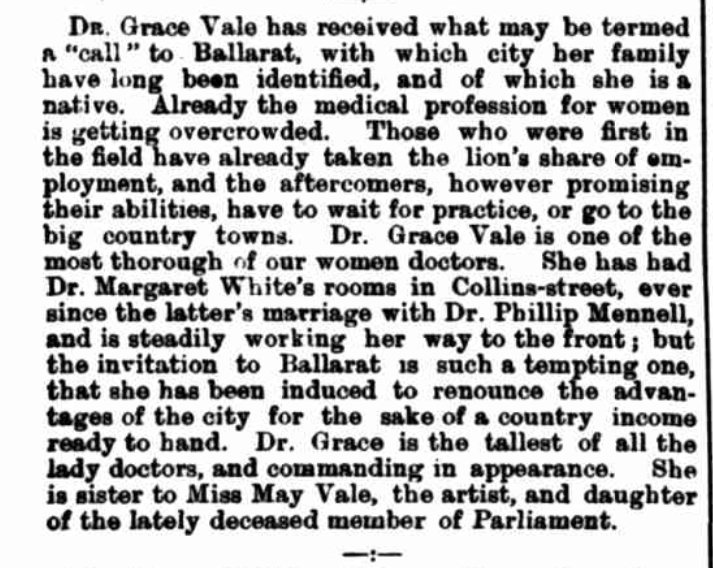
The article below gives a hint of the medical environment in which Dr Vale worked. The “medical profession for women” suggests that only part of the profession is open to them and they are always described as “woman” or “lady” doctors specifically. She has been working in the practice of another woman doctor, Margaret Whyte with whom she had graduated. Her appearance, rather than her abilities, becoming the focus of newspaper articles. In closing remarks, she is described as “the tallest of all the lady doctors, and commanding in appearance.”
Dr Vale used her position to lobby throughout her career for the rights of women. She was active in advocating for free or low-cost healthcare for female factory workers in Melbourne, she was elected to the Ballarat City Board of Advice and spent much of her career as a Medical Officer for schools in Victoria and NSW.
These four stories are amongst many examples of resilient, adaptable, and curious women on the goldfields. But this is just the beginning… what stories can you find? Do challenges still exist today for some groups wanting to enter STEM fields and how can we learn from these pioneers in the past?
In 1851 and 1862 Victoria produced 27,770,666 troy ounces of gold (over 800 tons), valued at about 110 million pounds at the time. The gold produced during this time was highly prized and would often be melted and transformed into different objects. Objects made from gold could include – coins, bullion, gold leaf, jewellery and even gold teeth!
Gold has been used in the making of jewellery Before Common Era (BCE) and has for many people, been seen as a symbol of wealth. Gold, being a rare metal, dominated the appearance of jewellery in the 19th Century. The gold being taken out of the earth in Ballarat from 1851 meant that by 1855 jewellery shops were appearing on the Ballarat landscape. Two men, who arrived from England, seized this business opportunity and opened a jewellery store, called Rees and Benjamin within Ballarat. You can visit Rees & Benjamin on the Main Street of Sovereign Hill to purchase jewellery.
Miners Brooch (1850’s) (GM07.0047)
The jewellery designs in the 1850’s reflected mostly the English style. However, jewellery being made in Ballarat could also take on a uniquely Australian design of flora and fauna and even mining. One lady on the Ballarat goldfields during this time, Lola Montez, who was a stage performer, was sometimes given gold jewellery by gold miners during her on-stage performances. One gold brooch given to Lola, as a token of appreciation in Melbourne in 1855, was then later sold by her, during her travels around San Francisco (America) a year later.
Before the mid-1850s, gold was a desired resource and usually only the wealthy could afford to have jewellery pieces, made from gold and other precious materials, handmade by a jeweller. However, largely due to the gold rush and the Industrial Revolution (creating a new emerging middle class of wealth), jewellery was becoming more affordable and popular. The Industrial Revolution made the manufacturing of jewellery more cost-effective and attainable for other levels of society. The invention of electroplating (metal coating) during this time was ideal for making inexpensive jewellery, that more people could afford to buy.
One of the great influencers of jewellery fashion in the 19th Century was Queen Victoria. Her reign as Queen on the British throne went from 1837-1901. During that time, she had great influence over the world’s fashion, including jewellery. Much like social media influencers today, Queen Victoria made a societal impact on the jewellery and fashion trends during the time she reigned. Examples of popular styles of jewellery in the mid-19th Century included lockets, rings, large bangles, brooches, crosses, and necklaces. Jewellery such as earrings were also fashionable in the Victorian era. Queen Victoria had her ears pierced when she was fourteen years old and one of her painted portraits shows her wearing dangling earrings. Wearing lots of jewellery before the mid-19th century for very young girls was frowned upon. However, ladies would wear large and chunky jewellery as well as delicate bejewelled pieces.
Locket with hair (GM 2012.0446)
Jewellery fashion in the 19th century was a little bit different compared to our jewellery today. Queen Victoria had a favourite piece of jewellery that she wore – a locket that contained her husband’s (Prince Albert) hair. Queen Victoria also wore and gave her children jewellery made from hair. In fact, a lot of jewellery of that time was made from hair, teeth, and animal claws. Prince Albert even designed a brooch for Queen Victoria that included their first daughter’s, Vicky, first milk (baby) teeth!
Another trend Queen Victoria made popular was that of receiving an engagement ring before marriage. Prince Albert gave Queen Victoria an engagement ring that was in a snake (serpent) design, with its tail in its mouth, entwined. In Victorian times this design symbolised eternal love. The snake design and many others would become popular amongst jewellery designers due to Queen Victoria.
In 1861, when Prince Albert died, Queen Victoria began wearing black jewellery, called mourning jewellery. This was mostly made from Whitby Jet (fossilised coal found in Whitby, England) and started a trend that lasted until around 1890.
Whitby Jet Jewellery(GM 84.2010)
Did you know?
The ‘Welcome Nugget’, a substantial gold nugget dug up in Ballarat in 1858 was eventually sold to the British Mint and melted down to make minted gold sovereigns coins. The coin, on one side, would have held an impressed image of Queen Victoria on its obverse.
Prince Albert also designed a brooch for Florence Nightingale. (Florence was named as such due to her being born in Florence, Italy).
Sea coral was popular and used in jewellery during the Victorian Era.
During the Paris Exposition of 1855, a life-size portrait of Queen Victoria was made completely out of hair!
People in the 1850s on the goldfields in Ballarat remained physically active differently to today. Today, people count their steps and go to the gym to keep active. School children keep active by playing sport and have Physical Education classes at school. In the past, mid-19th Century people had a very different lifestyle. Home duties and tasks to be completed around the home were unpaid work, and mostly completed by the women and older children in the household. Home duties were arduous and what was often considered ‘women’s work’, they required strength and resilience, especially when the 1850s household duties required hours upon hours of manual labour. Forward to today and groups in society are still calling for pay parity and equal opportunities.
Today, accessing clean noncontaminated hot and cold water in our home is as simple as turning on a tap. In the 1850s, if you weren’t wealthy, there were no taps in your house and no plumbed water. Most often children would have to collect the water with buckets, from the nearest water source. For many families, this could be downhill and a distance from your house. During the winter months collecting water closer to your home may have been easier with the seasonal rain, however, accessing water in the summer dry months, would have been physically exhausting. Collecting water would mean having to walk heavy buckets filled with water to your house.
Think about everything you need and use water for in your daily life – drinking, bathing, brushing your teeth, washing clothes, watering the plants, and cooking. Even the simple task today of washing the laundry would be physically demanding. The current average washing machine (7.5 Kg) uses about 64 litres to do one wash. Imagine now if you had to bring all that water up from the creek before you could start the washing. It could take up to 189 litres or 17 buckets to do a load of laundry in the 1850s. Washing clothes in the mid-1800s was hard and laborious work. It wasn’t as simple as placing laundry into a washing machine and placing the laundry on the washing line to dry. Instead, it was a time-consuming and tiring process. The laundry would first be soaked in tubs of water overnight. The next day, the laundry would be soaped, boiled, or scalded, rinsed, wrung out, mangled, dried, starched, and ironed, often with steps repeating throughout. This could have been done up to three times. Laundry would be scrubbed up and down on a washboard, by hand.
Laundry was sometimes dollied (this would mean using a wooden dolly that you would turn by hand – pictured above right) for 45-60 minutes (this is like the oscillation or turning process your washing machine does today). The wringing of laundry (getting rid of excess water out of material) was sometimes done first by hand and then squeezed through a machine called a mangle (pictured above left). The mangle required each piece of washed laundry to be squeezed or wrung through, piece by piece, it was also hard to turn, manually by hand. This would have caused a lot of sore arms! The wet laundry could be put through the mangle up to four times (the final fourth time would be before it would be hung out on the washing line outside, to dry).
At home in the 1850s, ironing traditional fabrics without electricity was also a hot, arduous job. Irons had to be kept immaculately clean and polished. Irons in this era did not have temperature controls like they do today, constant care was needed not to scorch material. The iron, depending on which one you were using, could weigh between 2 and 6 kilos requiring a lot of heavy lifting.
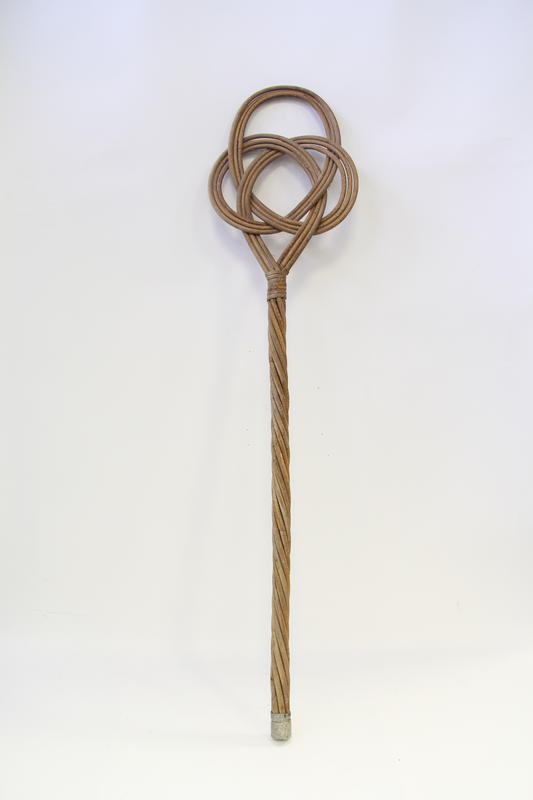
(GM Carpet beater; 06.0064)
Keeping the floors of a home clean in the 1850s was another task that was physically requiring muscle power. Today in our homes we have automatic vacuum cleaners that can be programmed to go around the home via a mobile phone app. However, in the mid-19th Century, sweeping floors, and beating rugs, and carpets would be done by the women of the household. In the 1850’s not everybody could afford expensive rugs, so many would make their own rugs out of scrap pieces of material (called rag rugs). Even a small rag rug would keep your feet warm getting out of bed on a cold morning! If people were fortunate enough to own rugs, cleaning such carpets or rugs was no easy task. To clean the rug/carpet you would take the rug outside, hang it over a fence, and then beat it with a carpet/rug beater (a handle and large flat paddle, usually made of cane-shaped in a knot). This was sometimes done twice a day.
A lot of physical work was required in the 1850s to make daily food. There were no takeaway meals and no microwaves in the mid-19th Century. For some, there would be a local shop nearby that would provide essential staples (e.g. flour, sugar), but there were no supermarkets or mass pre-packaged food items for convenience, like today. The food was not pre-packaged and there were no refrigerators, as we know them today. Therefore eating seasonal produce was essential. Women of the household, to ensure there was enough food and variety in their family’s diet would pickle foods such as tomatoes, piccalilli, and chutney. To make a preserve could take 3 hours over the stove. These preserves could be kept for months (no use by dates or best before in the 1850’s).
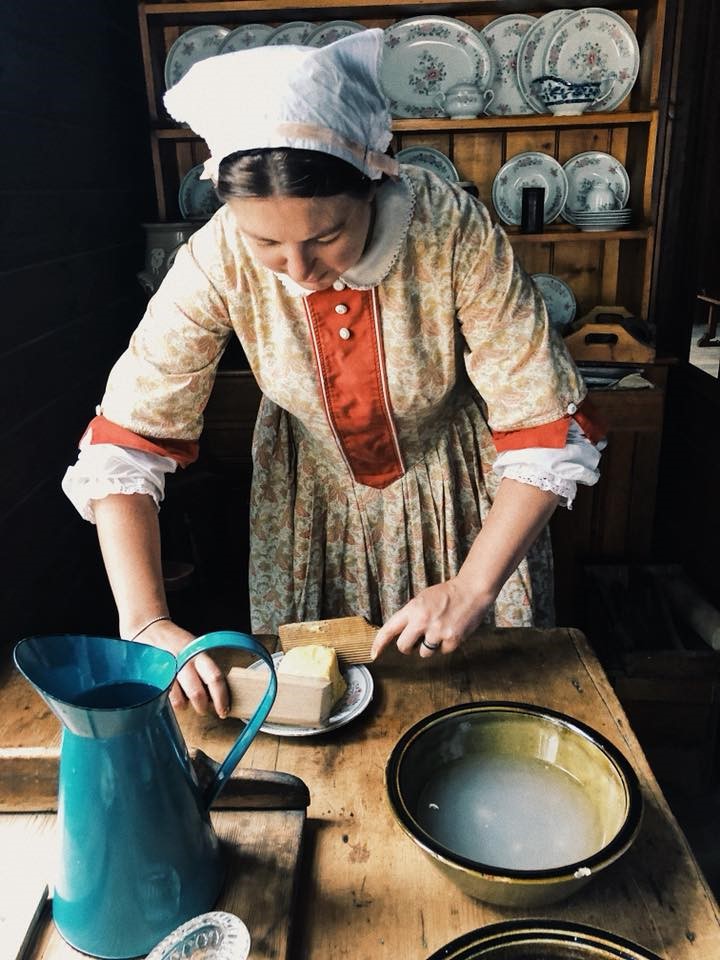
Other domestic physical work that had to be done daily would have included feeding animals and looking after them (chickens for eggs and cows for milking). One labor-intensive home duty could include making the family’s butter. Butter could be purchased from the store; however, many families saw this as expensive and would make their own. The process involved milking the family’s cow and allowing the milk to stand on its own overnight until the cream rises to the top. The next step would be to skim the cream off the top, place it into the butter churner, and turn it by hand. This would take approximately around 20 minutes of vigorous turning to turn into butter. Not to be forgotten household work by women and children would be foraging nearby areas for extra food, cleaning the house, garden maintenance, and emptying the chamber pot (toilet).
Interesting fact – Midway through the 19th century, Dr. John Snow discovered that cholera was being transmitted through unclean water. However, putting chlorine in the drinking water, so drinking water would become safe to drink, would only begin in the early 1900’s.
or, “don’t” for that matter as we never “clip our words”
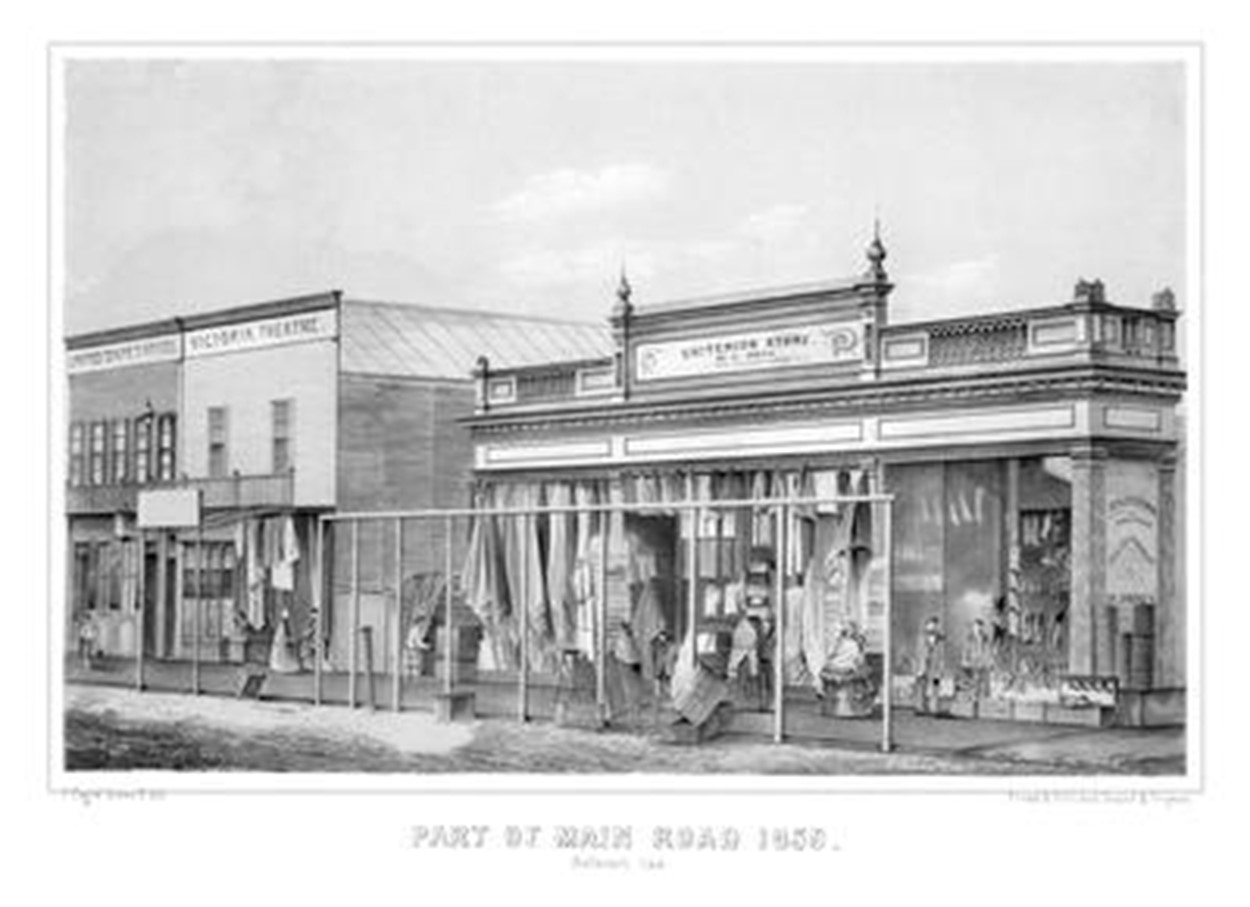
François Cogné 1859 (78.2403) Ballarat’s middle class shopping on Main Road, Ballarat East in 1859
In welcoming you to the nineteenth-century world of Sovereign Hill one of the first things you may notice, after the clothing, is the way we speak to each other. We will greet you with “Good Morning” or “Good Day”, never “hello”. Why is this?
“Hello” is just emerging in the late nineteenth century as a form of greeting, earlier versions of ‘hullo’ or ‘holla’ were not in common use as greetings, they were informal shouts for attention. Could you go a whole day without saying “hello”? In fact, it will take a big technological shift, the telephone, to change our use of ‘hello’. Telephones change the rules of communication when you cannot see the speaker on the other end. Legend has it, Thomas Edison championed “hello” (telephone inventor Alexander Graham Bell preferred “ahoy”)[1] as a useful greeting.
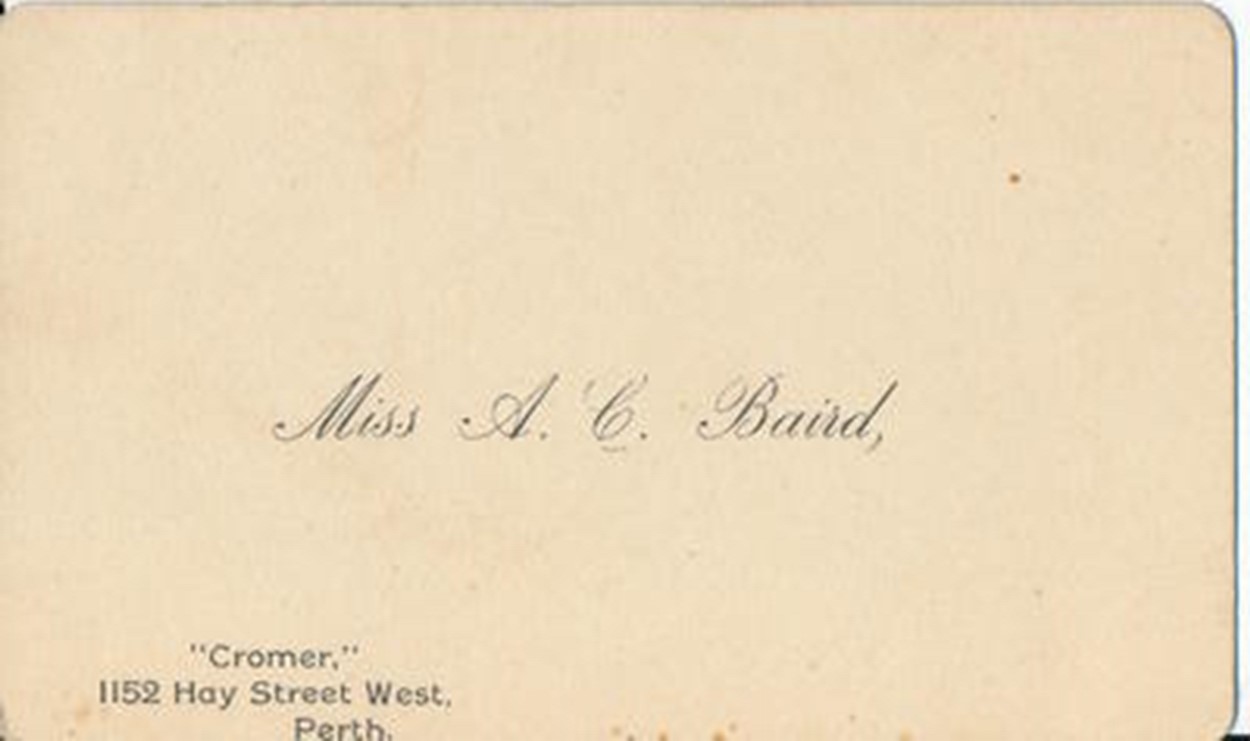
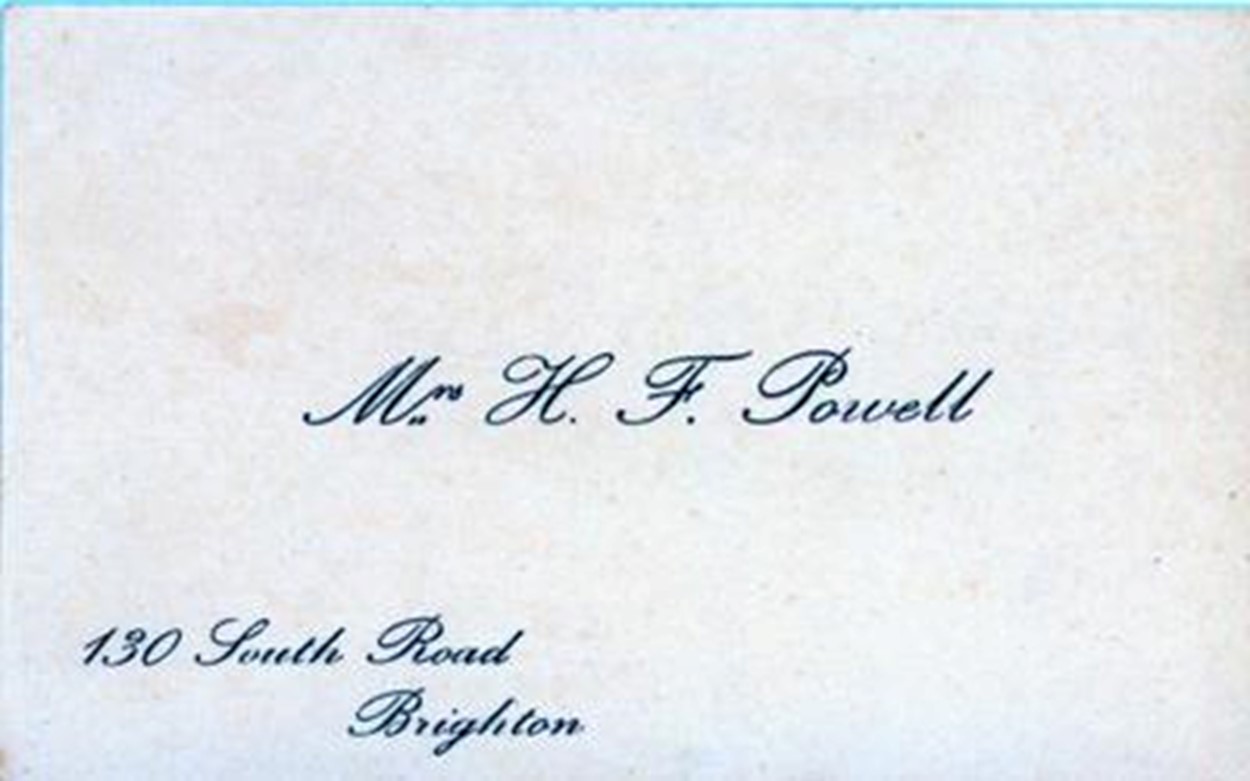
Before telephones, letters and calling cards provided introductions. You would leave a card, with your title and name, as an invitation to speak. We have several examples of these visiting cards in our collections. How many cards you left, whether you left a message on the card, or perhaps bent a corner of the card all sent a message to the recipient. It told the recipient you were home, that you were accepting visitors or that you would like to visit for example.
Is technology today changing the rules around who and how we behave when we speak to each other? Is this a good thing?
05.07292016.0352
In our pre-telephone world, there are very clear rules around how we look at each other (or don’t!), move around each other and speak to each other depending on our relative age, power, and how well we know one another. These rules of behaviour in society, called “etiquette”, are taught and practiced at home and at school. They are also published again and again in books of manners and our collection contains several examples.
The nineteenth century is a period of big and increasingly fast change amongst the societies from which many of our goldfield migrants come. This big, fast change is often referred to as the Industrial Revolution. Along with the advent of steam power and factory production, and the move from country life to city life came the rise of the middle class. The middle class was a group of people who did not come with titles (important family names and connections) or inherited power like the upper class, but who also no longer work in manual trades with little money, power, or education. This new group of people earn more money than it costs to live, have an education, and often professional jobs.
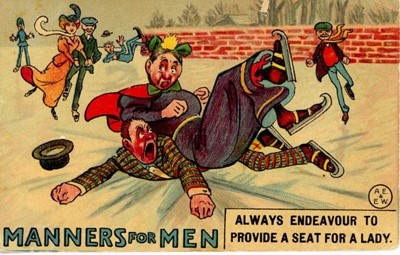
FitzGerald Postcard Collection (GM 83.16880)
The rules of behaviour are becoming a really important way of figuring out whether a person belongs in good society. In the dust and mud of the goldfields particularly it can be very difficult to tell if a person comes from the same background as you and fortunes are being made and lost very quickly. In a society used to organising people based on gender and social power, if you know and follow the rules you will have more opportunities to move up in the world. According to Australian Etiquette: Rules and usages of the best society, published in 1885, “He who does not possess them [good manners] … cannot expect to be called a gentleman; nor can a woman, without good manners, aspire to be considered a lady by ladies.”[2]
You may have noticed that our rules of behaviour are distinct for men and women. In the nineteenth century, there are very distinct understandings of what it means to be ‘male’ or ‘female’.
Here is a primary source example from The Bendigo Advertiser, 1859, where the writer is very upset that a Magistrate at a stone laying ceremony called the females present women and deliberately not ladies[3]. What an insult! The Magistrate’s Excuse? As an aristocrat (upper class) he should know better, but as a soldier (different social space) he may have rough manners. Appropriate titles are important and make a judgement on the person’s background.
What sort of words does the writer use that tell us how to identify a lady or gentleman?
Gentleman: by birth, education, gone through a college curriculum, conduct
Lady: gentler sex, fair sex
The idea that men and women are made differently, and therefore behave differently[2], shows in different expectations of men and women, including in good behaviour.
[2] Australian Etiquette, or the rules and usages of the Best Society in the Australian Colonies. People’s Publishing Company, Melbourne. 1885, p. 19.
Our good behaviour rules may seem unfamiliar to you, as a visitor, as how we interact with each other has become much more familiar and much more diverse in the twenty-first century. Do you have any classroom rules that you have to follow? Who made those rules? Are they different for boys and girls? Are they different for children and adults?
Meeting a new person is a good example of these changes. Our nineteenth century rules of etiquette say that we do not have to introduce someone. A formal introduction is like giving someone a good character reference for a job; if you have been introduced you must never ignore that person in future, it is very rude. Introductions must be done in the correct order: 1. Gentleman to the lady; 2. Younger to the older; 3. Inferior in social standing to the superior. Your social class decided who and how you spoke to others.
SOCIAL CLASS
PROFESSION
Upper Class – landowners and investors, no manual labour
Aristocracy Rich gentry Royals Military Officers Lords Wealthy Men/Business Owners (new to this class)
Middle Class – skilled jobs, white collar professions with no manual labour, very class conscious
Merchant Shopkeeper Bureaucracy – railroad, bank, government
Working Class – skilled jobs with manual labour, unskilled jobs, poor working conditions
Trades Factory work Labourers
*there was also an underclass of people in extreme poverty or “sunken people”
When you are introducing someone, you must use their title (which can let you know marital status, job, social achievement). Titles, and pronouns, are a great example of our changing society. We greet people by first name more often, may not use titles at all and our choice of titles and pronouns is expanding to become much more inclusive of different identities.
If you visit us, you may be greeted as “Sir” or “Ma’am” as an adult, or “Master” or “Miss” as a child, titles of respect in our time. It is respectful to greet a costumed person you meet with Sir or Ma’am. “Sir” is the title given to a gentleman whose name you do not know. “Ma’am”, short for madam, is the title for a lady whose name you do not know; it comes from the Old French for my lady. You must wait for the lady to look at you and nod a greeting first, before you speak to her, and if you are wearing a hat (which of course you would be in the nineteenth century) you would touch the side of the cap as you greet her. We do not generally shake hands when we meet new people; handshakes are more common between gentlemen, and we certainly do not high five. The high five will not be invented for another hundred years in our future.
Can you imagine how the rules might change again in the future? What do you think might be different about how we greet each other and what we call each other?
Sovereign Hill Museum’s Association’s outdoor museum is located on Sovereign Hill, where quartz mining began in 1860 by what became known as the Sovereign Quartz Mining Company. The ‘sovereign’ name was associated both with the British Crown and with gold.
A sovereign is a one-pound (value, not weight) gold coin. Much of the gold from the goldfields was sent to the mint to be made into these gold coins, initially in London and then to the mints of Sydney and Melbourne.
The museum cares for many collections including the Paul and Jessica Simon coin collection. This important collection includes a variety of sovereigns like these two examples.
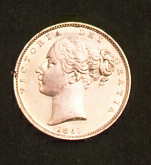
Gold sovereign coin (Edge Knock) featuring the bust of Queen Victoria on the obverse and the British coat of arms on the reverse. [GM 76.0107] 1851
Gold Sovereign Type 1 with bust of Queen Victoria on obverse and crown and wreath on the reverse. Made at Sydney Mint, one of the first Sovereign coins made in Australia. It was legal currency only in the colonies, you could not use an Australian Sovereign in Great Britain. [GM 76.0031] 1853
What is a pound?
As an immersive museum one of the things, you may notice as you explore Sovereign Hill are the changes in currency and units of measurement. Currency is the system of money, like paper bills and coins, used in a particular country. What we call our money and the look of our money have changed over time. Our miners were not using the same system of measuring or currency as we do today; there was no national standard of measurement as there is today. States within Australia determined their measurement systems independently, based on the imperial systems of weights and measures used in England. The need for a nationally standardised system of weights and measures was recognised as part of the Commonwealth Constitution in 1901. With Federation Australia became responsible for its currency – until 1901 Australian colonies used the British Pound but minted in Australia. The Australian pound was introduced in 1910 and in 1966 the Australian dollar.
Around Sovereign Hill, you may hear the term “pound” used both as a unit of weight and as a unit of currency. One pound weight (lb) is the equivalent of 450g (0.45 kg) in the metric units we use in Australia today. One pound currency (£) in today’s Australian dollars ($) is a little more difficult to compare. The relative value of one pound today can vary from hundreds of dollars to tens of thousands of dollars depending on what we are comparing. To understand the value of £1 today, we need to think about it relative to the cost of goods (what can you buy with £1 in 1852 and how much money would you need to buy the same things today) and relative to the average wage (how much would a person be paid in their job).
We currently use the approximate figure that £1 would have the buying and social power of $1000. But, where did we get this figure? Below are two examples of calculating the value of a pound that give us very different figures.
Compared to the Value of Gold
In the nineteenth century, the British Government adopted the Gold Standard. An economic system that matched the amount of money circulating (being used) in Britain to the amount of gold stored in the country. Gold has been highly valued for millennia so was considered a safe, stable resource on which to base the value of a country’s money. The value of 1 ounce of gold was set at £4.25 throughout the nineteenth century. As a British colony using British money at the time, we will use this value as our starting point.
1 oz gold = £4.25 in 1850
Currently (2022), gold is selling for approximately $2500 Australian per ounce.
2022 1 oz gold = $2500 AUD
We need to convert dollars to pounds to compare these values. Currently, 1 British Pound is worth $1.76 AUD.
($2500 / oz) / ($1.76/£) = £1420 / oz in 2022
This gives us a value of 1 oz, but we want the value of £1, so we are going to bring back our 1850 value.
(£1420/oz) / (£4.25/oz) = 334
Therefore, £1 in 1850 would be £334 in 2022. To understand this in Australian dollars:
£334 x ($1.76 / £) = $588
Using the changing value of gold £1 in 1850 is worth $588 in 2022. The price of gold changes daily, so this figure will not stay the same.
Compared to the Average Wages of the Miners
We have to consider that the average person in the 1850s had far less buying power than the average person today, even after having accounted for inflation (the changing cost of goods and services, CPI). The gold value above does not account for the changing cost of living (for example paying for food, rent, and clothing) or changing wages (how much you are paid for work). In 1851, at the start of the gold rush period, a married couple with a family likely has an annual income of between £29-35.
So, what does it mean to make a one-pound purchase if this is your household income – for example, a £1 / month Gold Licence? When you consider that, apart from Carpenters and Blacksmiths, most other jobs earned between £25-35 pounds a year, then one pound a month could be as much as a third if not almost half of a yearly wage (£12 / year).
In 2021 the average Australian weekly earning was $1328.90 or an annual salary of about $69 000 (https://www.abs.gov.au/statistics/labour/earnings-and-work-hours/average-weekly-earnings-australia/latest-release). As a very loose approximation, we can draw a comparison that if a third of $69 000 is $23 000 (this is our £12 / year figure), and one-twelfth of $23 000 is $1 919, then a £1 / month fee in 1850 in Ballarat would cost the wage-equivalent of $1919 Australian Dollars today.
Creating Connections:
Was a Gold Licence really expensive?
On the 1 September 1851 a fee of 30 shillings/month was introduced for a miner’s licence (there were 20 shillings in a pound) – all adult males on the goldfields were required to have one, whether searching for gold, finding gold, or not. By 1853 all persons (women, if they were prospecting, included) on the goldfields were required to have a licence and the fee had dropped to £ 1 / month or £8 / year. Reflecting on the relative value of a pound above ($588 or $1 919 current AUD) this was a significant expense. Following the events of the Eureka Rebellion in 1854, in mid-1855 the Miner’s Right replaced the Gold Licence and was purchased annually rather than monthly or quarterly.
A miner’s right is still required for fossicking or prospecting today, and it must be on you at all times when prospecting (even in your own backyard!). It currently costs about $25 and is valid for 10 years.
There are many great reasons to learn about the past, and that is why The Sovereign Hill Museums Association (SHMA) exists! We aim to “Connect people through our history to adapt for a better future” and “Provide meaningful, immersive experiences that tell stories of our humanity”. To support this purpose and mission, the Victorian Curriculum-aligned education programs presented by our Education Officers focus on learning through inquiry. Some of the key questions that guide our inquiries include:
Does the past make us who we are today?
Whose history is it?
What should stay in the past?
How has our culture changed over time?
Were we more sustainable in the past?
Being curious about where we come from helps us understand who we are today, and what our future might hold. Traditionally written History tells stories of individual people and societies from a specific point in time. However, interest in “Big History” (which places humans in a much longer story about the universe and the rise of life on Earth) is growing, as is the valuing of oral history traditions like those treasured by the Wadawurrung people – the Traditional Owners of the region on which this blogpost was written.
While History as an academic discipline has only existed for a couple of centuries, humans have explored themselves and their ancestors through historical stories for hundreds of thousands of years. A Greek writer by the name of Herodotus – who lived during the 5th century BCE – is thought to be the “father of HHistory” in the Western intellectual tradition, but the way we study History has changed much since then and will continue to change long into the future. When a capital “H” is used, the writer is referring to the academic discipline, while using a lower-case “h” indicates something that has merely happened in the past, e.g. “At university I majored in History” and “I like researching my family history”.
Below you will find descriptions of the onsite and online learning opportunities the SHMA makes available to students of all ages.
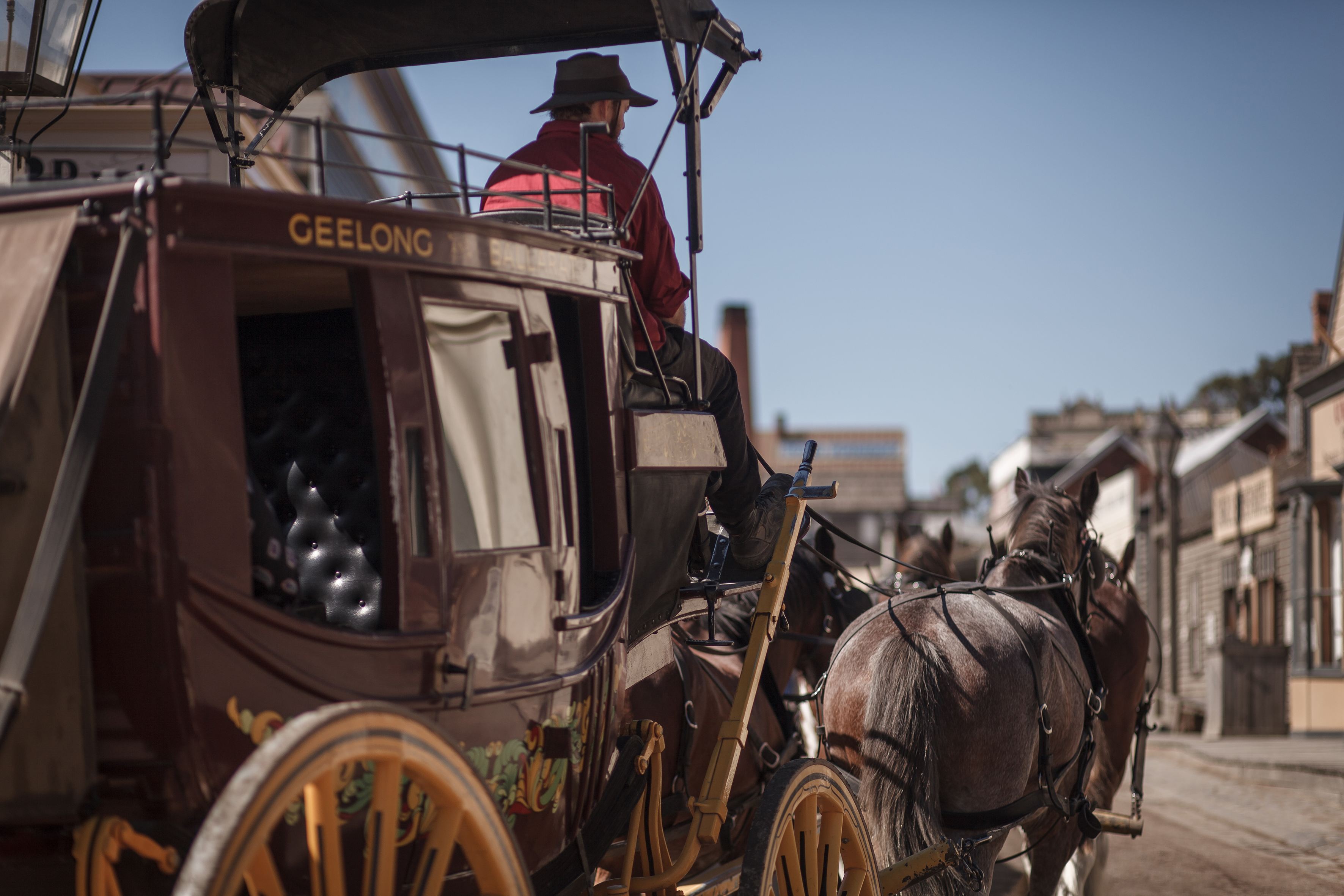
Students can learn about 19th century transport technologies through a ride on Sovereign Hill’s famous horse-drawn coach; we think experiential learning is the most powerful type of learning!
While SHMA’s Education Team enjoys reading and writing about history, we think one of the best ways to learn about the past is by immersing our visitors in it. This can involve getting dirty hands on the goldfields like a 19th century miner, exploring artefacts and past technologies with the help of museum experts, eating historical food, or interacting with interpreters in period clothing. The SHMA manages three sites to explore the history of both the Ballarat region and the State of Victoria:
The Sovereign Hill Living Museum (a historically-immersive timeline experience which tells the story of Ballarat’s famous 19th century gold rush through activated streetscapes),
Collections (the SHMA cares for more than 150,000 fascinating items which are used to tell the stories of Ballarat, the Victorian goldfields, and the extraordinary impact of the 19th century gold rushes had on Australia),
When teachers book class excursions/camps with us, our Bookings Officers help you personalise an itinerary that complements what your Foundation to Tertiary students are learning at school. Our Education Team can build rich learning experiences for students studying many topics and academic disciplines – from History to Science, English to Food Studies! We also offer special 1.5hr VCE masterclasses for Australian History, Geography, Business Management, and Health and Human Development students, which are becoming very popular. Most teachers choose one of these education programs for their class, and then add tours, demonstrations and self-exploration time into their itinerary. Discover the full list of exciting learning opportunities the Sovereign Hill Museums Association makes available to student visitors here. Teachers are also welcome to contact our team to discuss the development of a unique education session tailored to the needs of a specific class.
Many students go underground while visiting Sovereign Hill to learn about Ballarat’s “Deep Lead” and “Quartz” mining eras.
In the days before an excursion or camp, students can read blogposts and explore this “Student Resources” webpage. In particular, primary-aged students should watch this video to understand what to expect from a visit to the Sovereign Hill Living Museum. We partnered with ABC Education a few years ago to produce a “digibook” called The Colonisation of the Central Victorian Goldfields, which can also help students contextualise their visit and the stories the SHMA tells.
While onsite at the Living Museum, teachers can make use of the various resources listed on our “Teacher Resources” webpage.
After visiting, students can explore specific resources that relate to the contents of their education session, which are emailed to the teacher that makes the school booking.
Two excellent (and free!) SHMA resources that all schools should use to support learning about colonial Australia are:
The Sovereign Hill Museums Association works hard to bring History to life through both onsite and online experiences, and we hope teachers make the most of our organisation as an educational resource.
Handling artefacts = immersive and powerful learning. We think getting “hands-on” with history is the best way to explore the past.
When we consider the challenges that lie ahead for humans and our planet, it has probably never been more important to learn about how people in the past have tackled challenges, managed change, and made good decisions. We like this quote from the Australian History Councils’ “The Value of History” publication:
The study of the past and telling its stories are critical to our sense of belonging, to our communities and to our shared future. History shapes our identities, engages us as citizens, creates inclusive communities, is part of our economic well-being, teaches us to think critically and creatively, inspires leaders and is the foundation of our future generations.
Why do you think studying History is important? Please share your thoughts in the comment section at the bottom of this blogpost to get involved in the conversation.
In 1848, three years before Victoria’s gold rushes began, the shiny yellow metal was found in California which made the seaside city of San Francisco in the United States of America (USA) grow rapidly, much like Melbourne did after 1851. These two mining booms were similar in some ways but different in others. By comparing these two rushes we can explore what Victoria learned from California’s experience of rapid population growth and an ‘explosion’ in wealth.
Cradles were used in both gold rushes to separate rocks from gold. Left image: H. Sandham, The Cradle/California, 1883. Reproduced with permission from Library of Congress https://www.loc.gov/item/90713945/. Right image: S.T. Gill, Victorian Goldfields 1852-3, Cradling, 1869. Reproduced with permission from State Library of Victoria.
Similarities
Both of these gold rushes attracted miners from all around the world and in particular from Europe and China. The populations of these gold rush regions grew very quickly; 300,000 people arrived in California between 1848 and 1855, while Victoria’s population grew from about 80,000 in 1851 to 550,000 by 1861. Immigrants arrived by ship and then walked inland to the goldfields. These gold rushes also attracted ex-convicts from the British Empire’s penal settlements in Sydney and Hobart who had a reputation for causing trouble (but also became scapegoats when others caused trouble).
Sometimes goldrush immigrants worked closely with the local First Nations peoples to locate gold, food and water, while others were cruel and even violent towards the Aboriginal and Native American peoples of these two regions.
This wooden structure built over Sovereign Hill’s gold panning creek is called a flume. It diverts river water to where it is needed for mining work.
The same technologies were often used in both locations, including gold pans, cradles and flumes. The clothing the miners wore was also very similar from one place to another, as was the kind of imported food and medicine they typically used. The money that could be made from the trade of such goods often made business owners and merchants richer than the gold miners themselves in both ‘rushes’.
To protect the gold that was found on these goldfields, miners often carried guns and/or kept large dogs to protect their tents and huts (where they might store gold under their pillows or bury it under their beds). The site of a gold rush could be a dangerous place, and the police of the time faced a big challenge in maintaining law and order. This is why many miners took security into their own hands in California and Victoria.
Both of the governments responsible for overseeing these mining booms spent some of the wealth gold generated on building hospitals, schools and later train tracks and stations. However, most of the investment in services that cared for the sick and orphaned actually came from donations from wealthy individuals.
When the gold started to run out, new industries that were first promoted by mining helped to keep people from leaving both of these regions. Money made from gold was used to begin the industrialisation of both Victoria and California, supplying many jobs to those who had once been gold miners.
Left image: William A. Jackson, Map of the mining district of California, 1850. Reproduced with permission from Public Library of America. Right image: J.B. Philp, Map of the Roads to all gold Mines in Victoria, 1853. Reproduced with permission from State Library of Victoria.
Possible Similarities
It is argued by some historians that both gold rushes were encouraged by the respective authorities for political and economic reasons.
The state now called California was part of Mexico until the start of 1848, at which time the USA took possession of it following the Mexican-American War. The USA immediately encouraged people to start mining there because the fast-growing goldrush population would help the USA keep a claim on this region long-term; Mexico was not able to reclaim it with so many new Californians ready to fight to keep their gold (and the land it was found in). This delivered the USA both political and economic advantages in the short and long-term.
During this time, the British Empire was similarly eager to make what is now called Victoria a more permanent settlement, and did not want or need to make another penal colony (as they had in Sydney, Hobart and Perth). To grow the population and to secure their control of South Eastern Australia (mainly to stop it being colonised by the French who were also keen on empire-building in the Southern Hemisphere), the British Empire would need to attract free-settlers (much like the USA aimed to in California).
Just prior to 1851, Victoria was called the Port Phillip District of New South Wales (NSW); it was part of the Colony of NSW and consisted mostly of large sheep farms owned by Europeans. When the Colony of Victoria was declared in 1851 (which meant it would have its own government and be separate from the Colony of NSW), Governor Charles La Trobe set up a Gold Discovery Committee offering a £200 reward for anyone finding gold as a way to stop the flow of people to the new NSW goldfields. When it was announced that gold could be found in Clunes (33kms north of Ballarat) and Buninyong (12kms south of Ballarat), miners were encouraged to join the ‘rush’ in Victoria. Gold had already been found by Europeans in many parts of South Eastern Australia by this time (and Aboriginal people had known about it for thousands of years), but it was only after 1851 that colonial governments allowed the news to spread and goldrush immigrants were welcomed in Australia.
Other political and economic reasons some historians believe Australia’s gold rushes (in Victoria and NSW) were promoted from 1851 onwards include:
wanted to grow Australia’s European population to make it a more permanent military outpost and ensure the whole continent of Australia stayed in British hands (having learnt a painful economic and political lesson when they lost control of their American colonies in the American Revolutionary War, 1775–1783).
The industrial cities of England (such as London, Manchester and Liverpool) had filled to the brim with people, which made living conditions dirty and dangerous. Therefore, Britain needed somewhere appealing to send British subjects to live to ‘ease the squeeze’ at home.
It was hoped that Australia’s gold rushes would help the British Empire pay back its significant international debts, which it easily did (with a fortune left over which helped to fund the industrialisation of Australia). This enabled the British Empire to remain the world superpower until the mid-20th century when the USA took its place (mainly due to the economic stress caused by the two World Wars).
The British Empire thought they should reverse the Australian population drain that occurred when the Californian gold rush began – many European Australians (and some Aboriginal Australians) left after 1848 which impacted businesses like farms and merchant ships. The gold rushes in Australia encouraged many of these people to return to help make money for the British Empire through goldmining and trade.
Differences
Community leaders in Australia during the 19th century mining boom tried to copy the best aspects of the Californian experience, and avoid its worst.
Victoria’s gold licences allowed miners to ‘stake a claim’ (secure a patch of ground) which was not a feature of California’s early gold rush; this stopped many fights from breaking out on the diggings. One of the reasons (pre-Eureka Rebellion) gold licences were so expensive was because Victoria’s government needed money to support the fast-growing population with publicly-funded police forces, hospitals, roads etc. The high cost of Victoria’s gold licences was also designed to keep Europeans already working in Australia in their jobs, but regardless, many workers on Australia’s farms, ports and in hotels and shops dropped their tools and uniforms and headed straight to the diggings when news of the ‘rush’ began. In some ways, the gold licences probably made Victoria’s goldfields a bit more organised than the early years of California’s, however, their price was one of the main reasons the Eureka Rebellion happened, during which more than 30 people died. It could be said that while the Victorian government avoided some of the goldrush issues experienced by California, they created others through the way they chose to manage the goldfields.
The government wanted Australia’s gold rush communities to be much more polite and orderly than California’s, so along with supporting the population with roads, police etc. they also wanted to encourage women to come to the goldfields. Many Europeans at this time (such as social reformer Caroline Chisholm) believed women were a ‘civilising influence’ and could make goldfields safer and calmer. Victoria arguably did better at managing its new population in comparison to California in this respect. Interestingly, women on both goldfields had a level of social and economic freedom including being able to own businesses, which was not very common back in Europe at this time.
John Leech, Alarming Prospect: The Single Ladies off to the Diggings, Punch Pocket Book, 1853. Reproduced with permission from The Gold Museum, The Sovereign Hill Museums Association.
By exploring the way Victoria’s gold wealth was spent on new technologies and institutions the differences between the two gold rushes can be understood. While it took California nearly a decade to start spending its gold wealth strategically, Victoria got started straight away. By the mid-1850s, Melbourne had become one of the richest cities in the world thanks to gold. To prepare for the day the gold ran out, community leaders invested in what they thought would make Melbourne (and Ballarat, Bendigo, Geelong, Ararat etc.) as beautiful and ‘cultured’ as the great cities of Europe (London, Paris, Rome etc.). This is why many communities in Victoria that were built during the gold rushes feature large, beautiful, neoclassical stone buildings.
As a result of this, the State Library of Victoria (started in 1854) was built featuring huge Greek columns around its front entrance. In the 1850s it was one of the first free libraries in the world, encouraging the people of Victoria to educate themselves, and in turn, the generations to come. The University of Melbourne (founded in 1853) was the second university to open in Australia (the first in Victoria) and is today ranked among the best higher learning institutions in the world. The Melbourne Observatory (started in 1861) was developed to promote scientific research, and by 1869 it was home to the largest fully steerable telescope in the world. All of these investments – along with the State Parliament, Melbourne Town Hall, Melbourne Museum (now the largest museum in the Southern Hemisphere since it moved to its current location), General Post Office (in the Burke Street Mall – now home to a clothing store), and the Treasury Building – were created during this era to promote ‘high culture’ and keep new Australians in this country once with gold ran out.
Architect Joseph Reed, The Public Library, Melbourne, 1854. Reproduced with permission from Libraries Australia.
We can even thank the gold rushes and the wise investments the government made at this time for our sewerage pipes! California did not spend its gold wealth like this in the beginning, which caused many social and health problems for its residents.
While Victoria and California both had gold rushes, they were similar in some ways and different in others. Please add any other similarities and differences you learn about relating to these two ‘rushes’ in the comments below.