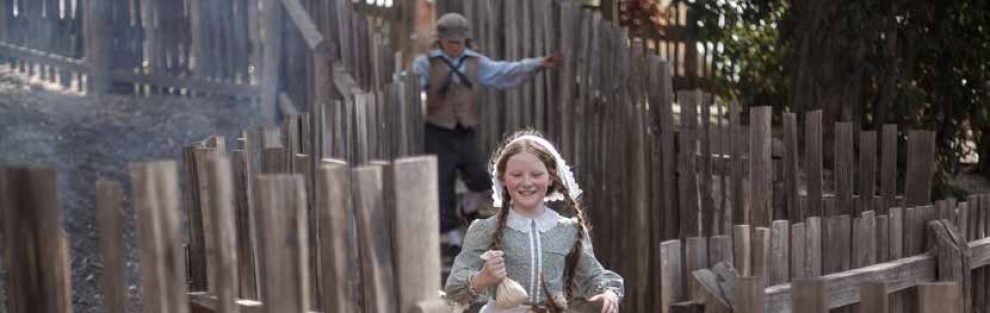

Ford Maddox Brown, The Last of England, 1855, reproduced with permission from the Birmingham Museum and Art Gallery.
Student visitors to Sovereign Hill often explore this painting during our education sessions because it can tell us interesting stories about the hundreds of thousands of people who came to Australia during the height of Ballarat’s gold rush. Painted by Ford Maddox Brown, it is entitled ‘The Last of England’. If we could, we would ask these people about the skills and ideas they are bringing with them to Australia, because these are the kind of people who shaped modern Australia into the country it is today. You can watch a source analysis of this artwork here. For better or for worse, European immigrants like these brought the Industrial Revolution, democracy, and a completely new agricultural system to this land ‘girt by sea’.
Let’s explore these imported skills and ideas in more detail.
Definitions:
- The Industrial Revolution is the name historians use to describe the period in history when humans radically changed the way things are made (approximately between 1750 and 1900). Instead of making things by hand, we started making goods more cheaply and in larger quantities by steam-powered machines. These new machines were also used to move these mass-produced goods (steam trains and boats revolutionised transport).
- Democracy means rule by the people in Ancient Greek. It is a system of government (a way to organise our society) in which all adult citizens get the opportunity to participate in decision-making (most commonly through voting in elections to choose someone to represent their community in parliament).
- Agriculture is an environmental management system that creates food, medicine and fibre for human use. While Australian Aboriginal people have been practicing agriculture for thousands of years, European colonisation brought a new system based on plants and animals that aren’t native to Australia.
Europeans realised there was gold in Victoria in 1851 at the height of the Industrial Revolution in Britain. In the same year Queen Victoria launched her Great Exhibition in London which showcased England’s new industrial technologies. Many of the six million people — equivalent to a third of the entire population of Britain at the time — who visited the Great Exhibition, were soon to join the mass migration to the Australian goldfields. They brought with them Industrial Revolution knowledge, experience and skills – many had ridden in trains, worked in factories, and believed that the ‘Age of Steam’ had made Britain the most powerful nation on Earth, and could have a similar impact on Australia.
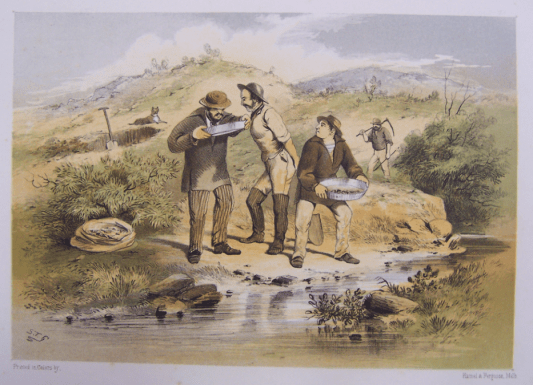
At the start of the Victorian gold rushes, only simple hand-held and often handmade technologies (like the ones in this sketch) were needed to find gold, but by the 1860s steam-powered machines were required to extract gold from deep underground. S. T. Gill, Prospecting, from The Australian Sketchbook, c.1865, reproduced with permission from The Gold Museum Ballarat.
After the Eureka Rebellion in 1854, the muddle of goldminers’ tents that people called ‘Ballaarat’ (a local Aboriginal [Wadawurrung] word for resting place) became a more permanent city. As the easily accessible gold started to run out, these immigrants began importing steam-powered machines from Britain so they could mine for gold trapped deeper underground. This meant that Ballarat’s mining changed from an individual occupation to a company (group) project, and helped to keep people here once the initial ‘rush’ was over. Without these technologies (which among other things pumped water out of mines and fresh air in, powered elevators, and crushed quartz to extract its gold) the Ballarat gold rush would probably have come to a grinding halt.
During the 1860s and 70s, many Ballaratians invested their gold wealth in local factories and foundries to build their own industrial machinery, such as steam engines and boilers. This meant that you didn’t have to wait a long time for your steam engine to arrive on a ship from the other side of the planet, you could instead purchase it (much more cheaply) from a foundry just down the road.
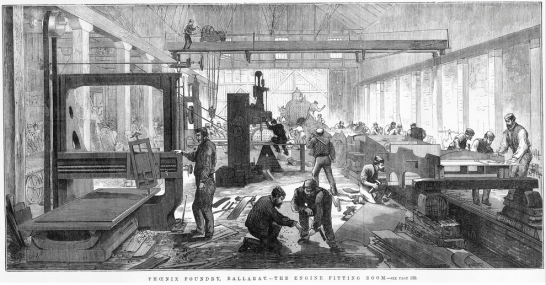
The Phoenix Foundry in Ballarat – capable of smelting iron to create steam engine components and steam trains. S. Calvert, PHOENIX FOUNDRY, BALLARAT. – THE ENGINE FITTING ROOM (where Target in central Ballarat is located today) 1873, reproduced with permission from The Gold Museum Ballarat.
Many Victorian towns had been built on gold by this time, but many withered and died as soon as their gold ran out, to the point that many are now ghost towns. However, Ballarat and Bendigo are major regional cities today, and although there are still gold mines in or near both, they do not rely on gold to continue to grow. So what are the things that decided whether a town would grow, survive or die after a gold rush? We think the answer involves the arrival of the Industrial Revolution in Australia.
The decision to change the local economies and jobs in these cities from mining to manufacturing, helped these cities to continue to grow and thrive. Immigrants with experience building railways, factories, foundries, and deep mines back in Britain used their knowledge and skills to start an Industrial Revolution here. Had it not been for the gold rushes, it may have taken much longer for such steam-powered inventions to arrive in Australia.
By 1900 the Ballarat region was dotted with steam-powered machines, and the people who lived here enjoyed mass-produced and therefore cheaply-made goods. Much came from local factories, but as steam trains and ships were making product transport much faster and safer than people had experienced before, buying things from overseas became easier than ever. Tractors and other farm technologies, along with introduced plants and animals (such as wheat and sheep) were also industrialising the way food, fibre and medicines were produced, and because we could support a growing population with jobs and food, modern Australia started taking shape.
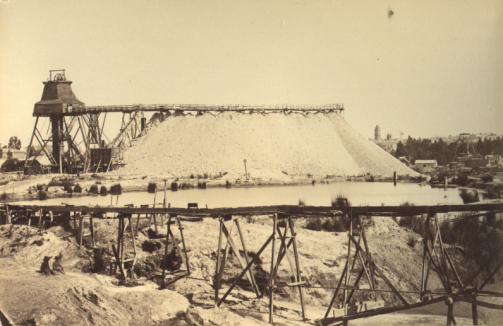
An example of a (steam-powered) company quartz mine in Ballarat. F. Kruger, Queen Mine (near Black Hill, Ballarat), 1887, reproduced with permission from The Gold Museum Ballarat.
Australia’s Industrial Revolution did have some significant environmental impacts which should be explored – namely in the way it required lots of trees to be chopped down to burn in boilers (local wood was also used to build houses and line mineshafts). This deforestation devastated local forests and caused the localised extinction of many plants and animals. Due to advances in industrial mining and transport technology, when wood couldn’t be regrown fast enough to replace what was being burned/built with, Australians started burning coal to produce power instead (once huge quantities of it were discovered). Read more about the environmental impacts of the Victorian gold rushes and Australia’s Industrial Revolution here.
While democracy – like the Industrial Revolution – was on its way to Australia one way or another, it is often argued by historians that the gold rushes and the Eureka Rebellion helped it get here faster. You can read more about this here.
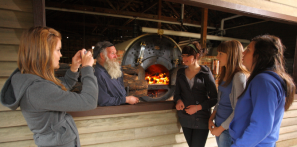
Some Year 9 students learning about the arrival of steam power in Australia and visiting many of Sovereign Hill’s related museum exhibits through the education session entitled ‘The Industrial Revolution in Australia’.
In summary, we think that Australia’s Industrial Revolution was likely sped-up by the gold rushes. If you would like to visit Sovereign Hill to learn more about this topic, we offer an education session for students entitled ‘The Industrial Revolution in Australia’.
Links and References
Wikipedia on the Industrial Revolution: https://simple.wikipedia.org/wiki/Industrial_Revolution
The impact of the Industrial Revolution on England: https://www.history.com/topics/industrial-revolution
A great video about the Industrial Revolution: https://www.youtube.com/watch?v=zhL5DCizj5c
A Sovereign Hill Education video on the Industrial Revolution in Australia: https://www.youtube.com/watch?v=kfVW6Xq3Pd4
An old post on the Sovereign Hill Education Blog called ‘The Industrial Revolution in Australia’: https://sovereignhilledblog.com/2013/02/06/the-industrial-revolution-in-australia/
Another old post on the Sovereign Hill Education Blog called ‘The Industrial Revolution in Australia: Part 2’: https://sovereignhilledblog.com/2013/04/29/the-industrial-revolution-in-australia-part-2/
Sovereign Hill Education Blog on the ‘Environmental Impacts of the Gold Rush’: https://sovereignhilledblog.com/2014/09/01/the-environmental-impact-of-the-gold-rush/
A history of Ballarat featuring lots of great primary source images: http://ballaratgenealogy.org.au/ballarat-history
Encyclopaedia Britannica on the Industrial Revolution: https://www.britannica.com/event/Industrial-Revolution
The Khan Academy on the Industrial Revolution: https://www.khanacademy.org/partner-content/big-history-project/acceleration/bhp-acceleration/a/the-industrial-revolution
A Gold Museum blog about a model train made by apprentices at Ballarat’s Phoenix Foundry in 1878: https://goldmuseumballarat.wordpress.com/2013/02/25/phoenix-foundry-model-locomotive-engine/
A podcast about the environmental impacts of Ballarat’s gold rush: https://talesfromratcity.com/2018/08/12/episode-eight/
A blogpost from the MAAS (Museum of Applied Arts & Sciences): https://maas.museum/inside-the-collection/2018/08/29/industrial-revolution-in-australia-impact-on-manufacturing-in-the-1800s/




 Sovereign Hill Education Blog