Tag Archives: women

WOMEN in STEM: Goldfields Pioneers

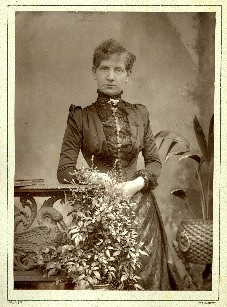
Pioneer Women. ACGRC: 78.707, Courtesy of Sovereign Hill Museums Association & Ballarat Historical Society Collection

At Sovereign Hill we are often asked about the experiences of women in the past; in particular, limitations on their dress, behaviour, education, and job opportunities as compared to men. Values, beliefs, and even some science of the time promoted the idea that men and women were inherently different and that this then justified their different treatment and access to opportunities. STEM (Science, Technology, Engineering, Mathematics) fields in the nineteenth century provide us with stories of amazing women, who were engaging, inventive, inquisitive, and pioneering in their respective fields.


MADAME ELIZABETH CHARPIOT: Daguerreotype 

Elizabeth Henwood, with her younger brother and sister, arrived in Port Phillip Bay aboard the Barque Velore in 1853. They made their way to the Victorian goldfields where in 1855 Elizabeth married George Charpiot, a watchmaker and dentist. It is unclear where her training or equipment came from but by 1856 Elizabeth had set herself up as a photographer, perhaps one of the earliest female photographers in Australia. Within her husband’s jewellery and dentistry business, she had a set of photographic rooms. The Ballarat Star, whose offices were opposite the business commented on her skill: 

“THE FINE ARTS.” The Star (Ballarat, Vic. : 1855 – 1864) 15 November 1856: 2. Web. 18 Jul 2024 <http://nla.gov.au/nla.news-article250439079&gt;. 

 A daguerreotype is the first form of commercial photography. A silver-plated copper plate was treated with a light-sensitive material that reacted when exposed to light. The plate was developed and fixed in a chemical bath, so it was a unique, single image. Our collection includes several examples of daguerreotypes like the style that Elizabeth was producing. The daguerreotype below is carefully mounted and beautifully framed. The lady is wearing several pieces of jewellery and carefully holding a book open – why do you think she chose to include a book in her picture?  

If you had your picture taken, would you wear anything special?
What one special object would you want to be included? 

“Unknown lady with book”  daguerreotype, 19th century. ACGRC: 2014.1392 

When the Charpiot’s moved to Dunolly, both continued their businesses; Madame Charpiot’s portrait services were regularly advertised alongside her husband’s dental business.  
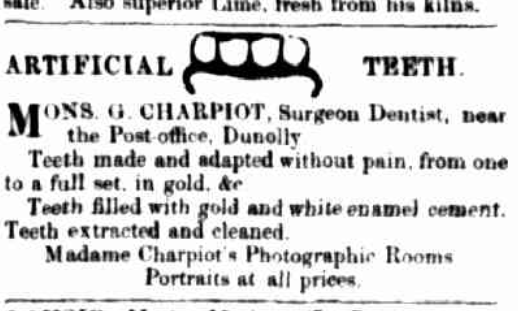
1858 ‘Advertising’, Maryborough and Dunolly Advertiser (Vic. : 1857 – 1867 ; 1914 – 1918), 23 April, p. 3.   http://nla.gov.au/nla.news-article253586868

A few years later they moved again to the goldfields town of Tarnagulla. On New Year’s Day 1868, their business caught fire and was destroyed. Most of Elizabeth’s photographic equipment was likely lost and it would seem she never returned to professional photography after the fire. 


EADY HART: Inventor 

  
Eady Hart, ACGRC: 06.0577 

Eady Hart arrived on the goldfields in 1854 as a six-year-old, with her family seeking gold. She became a dressmaker and married engineer William Hart. It seems to have been a difficult marriage and William deserted Eady and their eight children. Eady was remarkably resilient, she supported the family, including six foster children, with her sewing and millinery skills, then taxidermy, then an innovative fire-lighting product. Eady was curious and innovative and turned her attention to dyes. In her small kitchen, she experimented with native plants, like grass trees, to produce a beautiful range of natural dyes – useful for fabric and foodstuffs. Here she met with great technical success. Thirty years of experimenting led to the formation of Hart’s Royal Dyes in 1921. In our collection, we care for a number of her recipe and sample books, along with patent applications and business correspondence.  

What is a patent? Why would Eady need a patent for her idea? 

Eady had to solve various problems with her experiments. She needed to figure out what colours different plants produced, what was required to make the colour stable and stick to fabric, and whether the ingredients were safe to work with when mixed together. She also had to ensure there were enough ingredients to make lots of dye, and that the recipes were repeatable for others to follow.

Sample page in Eady Hart’s scrapbook. Accession Number 06.0576

People loved the colours Eady created; she won awards for her colours and her dye-making process. Newspapers were filled with reports of her wonderful discovery and for seeing the Australian bush as a sustainable resource: “Mrs. Hart says she has barely tapped on the possibilities of our vegetation. The glory of the Australian bush is not yet known … Mrs. Hart regards as criminal the ruthless cutting for firewood and building purposes valuable timber that should be producing priceless dyes”1 


EUPHEMIA BAKER: Artist & Photographer 

For Euphemia Baker, the move to Ballarat as a young girl to live with her grandparents opened to her the world of the Ballarat Observatory and the technology of the camera. In our collection we have a photo of young Euphemia “Effie” Baker with her grandfather, Captain Henry Baker, who ran the Ballarat Observatory, standing beside a large telescope. A retired sea caption, Baker was a master instrument maker, and his daughters grew up around the telescope and observatory. Access to this world inspired in them a love of looking at life through a lens for art and science. 
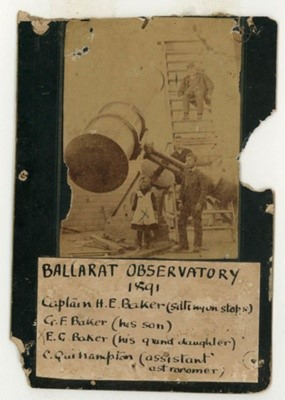
Ballarat Observatory 1891, ACGRC: 163.80 

His daughter Elizabeth Baker became a photographer and astronomical assistant at the observatory, down the road from where Sovereign Hill is situated in Golden Point. In 1896, the Ballarat Star noted that Miss Baker had taken charge of the observatory, the meteorological equipment and was contributing to international research projects and winning awards for her astronomical photography2. When her young niece, Effie, came to live with the family she gifted her a camera and mentored her in photography. Both Elizabeth and Euphemia were noted for their photography, including photos of the moon and stars taken through the telescope. 

Where do you find inspiration? 

The Goldrush Centre holds several early cameras, including this quarter-plate camera, perhaps similar to the one gifted to Effie, and the camera belonging to astronomer Mr John Brittain, who lectured in astronomy at the Ballarat School of Mines. 
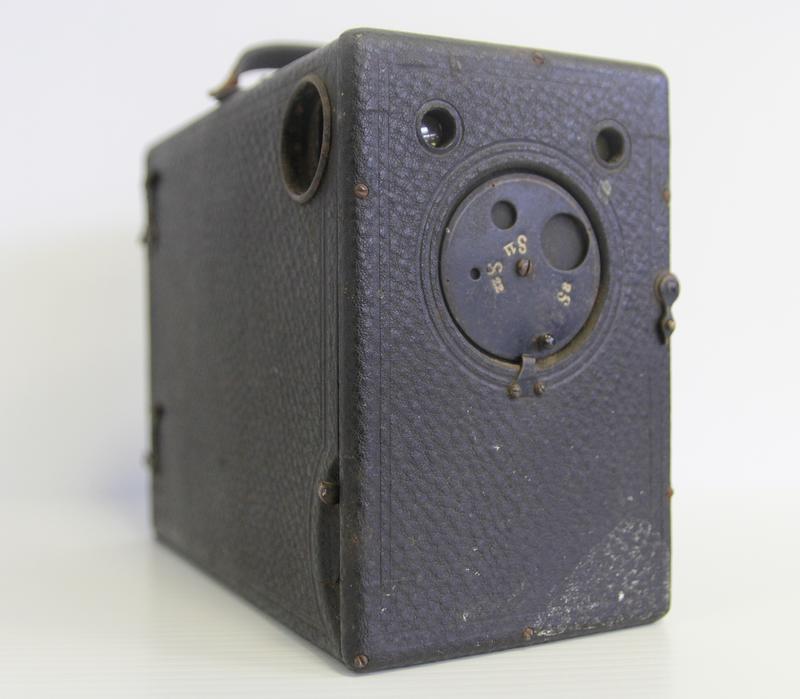
Quarter-plate camera, unknown maker and age, ACGRC: 2014.0204 
Camera belonging to Mr James Brittain c. 1890s, ACGRC: 78.0442 

DR. GRACE VALE: Doctor 

Were women treated equally in science and medicine? 

As a founding member of the Victorian Medical Women Society, one of the first female graduates from medical school in Melbourne, and then the first woman public vaccinator (in 1910), Dr. Vale became both a doctor and an active public figure in Ballarat, including being highly active in the suffrage movement to give women the vote. She was present for the first X-rays experiments at the Ballarat School of Mines. 

“Dr. GRACE VALE.” Table Talk (Melbourne, Vic. : 1885 – 1939) 28 December 1899: 6. Web. 18 Jul 2024 <http://nla.gov.au/nla.news-article145933182&gt;.  

The article below gives a hint of the medical environment in which Dr Vale worked. The “medical profession for women” suggests that only part of the profession is open to them and they are always described as “woman” or “lady” doctors specifically. She has been working in the practice of another woman doctor, Margaret Whyte with whom she had graduated.  Her appearance, rather than her abilities, becoming the focus of newspaper articles. In closing remarks, she is described as “the tallest of all the lady doctors, and commanding in appearance.” 
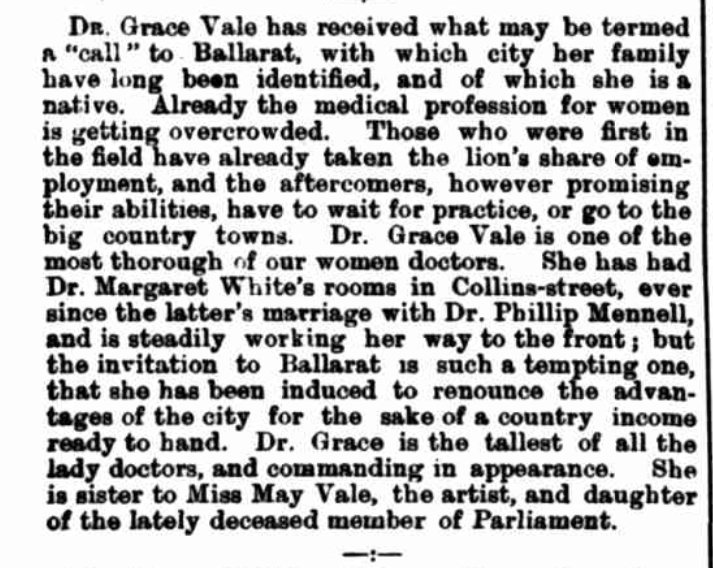
“Personal.” Table Talk (Melbourne, Vic. : 1885 – 1939) 24 April 1896: 2. Web. 17 Jul 2024 <http://nla.gov.au/nla.news-article145921688&gt;. 

Dr Vale used her position to lobby throughout her career for the rights of women. She was active in advocating for free or low-cost healthcare for female factory workers in Melbourne, she was elected to the Ballarat City Board of Advice and spent much of her career as a Medical Officer for schools in Victoria and NSW. 

These four stories are amongst many examples of resilient, adaptable, and curious women on the goldfields. But this is just the beginningwhat stories can you find? Do challenges still exist today for some groups wanting to enter STEM fields and how can we learn from these pioneers in the past?


Gold Rush Icons and Their jewels

Lola Montez
Date
[ca. 1846 – ca. 1861]

http://handle.slv.vic.gov.au/10381/40191

In 1851 and 1862 Victoria produced 27,770,666 troy ounces of gold (over 800 tons), valued at about 110 million pounds at the time. The gold produced during this time was highly prized and would often be melted and transformed into different objects. Objects made from gold could include – coins, bullion, gold leaf, jewellery and even gold teeth!

Gold has been used in the making of jewellery Before Common Era (BCE) and has for many people, been seen as a symbol of wealth. Gold, being a rare metal, dominated the appearance of jewellery in the 19th Century. The gold being taken out of the earth in Ballarat from 1851 meant that by 1855 jewellery shops were appearing on the Ballarat landscape. Two men, who arrived from England, seized this business opportunity and opened a jewellery store, called Rees and Benjamin within Ballarat. You can visit Rees & Benjamin on the Main Street of Sovereign Hill to purchase jewellery.

Miners Brooch (1850’s) (GM07.0047)

The jewellery designs in the 1850’s reflected mostly the English style. However, jewellery being made in Ballarat could also take on a uniquely Australian design of flora and fauna and even mining. One lady on the Ballarat goldfields during this time, Lola Montez, who was a stage performer, was sometimes given gold jewellery by gold miners during her on-stage performances. One gold brooch given to Lola, as a token of appreciation in Melbourne in 1855, was then later sold by her, during her travels around San Francisco (America) a year later.

Before the mid-1850s, gold was a desired resource and usually only the wealthy could afford to have jewellery pieces, made from gold and other precious materials, handmade by a jeweller. However, largely due to the gold rush and the Industrial Revolution (creating a new emerging middle class of wealth), jewellery was becoming more affordable and popular. The Industrial Revolution made the manufacturing of jewellery more cost-effective and attainable for other levels of society. The invention of electroplating (metal coating) during this time was ideal for making inexpensive jewellery, that more people could afford to buy.

One of the great influencers of jewellery fashion in the 19th Century was Queen Victoria. Her reign as Queen on the British throne went from 1837-1901. During that time, she had great influence over the world’s fashion, including jewellery. Much like social media influencers today, Queen Victoria made a societal impact on the jewellery and fashion trends during the time she reigned. Examples of popular styles of jewellery in the mid-19th Century included lockets, rings, large bangles, brooches, crosses, and necklaces. Jewellery such as earrings were also fashionable in the Victorian era. Queen Victoria had her ears pierced when she was fourteen years old and one of her painted portraits shows her wearing dangling earrings. Wearing lots of jewellery before the mid-19th century for very young girls was frowned upon. However, ladies would wear large and chunky jewellery as well as delicate bejewelled pieces.

Locket with hair (GM 2012.0446)

Jewellery fashion in the 19th century was a little bit different compared to our jewellery today. Queen Victoria had a favourite piece of jewellery that she wore – a locket that contained her husband’s (Prince Albert) hair. Queen Victoria also wore and gave her children jewellery made from hair. In fact, a lot of jewellery of that time was made from hair, teeth, and animal claws. Prince Albert even designed a brooch for Queen Victoria that included their first daughter’s, Vicky, first milk (baby) teeth!

Another trend Queen Victoria made popular was that of receiving an engagement ring before marriage. Prince Albert gave Queen Victoria an engagement ring that was in a snake (serpent) design, with its tail in its mouth, entwined. In Victorian times this design symbolised eternal love. The snake design and many others would become popular amongst jewellery designers due to Queen Victoria.

In 1861, when Prince Albert died, Queen Victoria began wearing black jewellery, called mourning jewellery. This was mostly made from Whitby Jet (fossilised coal found in Whitby, England) and started a trend that lasted until around 1890.

Whitby Jet Jewellery (GM 84.2010)

Did you know?

  • The ‘Welcome Nugget’, a substantial gold nugget dug up in Ballarat in 1858 was eventually sold to the British Mint and melted down to make minted gold sovereigns coins. The coin, on one side, would have held an impressed image of Queen Victoria on its obverse. 
  • Prince Albert also designed a brooch for Florence Nightingale. (Florence was named as such due to her being born in Florence, Italy).
  • Sea coral was popular and used in jewellery during the Victorian Era.
  • During the Paris Exposition of 1855, a life-size portrait of Queen Victoria was made completely out of hair!

Why we do not say “hello”

or, “don’t” for that matter as we never “clip our words”

François Cogné 1859 (78.2403)
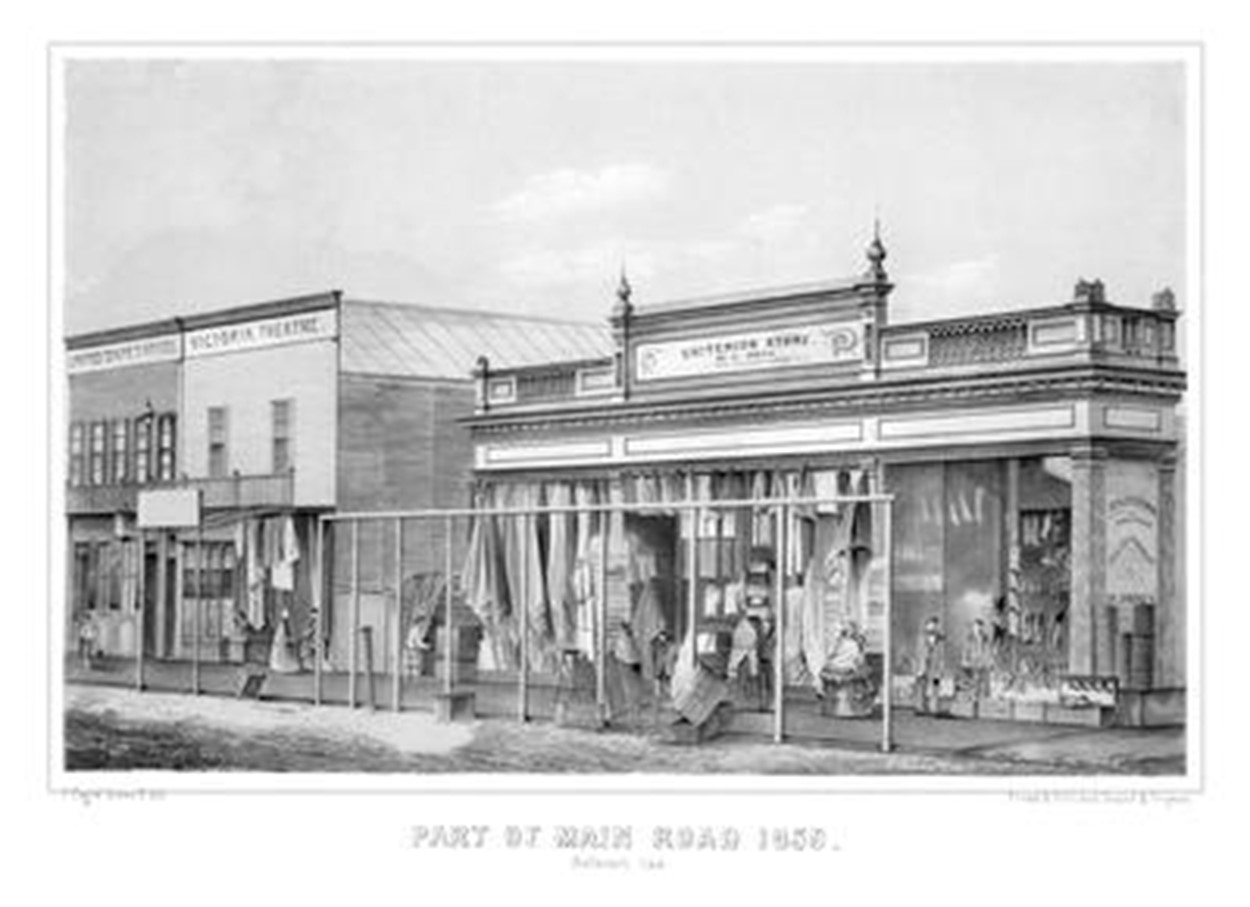
Ballarat’s middle class shopping on Main Road, Ballarat East in 1859

In welcoming you to the nineteenth-century world of Sovereign Hill one of the first things you may notice, after the clothing, is the way we speak to each other. We will greet you with “Good Morning” or “Good Day”, never “hello”. Why is this?

“Hello” is just emerging in the late nineteenth century as a form of greeting, earlier versions of ‘hullo’ or ‘holla’ were not in common use as greetings, they were informal shouts for attention. Could you go a whole day without saying “hello”?  In fact, it will take a big technological shift, the telephone, to change our use of ‘hello’.  Telephones change the rules of communication when you cannot see the speaker on the other end.  Legend has it, Thomas Edison championed “hello” (telephone inventor Alexander Graham Bell preferred “ahoy”)[1] as a useful greeting.

FitzGerald Postcard Collection (83.16892)

[1]“Quick Facts: Did Bell really say ahoy?” https://www.sciencemuseum.org.uk/objects-and-stories/ahoy-alexander-graham-bell-and-first-telephone-call accessed 21 Feb 2024 

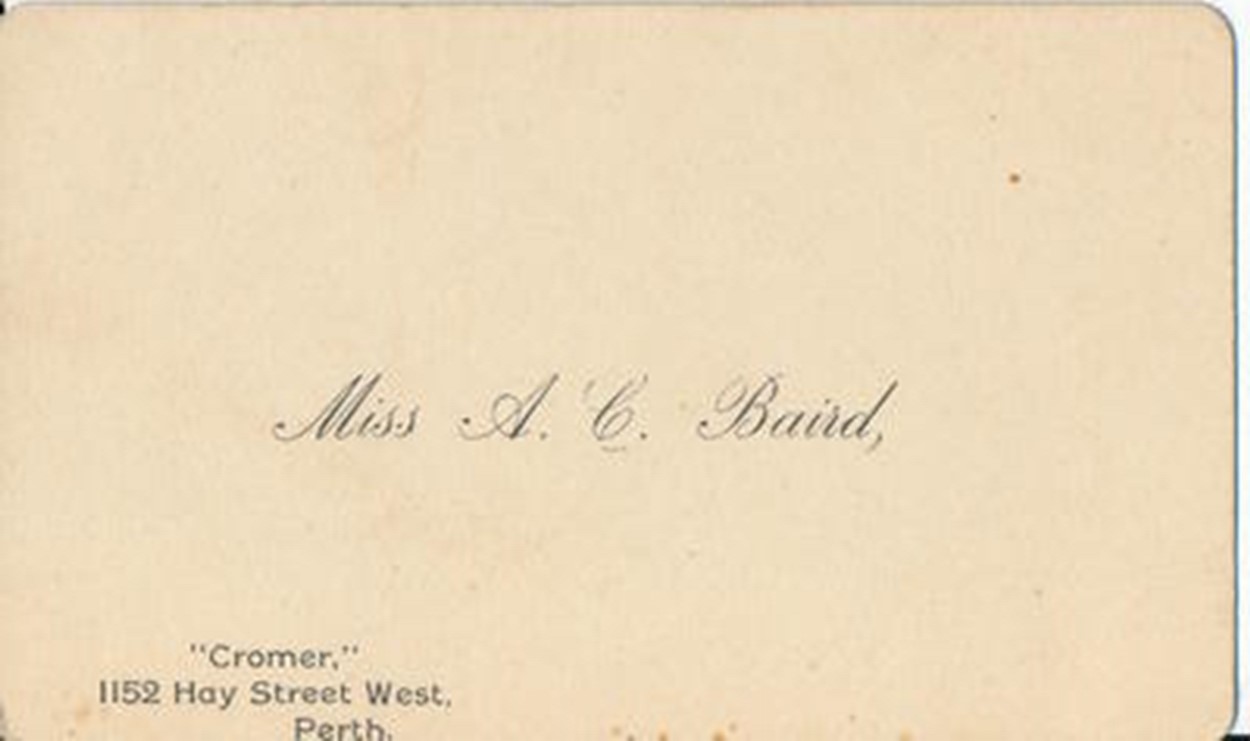
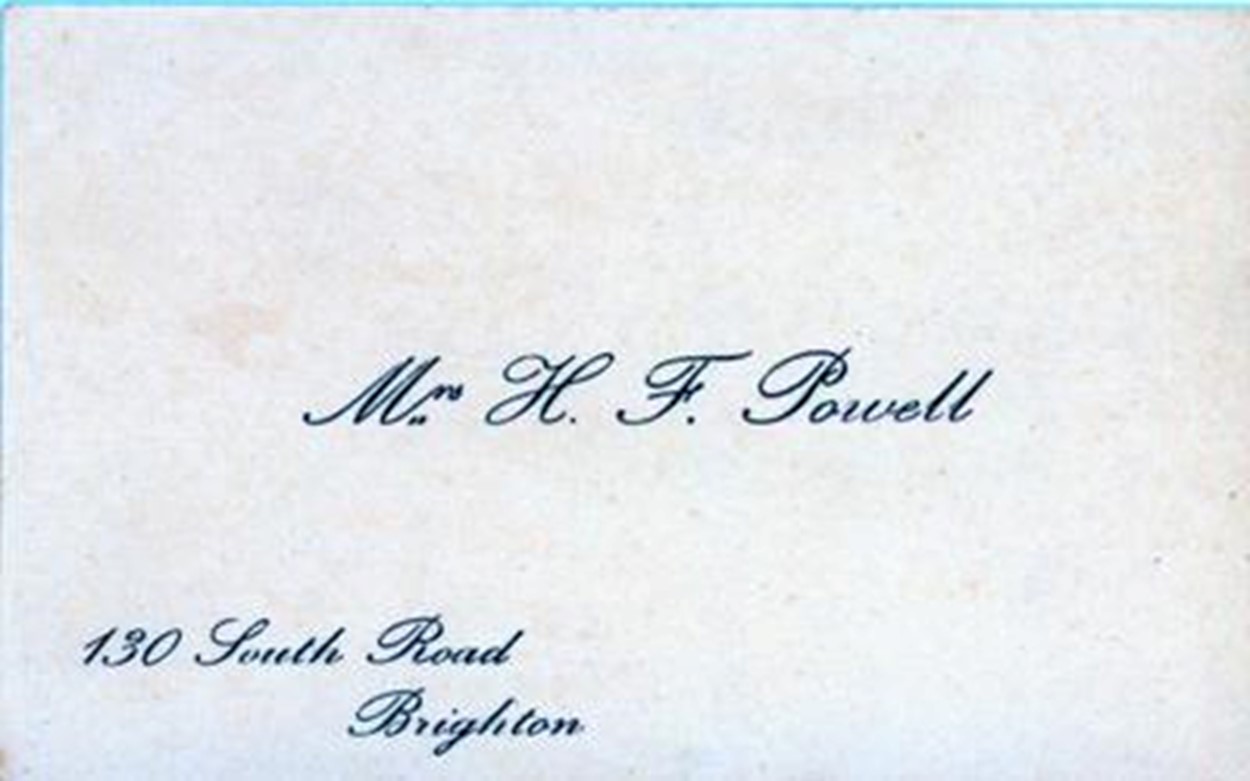
Before telephones, letters and calling cards provided introductions. You would leave a card, with your title and name, as an invitation to speak. We have several examples of these visiting cards in our collections. How many cards you left, whether you left a message on the card, or perhaps bent a corner of the card all sent a message to the recipient. It told the recipient you were home, that you were accepting visitors or that you would like to visit for example.

Is technology today changing the rules around who and how we behave when we speak to each other? Is this a good thing?

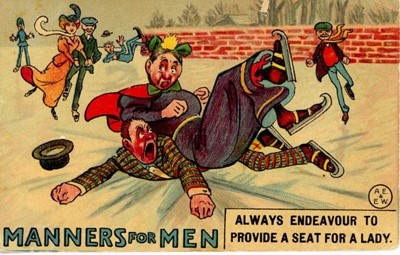
In our pre-telephone world, there are very clear rules around how we look at each other (or don’t!), move around each other and speak to each other depending on our relative age, power, and how well we know one another. These rules of behaviour in society, called “etiquette”, are taught and practiced at home and at school. They are also published again and again in books of manners and our collection contains several examples.

The nineteenth century is a period of big and increasingly fast change amongst the societies from which many of our goldfield migrants come. This big, fast change is often referred to as the Industrial Revolution. Along with the advent of steam power and factory production, and the move from country life to city life came the rise of the middle class.  The middle class was a group of people who did not come with titles (important family names and connections) or inherited power like the upper class, but who also no longer work in manual trades with little money, power, or education. This new group of people earn more money than it costs to live, have an education, and often professional jobs.

FitzGerald Postcard Collection (GM 83.16880)

The rules of behaviour are becoming a really important way of figuring out whether a person belongs in good society. In the dust and mud of the goldfields particularly it can be very difficult to tell if a person comes from the same background as you and fortunes are being made and lost very quickly. In a society used to organising people based on gender and social power, if you know and follow the rules you will have more opportunities to move up in the world. According to Australian Etiquette: Rules and usages of the best society, published in 1885, “He who does not possess them [good manners] … cannot expect to be called a gentleman; nor can a woman, without good manners, aspire to be considered a lady by ladies.”[2]

You may have noticed that our rules of behaviour are distinct for men and women. In the nineteenth century, there are very distinct understandings of what it means to be ‘male’ or ‘female’. 

Here is a primary source example from The Bendigo Advertiser, 1859, where the writer is very upset that a Magistrate at a stone laying ceremony called the females present women and deliberately not ladies[3]. What an insult! The Magistrate’s Excuse? As an aristocrat (upper class) he should know better, but as a soldier (different social space) he may have rough manners. Appropriate titles are important and make a judgement on the person’s background.

What sort of words does the writer use that tell us how to identify a lady or gentleman?

  • Gentleman: by birth, education, gone through a college curriculum, conduct
  • Lady: gentler sex, fair sex

The idea that men and women are made differently, and therefore behave differently[2], shows in different expectations of men and women, including in good behaviour.


[2] Australian Etiquette, or the rules and usages of the Best Society in the Australian Colonies. People’s Publishing Company, Melbourne. 1885, p. 19.

[3] “BAD MANNERS.” Bendigo Advertiser (Vic. : 1855 – 1918) 12 November 1859: 3. accessed 21 Feb 2024 http://nla.gov.au/nla.news-article87993464.

[4] For an example of someone who defied social conventions, explore the story of Edward de Lacy Evans. “The Mysterious Edward/Ellen De Lacy Evans: The Picaresque in Real Life” The LaTrobe Journal, No 69 Autumn 2002 https://latrobejournal.slv.vic.gov.au/latrobejournal/issue/latrobe-69/t1-g-t9.html accessed 21 Feb 2024


Our good behaviour rules may seem unfamiliar to you, as a visitor, as how we interact with each other has become much more familiar and much more diverse in the twenty-first century.  Do you have any classroom rules that you have to follow? Who made those rules? Are they different for boys and girls? Are they different for children and adults?

Meeting a new person is a good example of these changes. Our nineteenth century rules of etiquette say that we do not have to introduce someone. A formal introduction is like giving someone a good character reference for a job; if you have been introduced you must never ignore that person in future, it is very rude. Introductions must be done in the correct order: 1. Gentleman to the lady; 2. Younger to the older; 3. Inferior in social standing to the superior. Your social class decided who and how you spoke to others.

SOCIAL CLASSPROFESSION
Upper Class – landowners and investors, no manual labourAristocracy Rich gentry Royals Military Officers Lords Wealthy Men/Business Owners (new to this class)
Middle Class – skilled jobs, white collar professions with no manual labour, very class consciousMerchant Shopkeeper Bureaucracy – railroad, bank, government
Working Class – skilled jobs with manual labour, unskilled jobs, poor working conditionsTrades Factory work Labourers
*there was also an underclass of people in extreme poverty or “sunken people”

When you are introducing someone, you must use their title (which can let you know marital status, job, social achievement). Titles, and pronouns, are a great example of our changing society. We greet people by first name more often, may not use titles at all and our choice of titles and pronouns is expanding to become much more inclusive of different identities.

If you visit us, you may be greeted as “Sir” or “Ma’am” as an adult, or “Master” or “Miss” as a child, titles of respect in our time. It is respectful to greet a costumed person you meet with Sir or Ma’am. “Sir” is the title given to a gentleman whose name you do not know. “Ma’am”, short for madam, is the title for a lady whose name you do not know; it comes from the Old French for my lady. You must wait for the lady to look at you and nod a greeting first, before you speak to her, and if you are wearing a hat (which of course you would be in the nineteenth century) you would touch the side of the cap as you greet her. We do not generally shake hands when we meet new people; handshakes are more common between gentlemen, and we certainly do not high five. The high five will not be invented for another hundred years in our future.

Can you imagine how the rules might change again in the future? What do you think might be different about how we greet each other and what we call each other?

Women on the Goldfields Part 2 – Working Outside the Home

alice

Alice Cornwall, also known as ‘Madam Midas’ ran a company mine and became a millionaire by the age of 30. Reproduced with permission from the Gold Museum.

While getting dirty hands in search of gold was viewed as a man’s job in the imported European culture of 1850s Victoria, there were many hardworking and enterprising women making a living in Ballarat during this era. In addition to managing families and households, some women on the goldfields opened shops and eateries, or worked as teachers and entertainers. There is even evidence that a few women swapped their skirts for trousers to search for gold, one became a newspaper editor, and later in the 1800s a woman named Alice Cornwall became a millionaire by the age of 30 through the company mine she owned!

Back then, it was rare for a married woman in Europe to hold a job outside her home, or to play a role in public life. However, the conditions on Australia’s goldfields provided some women with new opportunities and different lifestyles compared to their equals back in Europe. This second blogpost in our series on 1850s goldrush women explores their roles in Victorian communities beyond the home.def2

Working Wadawurrung Women on the Diggings

The Wadawurrung women of the Ballarat region experienced rapid changes to their lifestyles and local environment when Europeans began to colonise South Eastern Australia in the early 19th century. Therefore, by the time the gold rushes began in Ballarat 1851, historians tell us that some Wadawurrung people already spoke English and understood the new political and economic systems that Europeans had introduced. Using their skills in tanning/sewing possum skins, sourcing native food and medicine, fossicking for gold, putting on cultural performances and taking Europeans on tours of the landscape, Wadawurrung women (and men) made money from Europeans by supplying these goods and services. According to oral history handed down by members of the Wadawurrung community, European families also turned to Wadawurrung women when they needed someone to babysit their children.

Working European Women on the Diggings

In the early 1850s, there weren’t many European women living in Ballarat. As explained in Women on the Goldfields Part 1, most of the people who came to try their luck on Australia’s goldfields were European (mostly from Britain), and gold rush communities tended to be male-dominated during this time. By the mid-1850s, Ballarat had become one of the richest places in the world, and as a result of this and the government push to encourage female immigration, the number of (mostly young) women on the goldfields grew.

miningladies

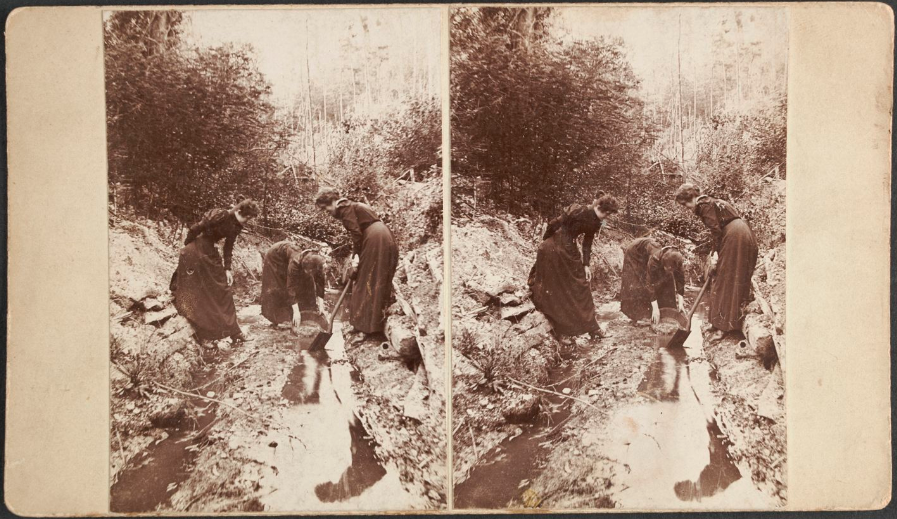
Author unknown, Bush scene, three women panning for gold, c.1855-1910. Reproduced with permission from the State Library of Victoria.

I saw the other day four or five of these fellows strolling on behind their cart. Amongst them was a young woman very well dressed, wearing a sun-bonnet … [with] a full flap behind at least a foot long, to screen the neck. On one shoulder she had a gun, and in the other hand a basket, while one of the men carried a baby, and another a swag. … You see a good many women going up on the whole, and some of them right handsome young girls. They all seem very cheerful and even merry; and the women seem to make themselves very much at home in this wild, nomadic life. – William Howitt, Land, Labour and Gold, 1855 (1972 ed.), Victoria, p.64.

Ballarat’s immigrant women proved themselves hardworking and capable, and many appear to have made the most of the opportunity to take up jobs on the goldfields. While housewifery was a highly respected family and community role for European women to perform during this era, some of these goldrush women did all of the work for their households and worked outside their homes as well.

Part of the reason some women took on extra work was due to economics. Food, clothing and household items (much of which was imported from Europe) were very expensive on the diggings, and households with two working adults usually lived more comfortably than those relying on just one income. The main motivation for these immigrants to journey to Australia in the first place was to make money, and the more creative and resourceful you were (whether you were male or female), the more successful you were likely to be.

Some women also took up work that was usually the domain of men at this time – such as school teacher, shop assistant or hotel manager – because the men in the community were too busy searching for gold to perform these roles. Since the social norms that influenced the way Europeans were supposed to behave were somewhat relaxed on the diggings, some women saw an opportunity to work and took it.

grog

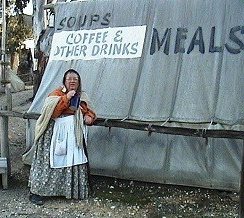
A costumed character at Sovereign Hill selling her potent ‘other drinks’ (sly grog) from her tent to support her family after the disappearance of her husband – a common goldrush experience for women on the early diggings.

Being practical and resilient were important characteristics for all to demonstrate on Victoria’s goldfields. Some women had to work because they were abandoned by their husbands. It was fairly common for men to suffer deadly accidents as a result of the dangers that come with gold mining, while others ventured to different Australian goldfields and never returned to their wives and families. When such abandoned women had children to support (and didn’t already have a job), if they could not immediately remarry or turn to charity (there was no Centrelink back then – churches did most of this type of welfare work) they sometimes had to resort to selling sly grog or even their bodies to pay the family’s bills.

Regardless of the work they did, European women arguably built a new kind of womanhood for themselves in Australia, which challenged the gentle, modest 19th century femininity they were expected to perform. This attempt at creating a new culture was part of a broader push by the youthful and broadminded goldrush communities around Australia to challenge European social norms. Some women who thought along these lines even became involved in the Eureka Rebellion.

anastasia

Anastasia Hayes was a mother, school teacher and Eureka rebel. Reproduced with permission from the Public Records Office of Victoria.

Some very adventurous European women from Victoria’s gold rushes who have interesting stories to explore include Clara Seekamp, Fanny Finch, Martha Clendinning, Anastasia Hayes, Lola Montez, Edward (ne Ellen) De Lacy, Caroline Chisholm, Anne Fraser Bon, Alice Cornwall, Eliza Perrin, Catherine Bently, Anastasia Withers, Céleste de Chabrillan, Ellen Clacy, Harriette Walters, Sarah Hanmer, Elizabeth Wilson and Bridget Hynes.

As Ballarat became a more permanent township by the 1860s, many of the women who had worked in shops etc. at the start of the gold rush began to return to full-time housewifery. Martha Clendinning was a shopkeeper during the early 1850s, but the more successful her shop became as time went by, the more her femininity and class came under question. 19th century European social norms began to be reapplied, sending women back to the private sphere – so how could she be the respectable doctor’s wife, and lady of the house, when working as a shopkeeper?

The time had gone by when, even on the goldfields, a woman unaccustomed to such work could carry on her business without invidious remarks.  I began to fear my husband might be blamed for allowing me to continue at it.  After the class of residents on the field had become so superior to those of the working class, whom we had found on our first arrival, to whom all species of employment for women seemed perfectly natural if they could carry it on with success. The doctor [her husband] had been most anxious and was greatly pleased when I announced my intention [of selling her shop]. – Martha Clendinning memoirs, 1853-1930.

Chinese Women on the Diggings

By the late 1850s, there were also thousands of Chinese people on Victoria’s goldfields, but only a very small percentage of them were women. The men from China mostly left their wives and children at home to care for their family farms, as most came from agricultural communities.

table

The 1861 Census of Victoria shows that women were still performing many roles normally undertaken by men at the time across goldrush communities. Reproduced from Weston Bate’s book called ‘Victorian Gold Rushes’, page 37.

Some of Victoria’s immigrant women in the 1850s were ambitious and outspoken, despite these being uncommon characteristics in women in other parts of the world during this era. However, as time went by and Ballarat became a more permanent community, the social norms of Europe directed women (regardless of whether they were European, Aboriginal, or from any other cultural background) to the private sphere (learn more about this at our next blogpost). This is where they largely stayed until Australian factories needed workers during the 20th century’s World Wars (when women replaced the men who became soldiers). Women only became permanent members of Australia’s workforce in large numbers after the Women’s Liberation Movement of the 1960-80s.

Links and References:

Sovereign Hill Education’s student research notes about women on the Ballarat goldfields: http://education.sovereignhill.com.au/media/uploads/SovHill-women-notes-ss1.pdf

A State Library of Victoria blogpost on women on the goldfields: http://ergo.slv.vic.gov.au/explore-history/golden-victoria/life-fields/women-goldfields and website about how Victorian women’s lives have changed since the 19th century: http://ergo.slv.vic.gov.au/explore-history/fight-rights/womens-rights

An SBS blogpost about women on the goldfields: https://www.sbs.com.au/gold/story.php?storyid=27#94

Dr. Claire Wright wrote a book called ‘The Forgotten Rebels of Eureka’ about the women involved in the Eureka Rebellion: https://www.textpublishing.com.au/books/the-forgotten-rebels-of-eureka

Women played many different social roles during the Victorian gold rushes: https://theconversation.com/flashers-femmes-and-other-forgotten-figures-of-the-eureka-stockade-20939

A Culture Victoria webpage about the few Chinese women living in 19th century Victoria: https://cv.vic.gov.au/stories/immigrants-and-emigrants/many-roads-chinese-on-the-goldfields/voyaging-to-australia/who-were-they/nearly-all-men/

A gender equality timeline made by the Victorian Women’s Trust: https://www.vwt.org.au/gender-equality-timeline-australia/ and a fantastic video telling a similar story: https://vimeo.com/225932476

The gender pay gap in Australian explained: https://www.wgea.gov.au/data/fact-sheets/australias-gender-pay-gap-statistics

Sex work on Ballarat’s goldfield: https://www.thecourier.com.au/story/3704053/the-brothels-of-ballarat/


Women on the Goldfields Part 1 – 19th Century Womanhood

The lives women led in 19th century Australia were similar in some ways and very different in others to those experienced by women in this country today. Much has changed for Australian women in the last 170 years from clothes to hairstyles, average life expectancy and experiences of motherhood.

Over three blogposts we will explore what life was like for women on Victoria’s goldfields between 1851 to 1861. This blogpost will focus on the common characteristics of the women who lived in Ballarat during this era, the second will explain the opportunities goldrush women had to work outside their homes, and the final blogpost will examine domestic life on the goldfields for European women in Australia.def1

The Aboriginal Women of the Ballarat Region

The first women of Ballarat were Wadawurrung women. They have been living in this region for tens of thousands of years and many continue to practice culture on Country (their traditional homeland) today. The lifestyles of Aboriginal and Torres Strait Islander people changed dramatically when Europeans began colonising Australia (starting in 1788). The changes took place rapidly in goldrush communities like Ballarat because of the speed at which immigrants – both human and animal – arrived from across the seas to live in such places. These new arrivals changed local ecosystems and cut off access to important Aboriginal and Torres Strait Islander cultural and food production sites.

waran

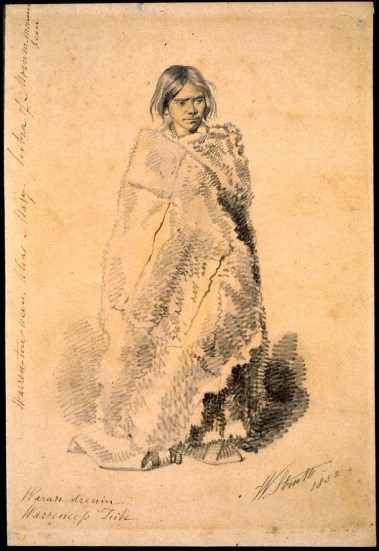
.A drawing of a young Wadawurrung woman who lived in Ballarat during the gold rush. W. Strutt, Waran-drenin, 1852. Reproduced with permission from the British Museum.

While many Wadawurrung women adapted quickly to the changing conditions and played a variety of roles in the new European economy and culture that was brought to Australia, others died from introduced diseases/alcohol and at the hands of violent settler-colonisers. By the late 1860s, most were forced off Country to live on reserves and missions in different parts of Victoria. Despite the damage this caused Aboriginal communities, many Wadawurrung women passed their language and culture onto their children, which is one of the reasons why it lives on today.

The Arrival of Non-Aboriginal Women in Ballarat

In the early years of Australia’s gold rushes, most of the non-Aboriginal women on Ballarat’s diggings came from Europe, specifically the British Isles. Female goldrush immigrants took huge risks to get to Australia by ship and hoped to become wealthy through hard work and/or a good marriage. Social mobility was nearly impossible back in Europe, but in Australia, anyone willing to work could strike it rich on a goldfield which is why around half a million new Australians arrived in Victoria during the 1850s.

punch

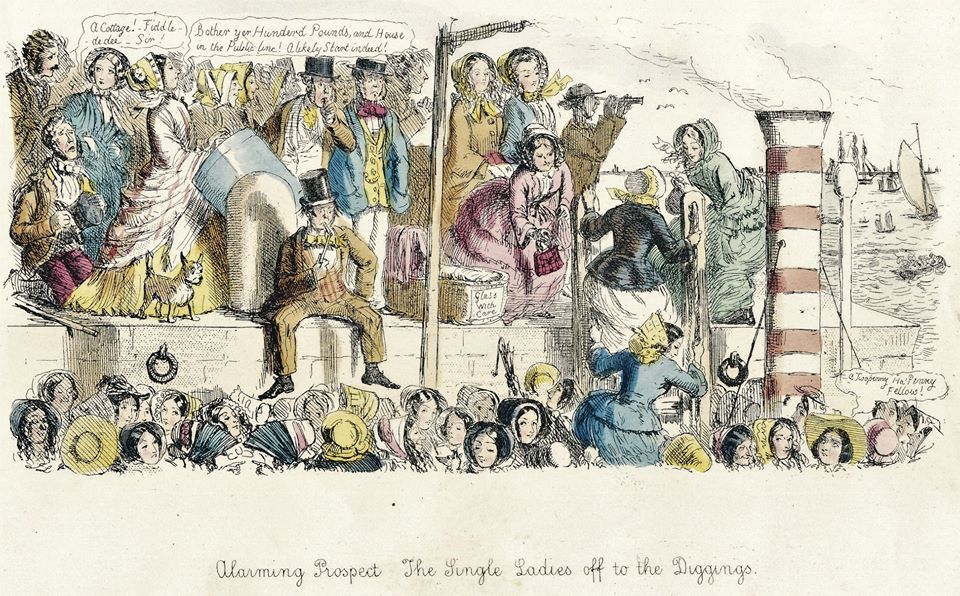
John Leech, Alarming Prospect: The Single Ladies off to the Diggings, Punch Pocket Book, 1853. Reproduced with permission from The Gold Museum, The Sovereign Hill Museums Association.

As most of these new arrivals were men, the colonial government (on advice from people like Caroline Chisholm) made many attempts to attract female immigrants because they were considered to be a ‘civilising influence’ on male-dominated goldrush communities like Ballarat. Gold seeking was thought to bring out poor behaviour in some men, and it was believed by many that just the presence of women could restore their more gentlemanly qualities.

Women were in such high demand on the early diggings – not only were they a ‘civilising influence’ but also companions, cooks and cleaners – that ships arriving in the ports of Melbourne or Geelong were often met by miners ready to propose marriage to the first female they clapped eyes on!

Typical 19th Century European Womanhood

SH ad

.A costumed character at Sovereign Hill panning for gold in a day cap which is designed to both keep hair clean and provide sun protection.

Religion, culture and tradition have always influenced the way in which people behave and dress. A model mid-19th century European woman was likely to be a Christian who obeyed the social norms that came with this identity. This included being quiet and calm, a loving mother/wife, a dutiful homemaker, and good at following the instructions of men. Such women believed that the Bible should guide their behaviour in addition to their clothing choices. During the daytime, European women wore dresses that covered every part of their body except their faces and hands because a polite Christian woman was expected to be modest and hide her body. This is part of the reason you see costumed women at Sovereign Hill wearing day caps.

Ideally, a European woman would only marry a man who could already afford to house, clothe and feed her and the family they would likely make together. On their wedding day, the bride would wear the best dress she owned in whatever colour she liked. White wedding dresses were popularised by Queen Victoria – but only very wealthy families could afford to dress brides in what was ultimately a one-use dress. Back then it was considered quite normal for European women to be married before the end of their teens, as was having ten or more children. In comparison, 21st century Australian women who choose to get married (which is far less common today than it was in the past) are on average aged 30 and will typically only have one or two children.

Womanhood on Australia’s Goldfields

Some historians suggest that immigrant women on Australia’s 1850s goldfields experienced a different kind of womanhood compared to women back in Europe. This was arguably due to the relative youth of the immigrant population and the opportunities that existed for European women in Australia to work outside their homes.

Many of the European women on the goldfields were in their late teens/early twenties. Their youth helped them survive the tough living and working conditions – raising a family in a tent and having to trudge through deep mud in a Ballarat winter to buy food or harvest it from a vegetable garden was hard work. On average, Australian women at this time in history would only live until they were about 40 years old, while life expectancy for Australian women today is about 80 years old. Their shorter (on average) lives is one of the reasons that 19th century women tended to marry and start families at a younger age than women today.

In Europe, if a woman had a job, perhaps as a seamstress, housemaid, or governess (tutor) at this time in history, she would be fired as soon as she got married (unless she was very poor). From her wedding day onwards, she was expected to be busy managing a household and having children, leaving no time for other work. If poverty forced her to work outside the home, it would be a source of shame for the whole family (you can read more about this here). In Australia, and especially in places like 1850s Ballarat, living conditions changed these social norms.

Women on Australia’s goldfields could ‘bend’ social norms somewhat because they filled essential roles that the community needed in order to function while men focused on mining. They could leave the house (to go shopping, visit friends etc.) once they were visibly pregnant, which in Europe was considered bad manners. Put simply, there were many vital jobs that needed doing, so Ballarat’s women rolled up their sleeves and got to work, whether they were already married or not. You can learn more about this topic in our next blogpost.

GM image

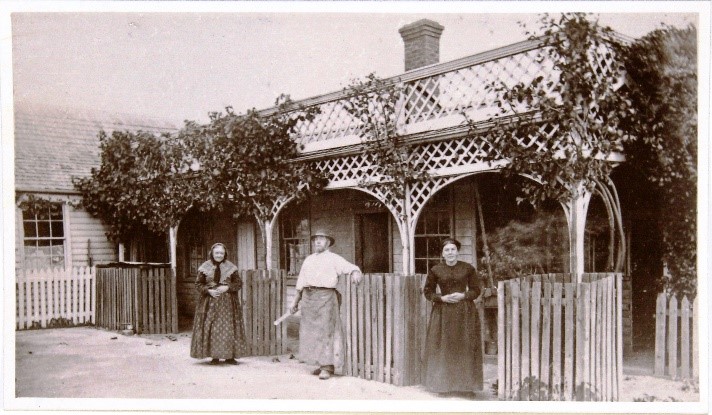
Photographer unknown, (from left to right) Eliza Sharwood, John Sharwood, and an unknown woman, Lot 50, Peel Street South, Ballarat, c.1875. Reproduced with permission from the Gold Museum, The Sovereign Hill Museums Association.

Once Ballarat became a more permanent community from about the 1860s, the European social norms of the era resumed and women became focussed on life in the private sphere once more.

The lives of Australian women have changed significantly since the 1850s. What social norms do you think have changed for the better and which ones have changed for the worse?

Links and References:

Sovereign Hill Education’s student research notes about women on the Ballarat goldfields: http://education.sovereignhill.com.au/media/uploads/SovHill-women-notes-ss1.pdf

A Crash Course video which summarises how women’s lives have changed in the last 150 years: https://www.youtube.com/watch?v=meC5Zl5PC1U&feature=youtu.be&utm_source=hootsuite&utm_medium=&utm_term=&utm_content=&utm_campaign=

A State Library of Victoria blogpost on women on the goldfields: http://ergo.slv.vic.gov.au/explore-history/golden-victoria/life-fields/women-goldfields

An SBS blogpost about women on the goldfields: https://www.sbs.com.au/gold/story.php?storyid=27#94

Two Sovereign Hill Education blogposts on 1850s women’s fashion: https://sovereignhilledblog.com/2012/02/28/gold-rush-belles-womens-fashion-in-the-1850s/   https://sovereignhilledblog.com/2013/09/06/gold-rush-undies-womens-fashionable-underwear-in-the-1850s/

A Sovereign Hill Education blogpost on general clothing in the 1850s: https://sovereignhilledblog.com/2018/06/19/1850s-fashions-in-australia/

A Sovereign Hill Education blogpost about Queen Victoria: https://sovereignhilledblog.com/2015/05/13/queen-victoria/

Dr. Claire Wright wrote a book called “The Forgotten Rebels of Eureka” about the women involved in the Eureka Rebellion: https://www.textpublishing.com.au/books/the-forgotten-rebels-of-eureka


1850s Fashions in Australia

At the beginning of the Victorian gold rushes in 1851, most of the people searching for the valuable yellow metal were male and dressed suitably for the tough camping and working conditions experienced on the goldfields. As it was dusty in summer and muddy in winter, a miner needed long leather boots to protect him from the mud, a broad-brimmed hat (usually made of felt) to keep the sun or rain out of his eyes, a comfortable cotton shirt, and a waistcoat. Here is a description of winter on the Ballarat goldfields:

This was called Gravel Pit Lead, but might with more propriety have been called Mud Hole; for a more astonishing scene of mud, muddy water, muddy diggers, muddy tools, and clay trodden into the most vilely adhesive filth, it is impossible to conceive. In fact, Ballarat in winter is unquestionably the most dirty place, the most perfect Serbonian Bog, on earth …- William Howitt Land, Labour and Gold; or Two Years in Victoria, Longmans, London, 1855, p.380

guerard

Typical Ballarat clothing in the early 1850s – note the long leather boots. Eugène von Guérard, Blackhill 21 Febrav [February] 1854, Reproduced with permission from the State Library of Victoria.

Capture

Gold Museum Curator, Snjez Cosic, modelling a fine example of 1850s fashion made recently by the Sovereign Hill Costume Department. Reproduced with permission from Jade Smithard, Mojo Photography.

It didn’t take long, however, for the wealth from gold to start attracting women and families to the diggings. As living conditions improved and permanent houses were built by the mid-1850s, the trendiest fashions from England, France and the USA began to grace the (still rather muddy) streets. It was no wonder – Ballarat had become one of the richest places in the world by this time, and the fashions sported by residents reflected this new wealth.

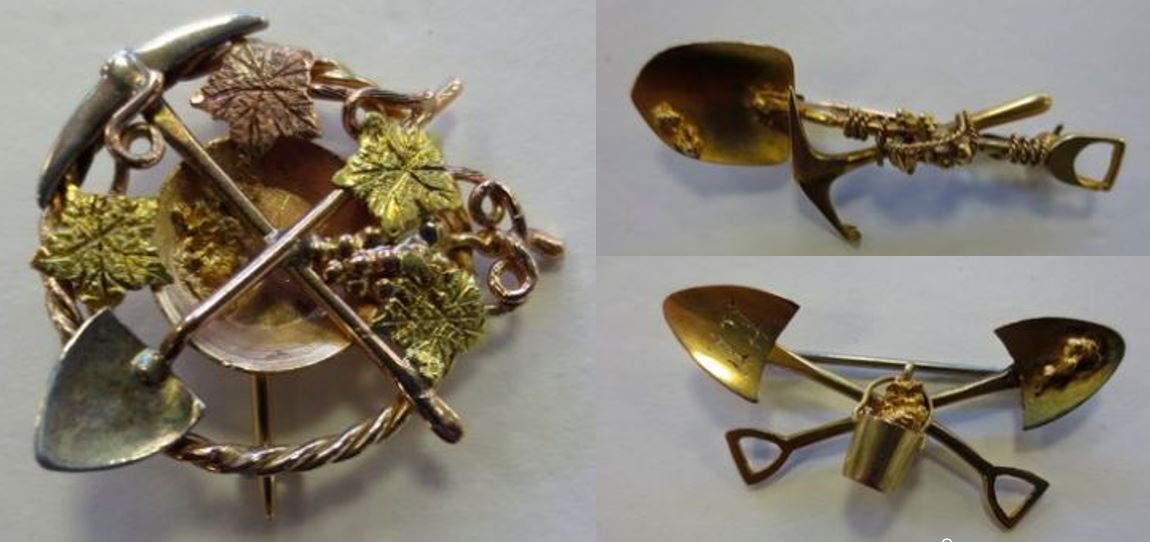
While crinolines and corsets, top hats and bling were all the rage, these flashy fashions, much like many today, were about communicating your social class (or status) in society – meaning they showed others how important you were. While the poor (and there were plenty of people at this time who weren’t reaping the rewards of the gold rushes) wore whatever clothing they could patch together, the rich were enjoying fancy fabrics, new dye colours thanks to the Industrial Revolution, and expensive accessories. Fashion brand names weren’t really invented yet, so instead of showing off your money by displaying an expensive brand across your chest like many people do today, you paraded around in lace, silk ribbons, tall hats and elaborate gold jewellery to show off. It will be no surprise that large pieces of gold jewellery were all the rage in Ballarat in the 1850s.

bling

Brooches made of Ballarat gold. Reproduced with permission from the Gold Museum.

At this time in history, cotton fabric was quite cheap to buy for sewing into dresses and shirts, because the plants that produce it were mostly being planted and harvested by African slaves in the USA. As cotton plantation (farm) owners didn’t pay their workers, this very cheap material was transported all over the world and was affordable to everyone; it was turning it from cloth to clothing that cost a lot of money (paid to a tailor/seamstress) or time (for the hardworking housewife). Poorer women made their own clothes by hand (until the sewing machine became widely accessible in Australia in the early 1860s), while wealthy women had their clothes tailor-made.

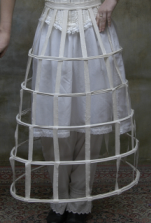
crinoline

An example of a crinoline created by the Sovereign Hill Costume Department. Underneath you can see the model’s pantalettes (undies!) and chemise (like a long singlet).

It might surprise you to learn that few people owned wardrobes until recent times, as even the cheapest clothing was still very expensive by today’s standards, which meant that during the gold rush each person only owned a couple of outfits. Clothes are so cheap today in comparison that Australians buy 27kg of new clothes on average per year, making us the second largest consumer of textiles in the world!

Interestingly, the bell-shaped crinoline underskirt which is probably the most well-known fashion of the mid-1800s was viewed by many women of the time as a liberating garment because they could walk more easily than beforehand when they had worn many layers of skirts to make the same shape. While some cartoonists saw the funny side of crinolines which many called ‘crinoline mania’, wearing one could be dangerous as they caught fire easily. Corsets were dangerous, too, when worn very tight – most women wore them like bras are worn today, while the rich and fashion-conscious sometimes wore them so tight they broke ribs and moved vital organs. The Victorian dress reform movement saw women encouraging other women to give up dangerous and uncomfortable clothing from the 1850s onwards, and this was thought by many to represent the first wave of feminism.


1850-g-cruikshank-crinoline-parody

‘A Splendid Spread’, a cartoon about crinolines by George Cruikshank, from The Comic Almanack, 1850. Reproduced with permission from Wikipedia Commons.

For men who had already found their fortunes on the goldfields, the wearing of white shirts, tall top hats and swinging about a fancy cane showed off their status, along with sporting beautiful fob or pocket watches. If your great-grandfather handed down his watch through your family, it is likely it was his most valuable and treasured possession, although by the late 1800s they became much cheaper thanks to the Industrial Revolution.

wadawurrung

This is a goldrush sketch of a Wadawurrung girl from Ballarat wearing a warm possum-skin cloak – the pelts of brushtail possums are warmer than wool and are waterproof. William Strutt, Waran-drenin, 1852. Reproduced with permission from the British Museum.

Australian-specific clothing became available from the 1850s onwards due to the special furs of our native animals. Warm brushtail possum pelts (the fur with the skin [leather] still attached) sewn together and turned into rugs which were supplied by local Aboriginal people, were useful for keeping miners alive during a Ballarat winter in a tent. As platypus pelts were fashioned into expensive jackets and rugs for the wealthy, it’s no wonder that platypus are so rarely seen in the wild these days.

The Sovereign Hill Museums Association has many pieces of clothing and jewellery in our collection of artefacts from the 1800s; however, they are mostly the fanciest items that people treasured, rather than everyday items. That’s why Eliza Perrin’s dress is a particularly special piece in our collection – watch a video about it in Chapter 6 of our ABC Education ‘digibook’ here. You can also learn about the popularisation of white wedding dresses here, fashionable 1850s hair dos here, how the Sovereign Hill Costume Department researches and makes our 1850s clothing here, the differences between clothing now and 19th century clothing here, and typical children’s clothing from the goldfields era here.


ladies

Ruffles, ribbons, fringes and extra details on outfits showed off one’s wealth in the late 1850s. Reproduced with permission from the Gold Museum (these Ballarat women are unidentified).

Links and References

A brief history of the ‘rush’ to Ballarat: http://education.sovereignhill.com.au/media/uploads/SovHill-lifeonthegoldfields-notes-ss1.pdf

Wikipedia on crinolines: https://en.wikipedia.org/wiki/Crinoline

A Gold Museum blogpost about another interesting dress in our collection: http://www.goldmuseum.com.au/a-victorian-dress/

Wikipedia on corsets: https://en.wikipedia.org/wiki/Corset

The history of men’s white shirts: https://theconversation.com/the-story-of-the-mens-white-shirt-26312

BTN on the amount of modern clothing Australians waste: http://www.abc.net.au/btn/story/s4663466.htm

A platypus fur cape in the National Gallery of Victoria collection: https://www.ngv.vic.gov.au/fashion-detective/


Life before plastic

parkesine

An example of 19th century nitrocellulose jewellery – if you rubbed it, it could explode! From Wikipedia Commons.

Many visiting students are shocked to learn that plastic didn’t exist in 19th century Australia. The Industrial Revolution, which began in England around 1750, encouraged the creation of many products which could be mass-produced in the newly-invented factories. Some plastic-like products – like fake ivory jewellery – were being produced as early as the 1860s, but the nitrocellulose from which they were made was extremely dangerous. Wikipedia says ‘When dry, nitrocellulose is explosive and can be ignited with heat, spark, or friction’! Therefore, the development of modern plastics (largely made from the fossil fuel crude oil) is a 20th century story. So how did people survive without plastic in the 1800s?

At Sovereign Hill, we have numerous garbage and recycling bins so our visitors can dispose of their rubbish responsibly, but these didn’t really exist in 19th century Ballarat. Before cheap plastics and paper (paper was expensive before we began making it entirely from wood pulp in factories), people rarely produced household waste. Items were reused and often re-purposed, and when they eventually fell apart, they would be disposed of in the fireplace or in the garden where most would biodegrade. Let’s describe a typical (European) family home’s production of waste over a normal goldrush day here in Ballarat to compare and contrast it to a family’s waste output today.

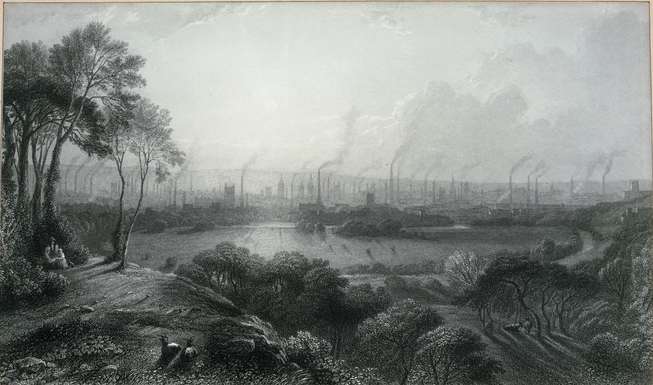
The family wakes at dawn (clocks were made of metal and were therefore expensive, so most people were woken by the sun). Their bedsheets were mass-produced in Manchester, England, from cotton shipped from the United States of America, and their woollen blankets were made in Bradford, England, from wool shipped from Victoria. If they were wealthy, they might also own a hand-made possum-skin rug, bought from the Wadawurrung people – these were sold on the Ballarat diggings for the equivalent of $4000-$5000 in today’s money! All of these items were made to last, and once they had reached the end of lives as sheets and blankets, they would be made into clothes or nappies (most 21st century nappies are made of plastic), used to stuff pillows, or as cleaning rags.

manchester from kersal moor by edward goodall c.1850

An industrial city indeed, full of cotton-spinning factories. Manchester from Kersal Moor, by Edward Goodall, c.1850. From Wikipedia Commons.

The house would be warmed by lighting a fire in the fireplace. This is also where the family meal would be prepared. Today, our energy is produced hundreds of kilometres away, by burning fossil fuels like coal or harnessing the energy of wind through turbines. Their fire fuel – wood – would be cut down from a nearby forest. Even the ash from the fire found other uses in 19th century Australia; ash could be used to make soap, polish metals, keep snails off the lettuce, fertilise the garden, or be used in the outhouse (also known as a ‘dunny’)!

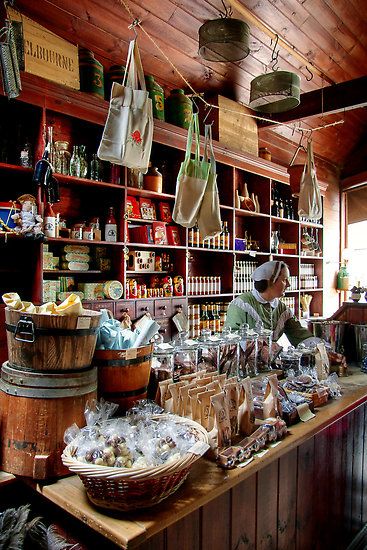
clarke bros

Clarke Bros. Grocers at Sovereign Hill – sometimes we have to wrap food in plastic for safety reasons, even though it isn’t historically accurate.

A breakfast would be prepared using food grown in the garden, or bought at the local grocer’s (the supermarket wasn’t invented for another 70 years!). Most store-bought food would be sold wrapped in paper (often wax paper), or perhaps even weighed and placed immediately into the family’s cooking pot (made of local iron from Lal Lal) or bucket (often made of cheap leather at this time). Only (relatively expensive) preserves like jam or mustard would be sold in glass jars or ceramic (clay) pots. After the meal, food scraps would be used again in cooking (bones for making broth/soup) or fed to the family chickens/pigs/goats/dog. The wax paper would be reused to wrap other foods until it disintegrated (the invention of Tuppaware was nearly 100 years off) and it would then be thrown in the fire. Jars or ceramic pots would be saved for another household purpose. The plates used to eat such a meal would have most likely been made in Staffordshire, England from nearby natural clays, and then shipped (by wind/steam power) to Australia. Drinking water was collected from local rivers and groundwater pumps.

If children were lucky enough to be sent to school, there they would learn the ‘3 R’s’ (reading, writing, and arithmetic) using slate boards and graphite pencils (which would last many generations of students) in the younger years, and after Grade 4 would begin using paper, ink, and dip pens (but only if they passed the Grade 3 writing test – paper was too expensive to make inky mistakes on!). For most children except the very wealthy, 19th century toys were typically handmade from wood or animal bones (which are all biodegradable materials, unlike plastic). As school uniforms were yet to be invented, children simply wore their normal clothes to school.

howmuchclothingwasted

Clothes waste in the 21st century – a big problem because much of it will never biodegrade. From Wikipedia Commons.

While cloth for making things like sheets and clothing was getting cheaper in price thanks to the Industrial Revolution, most people – including children – merely owned two to three outfits at any one time. The wardrobe only became common in houses in the 20th century when ready-to-wear clothing became fashionable and was being produced very cheaply. Therefore, in the 19th century your clothing was cared for, and carefully patched and refitted, until the fabric disintegrated. Clothing was most commonly made of cotton (or sometimes other biodegradable natural fibres like wool or silk), whereas today lots of the clothing in your wardrobe is made of plastic.

While the children were at school, and wives/mothers busied themselves with 19th century housewifery, men would be at work. Most men in Ballarat worked in the goldmining industry, or in another industry that supported mining, such as a candleworks or foundry. These types of workplaces produced some waste (but nothing in comparison to most industries today!), and while some was biodegradable, some industrial waste from the 19th century is still causing pollution to Ballarat’s soil and waterways today (like arsenic from mining). The safety clothes men wore (if any!) were made from thick leather and would often last their entire working lives.

At lunch time, family members would return home for a hot meal prepared by the woman of the house. If the wife/mother had found the time to visit the grocer, baker, or butcher (all selling food produced locally – refrigeration wasn’t invented yet, so only dry food like flour, lentils and herbs could travel vast distances), she may have fresh food to serve the family. Otherwise, people ate preserved foods like salted meat, stewed fruits or re-hydrated beans. Fizzy drinks were invented in the 1700s, but it wasn’t until the late 1800s that mass-produced glass and good sealing techniques made these beverages widely available. Dinner would be similar to lunch, and any leftovers would be saved for the next meal.

At night, candles made from animal fat (called tallow) would be lit if the family could afford it. Soap was also made from animal fat at this time. Again, today your candles and soaps are most commonly made of petrochemicals (taken from crude oil, the same as plastic).

PreCutProduce

A typical sight at the supermarket today – food wrapped in plastic. From Wikipedia Commons.

So, no plastic for covering or storing food, no plastic for toys, no clothes made from plastic, and no plastic safety wear at work. No drinks in plastic bottles, no plastic bags to carry the groceries, and no plastic pens and rulers etc. for school. This meant there was no need for weekly bin collections – because there were no bins! Life certainly was different in the 1850s.

Links and References

What is plastic?: https://simple.wikipedia.org/wiki/Plastic

The history of waste management: https://en.wikipedia.org/wiki/History_of_waste_management

An ABC Catalyst episode on the arsenic in Ballarat’s soil: http://www.abc.net.au/catalyst/stories/2843289.htm

A 4-part vlog on life as an 1850s woman produced by Sovereign Hill: http://education.sovereignhill.com.au/students/video/woman-of-the-hill/

A great documentary series about the history of the rooms of our houses (and many of the items you can find in them): https://www.youtube.com/watch?v=yrn42rvTlpk

1850s Hair Dos and Don’ts

While you may think that hairdos in history aren’t really worth studying, they can actually tell us a lot about what life was like in the past. A hairdo can tell us about technology, through the kinds of products historical ‘dos’ required, or about fashion and making a statement, or about social class (whether you were rich or poor, powerful or powerless … ), and it can even be handy for dating historical paintings and photographs!

hair

A collection of unknown Ballarat women from the Gold Museum collection sporting a range of 19th century hairdos. Reproduced with permission from the Gold Museum.

For thousands of years, people have enjoyed using hair from their heads to decorate their bodies. Hair can be a very important part of someone’s identity; it can relate to religion, law (yes, there have been laws in history that have controlled hairdos!) or simply fashion, and, of course, hairdos are closely linked with humanity’s various and ever-changing ideas around beauty.

vic2

Self-portrait of Queen Victoria, 1835. An image from Wikipedia Commons.

In the 19th century, hairdos for women in the British Empire (which included Australia) tended to follow the style of Queen Victoria, who reigned for 63 years. This powerful woman had a huge influence over all things fashion, and is even thought to be the bride who popularised the white wedding dress, which many women still wear today. Before her time, British women simply wore their best dress on their wedding day, whatever the colour. Fashions in both hair and clothes changed a great deal during her time as queen, as you can see here.

vic1

The first known photograph of Queen Victoria, pictured here with her eldest daughter, c.1845. An image from Wikipedia Commons.

By the 1850s, Queen Victoria tended to wear her hair parted in the middle. It was either pulled back behind the ears (which would then be covered by a day cap/bonnet), or would be used to cover the ears when a head covering wasn’t necessary (at a ball, for example). Otherwise, she, like the millions of women in her empire during this time in history, covered their heads out of Christian politeness, and always when outside (providing they could afford it!). Not only did wearing head coverings out of doors keep your hair clean before the invention of the shower and hair dryer, they tended to protect you from sunburn. And back then, fancy ladies wanted the whitest skin possible – ‘Only peasants and natives have tans!’. Beauty ideals like these demonstrate how acceptable racism (and classism) was in the 19th century.

For men, the beginning of the 1800s saw the end of elaborate powdered wigs and a return to natural hairstyles and colours. A few decades later and beards and moustaches also came into fashion. A male fashionista of the time, Beau Brummell, led the way with these new, relaxed, natural hairdos, which got shorter and more controlled as the century rolled on. Hair styling products such as hair oil became popular with men during this time; however, they didn’t have the means to wash it out like we do today (with shampoo) until the 1890s. The first shampoos were powders, and it wasn’t until the 20th century that we saw the invention of liquid shampoos.

Most people’s washing habits in 1850s Ballarat mirrored those practiced in England; however, clean water (that which wasn’t polluted by goldmining or human waste near it … ) on the diggings was often hard to come by. Miners and their wives would pay a lot of money – particularly during dry summers – for buckets of fresh water taken from what was then called Yuille’s Swamp (now Ballarat’s Lake Wendouree). Bathing usually only happened once a week (typically on Saturday nights so the family was clean for church on Sunday), but that bath wasn’t for washing hair, and besides, you had to share the water with your entire family because it was so scarce!

chinese-grant-070-80-2

Photograph of an unknown man dubbed the “Chinese Giant”, 1870. Notice his long queue. Reproduced with permission from the Gold Museum. 

Of course there were many nationalities present on the Ballarat goldfields, which meant yet more hair styles could be seen around 1850s Ballarat. One of the most striking hairstyles common during this era was the ‘queue’ worn by Ballarat’s many Chinese miners. Back in China, it was compulsory for men to sport this ‘do’, which involved shaving the front of the head, and growing the back very long and wearing it in a plait. The Aboriginal people of this region – the Wadawurrung people – may have worn their hair differently to the Europeans and the Chinese; however, from the limited photographic evidence we have, many appear to have adopted European hairstyles by this time.

hair4

Marcel curlers, also known as hot curling irons or hot curling tongs. 

An exploration of 19th century hair in Australia wouldn’t be complete without a mention of the fashion for hair artworks and even hair jewellery, which was commonly something a lady would give to her lover, or someone would make from the hair of a recently deceased loved one. You can see lots of examples of this curious practice here. Another weird habit of European women in the 1800s was the collecting of hair from a hairbrush to use as padding to create certain hairdos. Hair was collected in a ‘hair receiver’ and then moulded as required into a ‘rat’ to place inside a bun or to give hair volume. Lastly, the rather terrifying ‘Marcel Wave’ hair curler became popular towards the end of the century, even though it was very easy to burn your hair off while using it – it was heated in the fire before being applied to hair!

Links and References

A pictorial overview of Victorian hair styles: http://www.whizzpast.com/victorian-hairstyles-a-short-history-in-photos/

A series of videos on this history of women’s hairdos (Eurocentric): https://www.youtube.com/watch?v=rpGc2ylEgfQ&list=PLWpk-1VZu_yM5ms7Mm1wBirhm5G1UPOwZ

A brief visual history of men and women’s hairdos through history: https://www.youtube.com/watch?v=RVr8W6HME4A

A video on the history of shampoo: https://www.youtube.com/watch?v=NEjeTYzZjzg

Horrible Histories on Incan shampoo…: https://www.youtube.com/watch?v=jqWoWscljQs

A great history of hair from the Chertsey Museum: http://chertseymuseum.org/hair

A great BBC article on the history of the wedding dress: http://www.bbc.com/culture/story/20140503-how-wedding-dresses-evolved

A woman’s life on the Ballarat goldfield: http://education.sovereignhill.com.au/media/uploads/SovHill-women-notes-ss1.pdf